Friday, April 2, 2021

On Hallowed Grounds: A History of St. John's Cemetery

    Its massive trees are a setting akin to the Northwoods. Situated on a rolling ridge, on misty days one can almost hear the voices of the past whisper in a visitor’s ear. St. John’s Cemetery on Wolf Road is one of Mokena’s most hallowed places, it being the final resting place of a vast and impressive array of figures from our community’s history. As one leaves the busy thoroughfare, traffic becomes a distant hum, and as the guest wanders out into the sea of weather-beaten tablets and beholds the names thereon, it becomes clear that each and every one holds a story. An entire volume could be written about this place, and a thick one at that. It’s nearly impossible to highlight only a handful of the hundreds of people whose earthly remains lay here, and this piece will just barely skim the surface. 


    The history of the St. John’s congregation, one of our fair community’s oldest religious institutions, takes us back almost to the very birth of the village. A group of faithful German and Swiss families beginning worshipping together as early 1858 in Mokena’s schoolhouse, after a nasty falling out with their former brethren, the congregants of the Immanuel Lutheran church. Their preachers were itinerant ministers, and the flock finally gained their own resident man of the cloth when Prussian-born Reverend Wilhelm Meyer came onto the scene on New Year’s Day 1862. He brought the group into a new era, and on March 1st, the German United Evangelical St. John’s Church was founded, a mere ten years after Mokena was first platted. The devotees built themselves a simple yet refined church on the town’s Public Square the same year, and fitting themselves with all the trappings of a proper congregation, also began planning their cemetery at the same time. 


   The trustees of the church found willing property sellers in members John and Helena Schiek, who sold them a tract of land south of town for a burial ground on May 23rd, 1863 for $175, or about $4,000 in today’s figures. Situated on an old Potawatomi trail that is now Wolf Road, this slice of prairie was identical to the rest surrounding the small railroad hamlet that was Mokena in this time. The first burial took place that September, and over the years, the cemetery grew as the St. John’s congregation did. After 63 years of service, five additional acres were tacked on to the northern edge of the burying grounds in August 1926. Not a single monument profiled in this piece contains a word of English; each one is inscribed in the German tongue, with many bearing the regal gothic font chiseled in stone popular in the 19th century. While all of the founding members of St. John’s became proud Americans, they never forgot where they came from. 


   Tradition holds that Philippine Laufer was the first person to be interred in these historic grounds. Her bones lie in the middle of the cemetery, her gravestone long since toppled from its base and lying flush with the earth. The simple slab bears a smoothly worn motif of a weeping willow, a common symbol of mourning in the mid-19th century. This stone and this ancient grave represent chapter one, day one of this cemetery’s history.

   Philippine Laufer was born to the world in 1789, and lived most of her life in Bavaria, in a world far removed from her future home. She likely made the arduous journey to America with her adult son George, who first set foot on our shores in the summer of 1846, escaping his homeland two years before it was torn asunder by revolution. After being processed through the port of New York, all paths led to Chicago, and from thence the Laufers settled in eastern Will County, then quickly becoming a haven for German-speaking folk. The newly-arrived family made their rustic pioneer’s homestead on the north side of what would become 183rd Street on the outer fringe of modern-day Frankfort Township, atop a high crest that would come to be called Summit Hill. The building materials for their first domicile were brought from Chicago by a span of oxen; only later would a more spacious home be built directly across the road. 
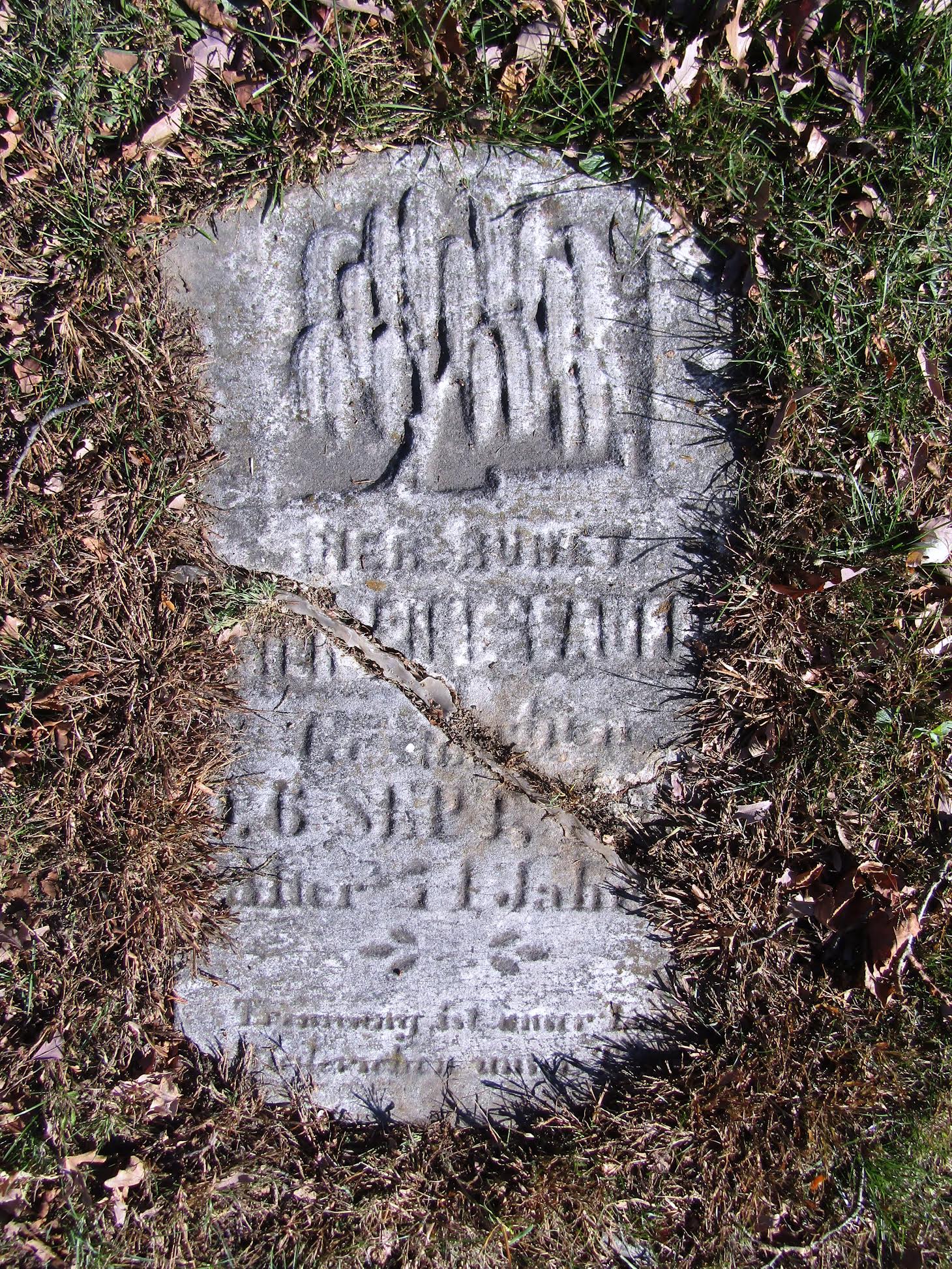


The grave of Philippine Laufer, traditionally said to be the first in St. John's Cemetery. (Image courtesy of Michael Philip Lyons)


   Philippine Laufer would come to have six grandchildren through her son, who in 1850 married Eva Utzinger. All of these children lived to adulthood, each one having families of their own, and while their surname gained an additional letter and came to be rendered as Lauffer, their descendants still live in and around Mokena to this day. Philippine drew her last breath on September 6th, 1863, and as the ground was broken in the new cemetery to receive her earthly remains, Abraham Lincoln sat in the White House, and the bloodbath at Chickamauga, Georgia, in which numerous Mokena men took part, was only a little more than a week away. 


   The Civil War and its dark days are intimately associated with this place, for not only were St. John’s church and cemetery born during this time of conflict, but at least eight of its Union heroes are interred here. One of them was a young man named George Treuer, who came from a small village called Hügelheim in the far southwestern German grand duchy of Baden, a mere stone’s throw from the French frontier. History doesn’t tell us when or why he made the trek to America, but Treuer lived in the environs of Mokena by 1860, when a federal census taker found him living as a farmhand on the property of Jacob Bauch, just north of today’s intersection of Wolf Road and 191st Street. 


   While working at the craft of shoemaking, the Civil War erupted in April 1861, and a month later, George Treuer came to the defense of his adopted homeland by rallying to the flag with the 20th Illinois Volunteer Infantry, mustering into the regiment on June 13th at Joliet. The unit saw hard service, and the February 1862 campaign in northern Tennessee to capture the rebel Fort Donelson on the Cumberland River was a typical example. The march to the battlefield spelled untold hardship for Private Treuer and his comrades. In the lead up to the fight, he and his brothers in arms camped in the open air during a punishing winter rain, and upon waking up the next morning after a fitful night, found their blankets frozen solid in a deep freeze. Due to these harsh conditions, an exhausting illness set in on the young man. During the battle for the fort, in which the Union men suffered over 2,600 casualties, a rebel ball passed through the fleshy part of George Treuer’s leg. His blood was not shed in vain, as the action was a major victory for the North. 


   Treuer served with the 20th Illinois until he was discharged from the unit upon the expiration of his term of enlistment in June 1864. Despite his wound, he volunteered yet again in the army, this time for duty with the Veteran Reserve Corps in February 1865. Sometimes called the Invalid Corps, they were a group of volunteer Union soldiers who were physically incapable of carrying out normal charges, and thus manned forts, guarded sites in the nation’s capitol, and tasks of this nature. Exactly a year after the war’s end, George Treuer married Anna Mavis in April 1866, and not long thereafter began a new chapter of his life, namely fathership, with the birth of their daughter Elizabetha in the fall of 1868. For a brief period in these years, its bookends unclear through the fog of time, Treuer also kept a saloon in Mokena, catering to the village’s thirsty German-Americans.  
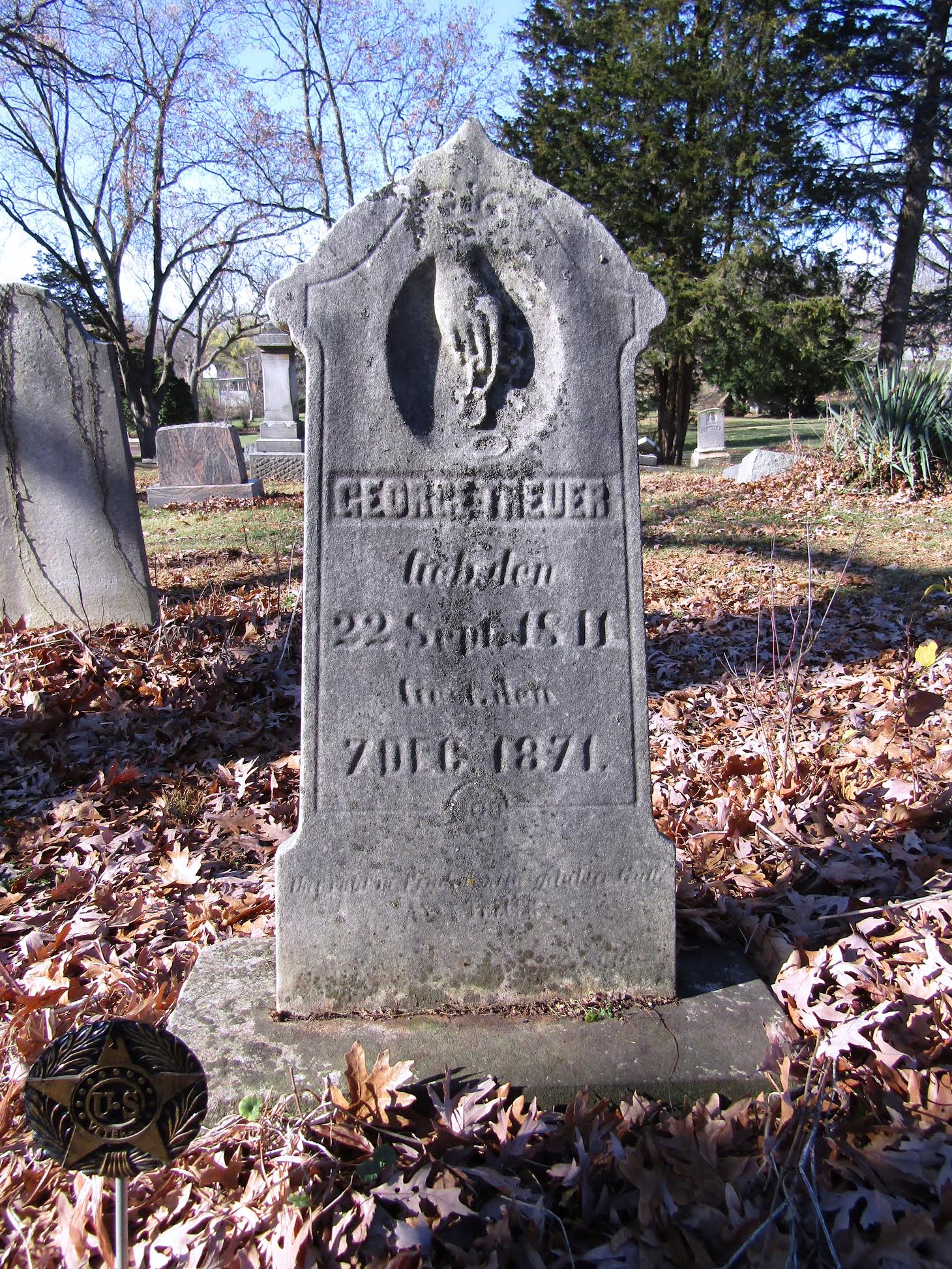


The time-honored headstone of Civil War hero George Treuer. (Image courtesy of Michael Philip Lyons)


   The war never really ended for Treuer, who was burdened by the pain of a battle wound that never properly healed, and the after effects of the debilitating sickness from that wet, freezing night in Tennessee. At the end of 1871, not two months after Chicago was ravaged by the Great Fire, the young veteran’s health issues were compounded when his weakened lungs were attacked by tuberculosis. George Treuer lost this battle, and he passed away on December 7th, 1871 at the age of 30 years. He was buried in a simple grave at St. John’s Cemetery outside town two days later. In time his loved ones had a proud marker erected over his mortal remains. Nowadays a thick crop of day lilies surround it in the warm months, this gravestone holding silent watch over a warrior hero’s dust. When the sun hits its ancient, weathered letters in just the right way, they can be read as clearly if they were chiseled yesterday. In the rays’ relief, the figure of a slender hand can be seen picking up a broken chain, its severed links representing a centuries’ old belief that the soul was tethered to the body by a golden chain. 


   Treading slightly northwest from George Treuer’s grave and down the ridge, one comes upon another time-honored plot, this one marked by a traditional gravestone with a rounded top, bearing the icon of a hand pointing toward the heavens. Here the earthen mound of Dr. Johann Andreas Grether is beheld.  One of the many early Mokenians with Swiss roots, Dr. Grether was born in the winter of 1807 near the city of Bern. Any details on the doctor’s early years are sparse, but it has been confirmed that he came to our country in 1852 with his wife Catharina and a daughter whose name has been long since lost to the ages. Three years later, Johann Andreas Grether was joined in America by his son Peter, who was finally able to make the journey.   


   It was in this decade that Dr. Grether made Mokena his home, not long after the Chicago, Rock Island and Pacific Railroad was built, and the village was first platted. Nevertheless, it was a period of hard times, as Catharina Grether died in 1854, whereupon a year later, Johann Andreas married the widow Elisabetha Schiffmann. As the United States entered the Civil War years, the family was deeply impacted by another tragedy when Peter Grether died as a Union soldier at Vicksburg, Mississippi in August 1863, being felled by disease. In this era, Dr. Grether humbly administered to our village’s sick and injured, and became successful enough in his practice that he was able to afford buying property in the new town. In the fall of 1867, he acquired a roomy house on today’s Front Street that is still with us a century and a half later, of late housing Le Angeline’s salon. 


The final resting place of Dr. Johann Andreas Grether. (Image courtesy of Michael Philip Lyons)


   Johann Andreas Grether died September 5th, 1869 at the age of 62, having surpassed the life expectancy of his time by more than two decades. Decades later, Mokena old timers would look back on his funeral, and remember it for a very unique reason. While friends and family were watching over his bier in the late doctor’s home, the figure of a woman clad completely in black was seen to enter the room. The others became aware of her presence, and while many laid eyes on her, no one knew her. After staying just long enough to make herself known, she passed into another room, whereupon another mourner gently went after her to see if her identity could be ascertained. Upon reaching the other room, she was nowhere in sight, and had disappeared into thin air. In the minds of those there that day, the only possibility was that she was a ghost. 


   St. John’s Cemetery is home to many understated, spartan graves. However, numerous larger, statelier remembrances can also be seen within the grounds. They are the grand monuments to even grander lives. They are not so much displays of wealth, but of love felt. One such obelisk marks the family lot of Franz Maue, a man who exemplified the iron-willed fortitude of the pioneer. He first saw the light of day on February 15th, 1805, in the small, picturesque town of Katzweiler in today’s western Germany. He came of age in agricultural surroundings, and would be a farmer his whole life. Along the way, he also learned the trade of tailoring, as a way to buttress his income during spells of bad weather. He was wed to Elisabetha Berdel, a native of a neighboring village on May 27th, 1827. Together they would bring nine children to the world, of which six lived to adulthood. 


The Maue plot in St. John's Cemetery. (Image courtesy of Michael Philip Lyons)


   The Maue family set sail for America in 1847, and undertook a crossing of the seas in 21 days, which to modern readers may sound unbearably rough, but in their day, it was considered an easy trip, as far as cross-Atlantic sailings went. During the journey, Franz and Elisabetha’s 16-year-old son Daniel met Sarah Mast, member of another America-bound family. Seven years later, the two would be married, as a result of what would come to be called their “voyage courtship.” Landing was made in New York, and the Maues then made their way up the Hudson River, and followed the Erie Canal to Buffalo. From there they entered the Great Lakes by boat, and eventually reached Chicago, then a fledgling rural outpost. As would later be remembered by a family member, Franz Maue then “drove into the country, looking for a good location.” He reached what we now know as Frankfort Township, the vanguard of the first wave of Germanic emigration to our community, and found in the soil here exactly what he was looking for in an American homestead. Maue immediately got to work setting up his family’s hearth here; by and by he acquired land, and eventually could look over an estate of 160 acres that was all his. His holdings, which were located northwest of where Mokena would come to stand, would ultimately be bisected by the Rock Island railroad. By 1862, a sizeable chunk of his farm had passed into the hands of his oldest son Daniel, while Franz himself still oversaw a large tract along our current 191st Street. At least two homes stood on this acreage, one east of the modern-day intersection with 104thAvenue, and another on the northwest corner of LaGrange Road’s crossing. Every trace of these have long since disappeared from our landscape. 


The fine craftsmanship of the stone etching on Franz Maue's monument. (Image courtesy of Michael Philip Lyons)


   The Maues were also founding members of the St. John’s congregation, and Franz would serve the flock as a member of the church’s council. Franz Maue passed away at his home outside town on March 2nd, 1879, after having been hit by a stroke. His respected status in our community is evidenced by a long, heart-felt obituary that was penned by Rev. Carl Schaub of St. John’s. Printed in Germania, a German language newspaper, the preacher stated that Maue “lived in harmony with his neighbors, as well as with all people” and referencing the makeup of our town in the period, said that “he was loved and beheld as a man of honor by not only the Germans, but by the Americans as well.” The Frankfort correspondent to the Joliet Weekly News said in a loving tone that “we did not suppose he ever had an enemy.” Franz Maue was buried at St. John’s Cemetery on March 5th, a rainy day on which the neighborhood’s single-track farm lanes were swamped with mud. Despite the gloomy weather, Rev. Schaub counted 85 carriages in attendance at the funeral. 


   No less a pioneer was Diederich Brumund, whose granite obelisk stands southeast of Franz Maue’s lot, being triumphantly reminiscent of the Washington Monument. Remembered by a contemporary as “honest and truthful in all things, a friend to the needy and a father to the fatherless,” he was born January 23rd, 1816 near the North Sea in a place called Sande, in the grand duchy of Oldenburg. Brumund spent his youth on the plains of northern Germany. It was later remarked that he received an “excellent education” while growing up, was noted as a “fine mathematician and scholar” and would later work as a clerk in Holland, where he picked up the Dutch language. He took Nicolina Folkers as his wife in 1843, and with four young children in tow, the family crossed the Atlantic and made their way to America in 1849. Sailing from the German port of Bremerhaven aboard the Ornholt Boming, the Brumunds navigated the choppy Atlantic for seven weeks before their arrival in New York. That August 28th, their journey ended when they picked a spot in our midst, carving out their home on the north side of modern-day LaPorte Road, a little way west of its intersection with what is now Wolf Road. 


   The Brumunds built a modest home and began farming, and within two years of their planting stakes, Diederich was able to buy the land where he made his home. These early days were tough ones, when everyday tasks could potentially be fraught with danger and hardship. Typical of this is the time when, on a trip carrying goods to the Chicago markets, one of the family’s oxen bolted and drowned in a canal. While he was a man of the soil, like so many of his brethren interred in this cemetery, Diederich Brumund also kept a small general store on the farm, a haven for pioneers in search of a convenience. Like more than a few of his neighbors, his farm was cut in two when the Rock Island railroad was built, and while some used this as time to seethe in anger at the railroad, this new American saw an opportunity to capitalize. On May 27th, 1853, a plat was filed with the Will County Recorder of the northern edge of his property bordering the west side of Allen Denny’s new town. Known as legally as Brumund’s Addition to Mokena, the farmer began selling off the parcels of land therein to some of the first residents of the young community. 


Diederich and Nicolina Brumund's obelisk, the tallest in St. John's Cemetery. (Image courtesy of Michael Philip Lyons)


   Five more children joined the Brumund fold after their arrival in our neck of the woods, and Mokena grew bit by bit, slowly becoming a small village. As the St. John’s flock came together in 1862, Diederich Brumund proved the giving spirit in his heart by being instrumental in the building of their church. He was a man who gave freely of his money when it was for the greater good, and one who also was very shrewd when it came to investing it. Aside from his large Mokena farm, Brumund came over time to own seven hundred acres in Green Garden Township, over a thousand acres in Missouri, and some land in Iowa to boot. Due to the effects of asthma, Diederich Brumund was called to eternity in Mokena on February 17th, 1885. A pillar of his church and community, he was laid to rest in St. John’s Cemetery, not far from the humble house he called home for 35 years. 


The names of the patriarch and matriarch of the Brumund family are forever preserved in granite. (Image courtesy of Michael Philip Lyons)


   These few personalities, these historic figures who grace the pages of our community’s narrative, are but a tiny sliver of all those represented at St. John’s Cemetery. A stroll through these grounds counts as an unforgettable journey into our collective past. May all who found their final resting place here be loved and honored now, just as they were in their own time. 

Friday, March 19, 2021

Where Cattle Crossed: A History of the McGovney-Yunker Farm

   Arising at the crack of dawn, milking cows by hand, herding them into pasture, preparing hay for bedding, and maintaining all the tools of the trade. These are but a select few, a tiny handful, of the many responsibilities that a dairy farmer has on his plate for just one day, winter or summer, rain or shine. A farmer must have mechanical and analytical skills, as well as raw strength for repetitive, strenuous tasks. Our village’s heritage is purely agricultural, and farms once dotted our community’s landscape in every direction one looked. This lifestyle was the everyday existence for so many in Mokena, but now it is totally extinct in our surroundings. There is however, one place in our midst that can be visited to absorb these old ways. McGovney-Yunker Farm on LaPorte Road is a gleaming jewel in our town, and a certified National Historic Landmark to boot. Now frozen in time, this place once abounded with life. While the farm and its quaintness remind our 21st century eyes of something far separated from our lives, there is a long, untold story about the history of this old spot, one of real people who lived and loved just like us. 


The McGovney-Yunker Farm on a snowy winter's morn. (Image courtesy of Michael Philip Lyons)


   As we turn back the pages of history and follow the threads of time, we find the beginning of this story with John and Nancy McGovney, two brave, rugged pioneers who in the spring of 1831 were the first young family of European descent to settle the land where Mokena would later stand. These intrepid explorers made their journey to Illinois in a covered wagon via Adams County, Ohio with five small children in tow, ranging in ages from ten to two. After the McGovneys’ arrival, three more would join the bunch. They carved out a primitive home on the untamed prairie, and built a home out of logs hewn from the Hickory Creek timber. They had barely gotten comfortable in their new surroundings when the Black Hawk War broke out in April 1832, an oft-forgotten conflict between Illinois settlers and elements of the Kickapoo, Sauk and Meskwaki tribes. When news drifted to the McGovneys of the outbreak of hostilities, they immediately packed up their belongings and fled to more thickly populated points in Indiana, it was said, on advice of the friendly Potawatomi who inhabited what would later be Frankfort Township. When the former Ohioans returned to their Illinois home after the war’s end that August, they were very pleasantly surprised to find out that their Potawatomi neighbors had tended to their property in their absence, taken care of their animals, and even left unmolested a loaf of bread that was left baking in their haste to escape. 


   The exact spot of John and Nancy McGovney’s pioneer homestead and where it corresponds to in today’s landscape remains a prickly issue. What is definitely known, is that John McGovney formally purchased two separate 80-acre tracts of land on May 20th, 1841 from the federal government land office at Chicago, after having squatted on them as a tenant. Eleven years later, the Chicago, Rock Island and Pacific Railroad would bisect this property, which enclosed part of the future village of Mokena.


   With the passage of years, beginning in 1857, ownership of part of this tract began to transfer to John and Nancy McGovney’s youngest son, 21-year-old Elijah. Over time, he added on to it, creating the acreage that is today known as the McGovney-Yunker Farm. One of the first white children to be born in the wilds of the yet unformed Frankfort Township on July 29th, 1836, Elijah McGovney wed Katherine Van Horn in September 1857. Their union ultimately welcomed nine children to the world, of which six survived to adulthood, namely Theresa, Walter (called Dick), Edward, Ada, George and Mattie. All of them would become well known and respected Mokenians. The 1860 federal agricultural census paints a vivid picture of the McGovney farm in this period, giving it a value of about $6,000, or roughly $175,000 in today’s currency. No small-time operation, the farm boasted of $100 worth of farming implements and machinery, and three horses, five milch cows, thirteen other cattle, and six swine. That year, Elijah McGovney estimated he had harvested 150 bushels of wheat, 400 bushels of Indian corn, about 100 bushels of Irish potatoes, and 40 tons of hay. 


   In this same timeframe, the United States was entering a great existential crisis, and the Civil War erupted in the spring of 1861. A little over a year later, after President Lincoln called for 300,000 more men for his army, Elijah McGovney volunteered for duty on August 22nd, 1862 in the 100th Illinois Volunteer Infantry, the newly organized Will County regiment. While donning his blue uniform, he served as the unit’s wagon master as well as a message carrier. The battles of Stones River, Chickamauga, and Franklin, some of the darkest days in our country’s narrative, which stand so starkly on the pages of our history books, were for Elijah McGovney places of intensely personal experience. He survived the war with life and limb in one piece, and was mustered out of the army in June 1865 as a hero of the Union. According to a story passed down in the McGovney family for generations, during his time at war Elijah had taken under his wing an orphaned slave child, and after the end of the conflict, he came to Mokena to the farm, where he lived as a member of the family. While his name has disappeared into the mists of time, it has been remembered that after he struck out on his own, he became a successful preacher. 


   In the aftermath of the Civil War, the McGovneys decided to try their fortune in Missouri, and much like his father did a generation before, Elijah and his brood made the tough, three-week journey via a wagon. Years later, his son Dick would recall sleeping nights with his father under the conveyance, armed to the teeth to ward off potential highwaymen. Luck was not in their favor, and two years later the McGovneys came back to their farm just outside Mokena. 


   Disaster struck on the unlucky date of Friday, August 13th, 1880, when a destructive fire broke out in their farmhouse. The blaze started a little after noon, and as it was the height of harvest season, help tamping the flames was scarce, but a fair amount of the McGovneys’ furniture and clothing were rescued. The entire house was completely ruined, but luckily, no one fell victim to the fire or smoke. By the following month, Elijah and his family were hard at work building a new house, and this structure which rose out of the ashes is likely the western portion of the current domicile on LaPorte Road. 


   Danger in the form of fire visited the McGovney farm again in June 1883; this time the tool house fell victim. The family was roused from their beds at 1:00am, and by the time they rubbed the sleep from their eyes, the building couldn’t be saved. Only by the “dexterous efforts” of Elijah and his sons could the conflagration be checked, but not before some embers had started another fire underneath a barn adjoining, which was also soon under control. Ominously, evidence on the scene pointed to the flames being the work of an arsonist.  


   The McGovney family’s time on the farm is tangible to this day, for aside from their farmhouse which still stands triumphant, other improvements that came in his time which remain now were a chicken coop and brooder house which likely date from the 1880s, alongside a well house and smokehouse which were erected around the same time. McGovney also had a new windmill put up at the end of 1883, which is regrettably long gone. In this time, a persistent problem cropped up on the farm that any longtime Mokenian will be familiar with, namely the seasonal flooding of the northern edge of the fields that adjoin the village proper. On June 17th, 1893 a special meeting of the mayor and board of trustees was called to address a petition that had been handed to them by Elijah and Kate McGovney. In it, the couple asked the village dads to “contribute a share toward draining a slough” that had formed on their property. The note went on further to “claim that their lands are kept in bad condition by reason of wash and overflow from surrounding lands, including that which comes from territory inside of the limits of the Village of Mokena.” The board left the matter with the Committee on Public Property and Nuisances, which ruled at their next meeting that “said slough would not stay there long enough to effect the sanitary condition” of the village, and therefore, the McGovneys’ request for help easing the financial strain of the flood was shot down. 


Mokena resident and Civil War veteran Elijah McGovney, seen here around 1890.


   As Elijah McGovney got older, he began to slow down on the farm, and eventually moved to Chicago to live with his daughter Ada. In the meantime, his middle son Edward took over the agricultural responsibilities in Mokena. The younger McGovney was a tinkerer, and gained a patent in 1905 for a contraption that picked bugs off spud vines. It also appears that an eastern wing was added to the McGovney farmhouse during Edward’s time at the helm. His tenure is also marked by the third nasty fire in the farm’s history, having taken place on August 5th, 1911. This time, the alarm was sounded at 3:00am by eagle eyed youth Herbert Hohenstein of Front Street, who spotted flames in the inky darkness across the fields south of his home. After Hohenstein’s having called the Mokena telephone exchange, many villagers received word of the emergency and flocked to the farm to help. The fire was confined to two large tool sheds on the south side of LaPorte Road across from the farmhouse, and after the blaze was extinguished, the buildings were completely destroyed, and McGovney had lost a binder, corn planter, hay loader, hay press, plows and other implements. Altogether, it was estimated that he had suffered a loss of about $2,000. No immediate cause was ever found for the disaster, and like a menacing ghost of the 1883 fire, it was guessed that the inferno was the work of an incendiary. 


The historic McGovney-Yunker farmhouse on LaPorte Road, a priceless Mokena landmark.


   Over the years, the problem with the so-called “slough”, or the flooding of the northern half of the farm’s fields, never really went away. However, in the World War I era villagers made the best of it, as a Mokenian in February 1916 noted it to be a “fine skating rink”, which was being used by town youth every night. On March 3rd, 1921, in what would have been his 85th year, Elijah McGovney peacefully passed away at his daughter’s home in Chicago. His mortal remains were transported back to his old Mokena home, where his funeral was held on the farm, being attended by a “large number of old settlers”, in the words of the village’s News-Bulletin. Mourning quickly gave way to chaos, as disunion and animosity sowed themselves in the McGovney family in the aftermath of their patriarch’s passing. That summer, Dick McGovney filed a suit in the Will County circuit court to break the will of his father, having charged that his siblings used “fraud, misrepresentation, and coercion” to compel their father to make the document. Furthermore, he declared that his father was not mentally capable of having made the will on his own accord when it was first filed in 1917, alleging that his brother Edward and sister Ada dictated the document, composed it, and forced their father to affix his signature to it. It took almost two years for the dust to settle, the case being settled out of court between the heirs in March 1923. 


   The entire McGovney farm, composed of 120 acres in all, was sold at auction on Saturday, December 8th, 1923. The high bidder was Elijah and Kate McGovney’s youngest son George, who forked over $130 per acre, or about $2,000 in modern funds. For reasons that have long since been lost to time, McGovney didn’t keep the place for long, and he flipped it a year later. At this station in the timeline of history, we can close the book on the McGovney family, and put it in its rightful spot in the library of ages. Let us now open a new volume, and enter at this point the Yunkers, where a fresh sunrise begins. 


A striking view of the McGovney-Yunker Farm from the north. (Image courtesy of Michael Philip Lyons)


   After having been in the McGovney family for 83 years, Fred and Carrie Yunker acquired the farm in 1924. Born Friedrich Junker on the day after Christmas 1869 to parents of sturdy Swiss origin, the new owner was a native of Orland who, along with the rest of his family, eventually anglicized the spelling of his last name to Yunker. Called an “enterprising agriculturist and horseman” by those who knew him, Fred Yunker tied the knot with Carrie Cappel, a member of a long-established Mokena family, in the spring of 1913. The couple came to make their home on the old Holstein farm on today’s LaPorte Road at the well-known s-curve, where they made their living working the land and tilling the soil. Their time spent here would likely remain dearest in their memory, for it was here that their union was graced by the birth of their only child, Edwin Walter Yunker, on March 13th, 1918. 


   After Fred and Carrie Yunker first set down their stakes on the old McGovney place in 1924, they had the stately dairy barn from the Holstein property moved east down LaPorte Road to its new home, setting it down atop a limestone foundation dating from an earlier era. It still remains today, as robust as the day it was moved. The Yunkers made other improvements to the property during their years here, making the farm uniquely theirs. A cattle shed and hog house was built around 1940, three open-wire corn bins were added in 1945, along with a new corn crib five years later, which like the dairy barn, all still stand. 


   While growing up on his family’s farm, Eddie Yunker attended Mokena schools, where he would become a star player on the basketball team. He and his family weathered the Great Depression with the rest of the village, and were known to help other Mokenians who weren’t as fortunate as they were in this dark chapter of our history. The Yunkers generously gave to the family of Mabel Kropp when they could, a local mother raising two children on her own. Her young daughter Laverne Mae would often travel from her home on Wolf Road to the Yunkers’ to visit and accept what they could humbly send her way. In doing so, she formed a tight connection with Eddie, and the two were married in the spring of 1940 in Laverne’s Mokena home. Like countless young men of his generation, Eddie Yunker was summoned to the army during World War II, but Uncle Sam ultimately felt he’d be more useful to the country’s efforts if he stayed on the farm, feeding the men and women in uniform, rather than marching with them. During the war years, Eddie and Laverne would bring their two sons Lee and Ron into the world. 


Eddie and Laverne Yunker on the farm, with LaPorte Road in the background. (Image courtesy of Brian Yunker)


   In April 1948, Fred and Carrie Yunker retired and moved to town, settling in a new home they had built on Mokena Street. A new epoch was heralded when Eddie and Laverne inherited the farm not long after the passing of Fred Yunker in 1949. As was the case since day one, the Yunker farm was in a slow but constant state of transformation, with a garage workshop being completed in 1960 along with two doghouses the same year. A new tool and implement shed was completed around 1965, and a metal shed on the south side of LaPorte Road was added in 1975.  Among his many hats worn in Mokena, Eddie Yunker helped found the village park district in 1959, and served on its board of directors from its inception until 1975. He also had a chair on the board of Mokena Elementary School, District 159. To top things off, the Yunkers were active members of St. John’s Church. 


   To know Mokena, was to know the Yunker farm. This author can reach back into his memory and recall being delighted as a child by the sight of Eddie’s many dairy cows in their pasture, and can also easily remember what little traffic there was on LaPorte Road in this time occasionally being halted as the farmer would lead his herd across the road back to their home on the north side of the thoroughfare. It was also not uncommon to see Sailor, the Yunker border collie, chasing cars on LaPorte Road. 


   Craig Yunker, a Mokena resident and Eddie and Laverne’s grandson, started out helping his grandfather around the farm by hunting rodents, all the while receiving a bounty of a dime per mouse, and quarter for every rat. He eventually became Eddie’s right hand man, which was a full-time job in itself, and fondly remembers that “it couldn’t have been a better childhood out there in the fresh air.” 


   His cousin, Lisa Welz, paints a vivid picture of their grandparents. Her grandfather was a man of few words, but when he spoke, she remembers that he “commanded attention.” He was a farmer of the old school, a man who was able to do parts of the job that would easily rebuff those not accustomed to them, and simply accepted them as facts of farm life. Eddie Yunker was “very patient, extremely kind, and very smart”, but was also possessed of a keen sense of humor, as Lisa recalls that he loved to tease and joke around. Those who took part in Eddie’s dairy milking demonstrations readily relate how he would squirt visitors from the cow’s udder when they least suspected it. Craig Yunker related that his grandfather was a man of class, and “never said a bad word about anybody.” He was a man of great height, standing in at a regal 6’2’’, and as Lisa Welz related to the author, “he had huge hands, his fingers were the size of bananas!” 


   Laverne Yunker is remembered as a talker, a lady whose family was everything to her, one whose passion was cooking and baking. She kept a huge garden behind the farm’s silo, one that was brimming with produce such as squash and zucchini. Lisa Welz remembers the stream of visitors that always seemed to be stopping at the farmhouse, where her grandparents treated everyone as a friend, offering all food and drink, turning away no one. 


   In this same vein is the way the Yunkers opened their farm to area youth. Craig Yunker recalls how his father Ron’s position as a history teacher at Lincoln-Way brought him into contact with a fair number of troubled youths from the community. Ron Yunker came to be a mentor of sorts, offering the teens places to work on the family farm in Mokena, where Eddie and Laverne welcomed the opportunity to teach them. After Ron Yunker’s untimely passing in 1987, Craig well remembers the “dozens of kids” who approached him to tell of how his father and grandparents had changed their lives. 


 Eddie Yunker and his Rascal, his canine companion, in a 1990 image.


   Animals played a huge role in life on the farm. The Yunker cows are remembered as docile creatures, but the bulls had a fiery meanness to them. Lisa Welz says this is best exemplified by the time Eddie entered their enclosure, and one charged him, knocking the pitchfork from his hand that he carried for protection. As the bull went in to attack again, Bimmie, a rough-around-the-edges dog of Lisa’s that had been sent to live on the farm, sprang into action. He jumped up and fiercely latched onto the bull’s tail with his jaws, allowing Eddie to escape. She calls the dog’s rescue of her grandfather nothing short of divine intervention. Craig Yunker remembers his grandfather’s heart for animals, and how he would tear up whenever a calf would be stillborn. There was also the time Sailor, the Yunker border collie, was stolen from the farm. Eddie searched high and low for his companion, but found no trace of him, and was absolutely heartbroken. One day a few months later, a neighbor called Eddie out of the blue and relayed the news that Sailor was back, and had been seen in the pasture. The farmer hurried to the spot, and the dog immediately came to Eddie, despite being underweight. From then on, he never needed to be chained up, as he never left his master’s side. Lisa Welz says “Grandpa was so happy and relieved to him back.” It was never resolved who took Sailor, or where he was in his absence. 


   As the years passed, and the other farms in Mokena became unceremoniously swallowed up by development one by one, Eddie and Laverne’s farm stood out like a beacon in the night. As time went on, they fended off developers who offered them astronomical sums for the property. They could’ve lived like royalty in their final years by taking any of these offers, but instead the Yunkers chose to give the farm, the scene of so much of their love and labor, to all of Mokena. In 1997, Eddie sealed a deal on the farm with the Mokena Park District, in the understanding that it be kept up for future generations of villagers to enjoy and learn from. All was sealed with a handshake, as he was an honorable man, and his word was his deed. 


   Laverne Yunker, who had been a mother figure to so many in Mokena, passed away in 1995, and Eddie kept working the farm until his last harvest in the fall of 1997, when his second cousin Richard Erickson helped him do the work. Eddie Yunker crossed the great beyond at the age of 83 on July 22, 2001, a date which marked the end of an era. Through the tireless efforts of Mokenian Jen Medema, the McGovney-Yunker farm was officially added to the National Register of Historic Places on May 31st, 2006, after she spent two years laboring on the immense nomination project. 


                    Eddie Yunker reflects upon his life in Mokena in this 1997 image.


   As the farm is such a prominent place in our town, the Yunkers, especially Eddie, have taken on an almost larger than life status in the community. Craig Yunker summed it up perfectly when he said that being with his grandfather “was like working with Paul Bunyan, he was so strong and tough.” The onus of preserving the farm, this wondrous historical treasure, is in the hands of the Mokena Park District, its current owner. All Mokenians with love in their hearts are looking to them, in fervent hope that the Yunkers’ wishes are carried out. The responsibility is big. If any piece of the farm were to be removed from the landscape, as has already been attempted, no replica could ever take its place. Eddie and Laverne were the last of their kind, and our community owes it to their memory to keep and preserve their farm. Let us remember Proverbs 22:28: “Remove not the ancient landmark, which thy fathers have set.”

Friday, March 5, 2021

Beer Suds to Piping Pizza: A History of 11116 Front Street

   On a walk down Front Street, one is greeted by many familiar sights. Here the Curtain Call Theater, there Tribes Beer Company, not to mention other local mainstays. As part of our village streetscape, it’s easy to become so used to the scene that many of these buildings are easy to take for granted. Notwithstanding, our most historic structures demand our attention and appreciation, and one of these is the old structure at 11116 Front Street, which most recently was known as Paul E’s restaurant. In the last two decades of the twentieth century, this place was A Pizza, a Front Street fixture. A well-known gathering place for Mokena’s youth, this writer whiled away countless hours here with his friends, counting many days of joy and mirth in this spot, which on more than a few weekends, could become quite crowded. It’s easy to find a Mokenian who can remember both of these eateries, but the history of this landmark reaches back well over 150 years, and includes more than a few interesting personalities.


History runs deep at 11116 Front Street.


   The heart of this story, like so many in our fair village, lies with a member of the storied Schiek family. Georg Heinrich and Juliana Rosina Schiek were old natives of Neckarbischofsheim in the German grand duchy of Baden. Building their family there, the couple welcomed eleven children to their fold, before leaving the old country and emigrating to America in August 1848, arriving on the heels of unrest and revolution in their homeland. Setting foot in Chicago with 300 five-franc pieces in their name, the Schieks stayed there only a few days before trudging on foot southward, before they came to their new home in what would become Frankfort Township. Georg Heinrich and Juliana Rosina’s middle son, Ferdinand, came into the world on September 12th, 1832 and was 16 years old when his family set down their stakes in our midst. He tried his hand at farming, the family profession, and would later even come into his own acreage a little further west from the family homestead down what is today 187th Street, near where Marley now stands. 


   In the spring of 1871, Ferdinand Schiek entered the business world of Mokena when he bought a Front Street lot and the two parcels adjoining to the north and northeast from Peter Knapp, valued altogether at $2,500. This is the property that is today known as 11116 Front Street. At the time of Schiek’s purchase, a building already stood here, however, it was likely not the structure which currently stands on this spot. Boasting decorative wooden cornices and framed windows, this rambling edifice is a stunning example of the vernacular Italianate architecture that was popular in the American Midwest in the years following the Civil War. This current structure and all of its outward treasures likely dates from the time of Ferdinand Schiek’s acquisition of the property. 

   Interestingly, the building’s northern half, tucked behind the main structure like a shy child, is of an even older vintage, displaying attributes of the Greek Revival style, a feature seen in Mokena houses in the 1850s and 1860s, the earliest period of our village’s history. This is possibly the first building on the lot, and it’s not out of the realm of possibility that it was pushed a few yards to the north to make room for a new building. Alternately, it may have been moved from elsewhere at a later date and then tacked on to the main structure. 


The northern, or rear portion of 11116 Front Street is likely the oldest part of the structure.


    To segue back to the principal section of the building that faces Front Street, Ferdinand Schiek opened a saloon within these walls around 1871, where he was also known to board guests overnight. Along with a host of other Mokena and Frankfort saloonists, he was indicted by the Will County grand jury in early 1879 for “selling drink to a habitual drunkard.” A trial soon followed in the county seat, which took up two days and the testimony of some 50 witnesses. By the time the dust was settled, Schiek and his fellow barkeeps were each fined $20 and costs by the court, along with 20 days in jail, the time in the lockup to let up as soon as the fine was paid. The Joliet media was decidedly aligned against them, the Daily News of that place blustering “That should teach them to look out for these old suckers, who should be fined for each offense, just the same as the saloon keeper who sells it to them.”


   Legal trouble notwithstanding, Ferdinand Schiek became very successful in his business, as is evidenced by his Christmastime 1883 purchase of a musical machine which, in the words of the Will County Advertiser, “is a whole brass band within itself.” The buy set Schiek back $600, or about $16,000 in today’s money. On Christmas, he treated his customers to a concert from the contraption. He appears to have kept up the watering hole and hostelry until the end of 1891, when he and his wife Louisa sold the property to Mokenian Charles Moriarty and his younger brothers George and Frank at the end of that year for $2,400, from whence the Schieks moved to Joliet. His life caught dramatically short; Ferdinand perished there in early 1897 in a ghastly fire. 


   New owner Charles Gilson Moriarty was a lifelong native of the Mokena area, and a Civil War hero to boot, having volunteered for duty in the 20th Illinois Volunteer Infantry as a 17-year-old year old in October 1864, having exaggerated his age by a year. He later became an auctioneer, where he was known around town as “Colonel.” Moriarty cried sales all over the region, and was also known for his ability to do them in German, which made him much in demand amongst Mokena’s Teutonic population.  In the tradition of the building, the Colonel and his brothers ran a beer hall here, but they weren’t long for this place, as they flipped it in January 1893 to John Wannemacher. 


   The Wannemacher bunch were another old Mokena family, arriving in our neighborhood as early as 1848 via Erzhausen, a small village near the Hessian town of Langen in south central Germany, a point of origin for many of our earliest pioneers. As luck would have it, the Wannemachers carved out their home off of today’s 187th street, a stone’s throw from the aforementioned Schieks. John Wannemacher was born March 24th, 1850, and like his neighbor Ferdinand Schiek, was an agriculturist in the earliest years of his life, before opening his own tap room in Schiek’s old building on Front Street in 1893, the same year of Chicago’s legendary Columbian Exposition. 


  John Wannemacher’s saloon became a Front Street mainstay, and could also be quite a lively place, as is shown by the dance he gave on July 4th, 1902. Mokena’s correspondent to the Lockport Phoenix-Advertiser, in referencing the party with a thoroughly salty mien, wrote that there was “considerable doin’ that day and next down in the west end”, in fact so much that some “came near forgetting where the beginning was and when the finish should occur.” Another newsworthy party happened here in October 1910, this time not for its raucousness, but for the fact that each of its guests arrived in autos, new-fangled machines that were not yet often seen on village streets. One of three saloons in town during its time, Wannemacher’s boasted billiard tables, an ornately carved wooden bar, a stack of wooden kegs in one corner, and spittoons on the floor for its guests. Beginning to show its age, John Wannemacher spruced up the place in the summer of 1914, just as World War I was about to kick off in Europe. 


        A window into a bygone world: Front Street, circa 1910. The saloon of John Wannemacher is at the center of this image. 


   Aside from being a liquor purveyor, Wannemacher was also a civically minded resident, and served as a village trustee from 1904 to 1906. He sold beer at this location for decades, until the 1920 country wide prohibition on the sale and manufacture of most kinds of alcohol almost threw him out of business. The federal census that year listed John Wannemacher as the operator of a “soft drink parlor.” Around this timeframe, his son George, who tended the bar and waited tables in the tavern, began to take more of an active role in the affairs of the business. George Wannemacher was a unique personage in Mokena’s history, if only for a very serious disability that he had, namely the loss of his left eye. While working on a Minnesota farm as a 21-year-old in the summer of 1907, Wannemacher and some of the other young men he worked with were experimenting with dynamite caps and electric currents. While holding two caps in each hand, an electric battery was switched on and the wire touched to his hands, causing an explosion of “almost fatal results.” The young Wannemacher was sent to a specialist in Chicago for his severely injured eye, whereupon the doctor in charge ultimately removed it.


   Like his father, George Wannemacher was elected to a spot on the Mokena village board, and held this office from 1919 to 1925. As the town and nation at large were officially dry for most of this time, the former taverns in the community removed the coverings on their storefront windows, in an effort to prove there was no shady business going on within. Oddly, George Wannemacher’s stayed in place, and when the village board asked him what was going on, he became oddly defensive. Rumors swirled around town, which eventually made their way to the county seat at Joliet. So it was that on the evening of January 19th, 1925, Will County Sheriff’s deputies raided the property, and discovered gambling equipment such as punch boards, as well as illegal moonshine, whiskey and wine. These items and Wannemacher himself were hauled to Joliet by the deputies. The village trustee made bail, but wound up paying a hefty $700 fine for keeping these materials on his property.


   After having gotten his dose of legal medicine, a change of business was in order for George Wannemacher. He put saloon keeping (legal or not) behind him, and converted his place into a grocery store. Opening his newly-branded doors to Mokena on June 24th, 1925, after having the building “newly remodeled and painted”, Wannemacher carried “the standard brands of package, bottled and canned goods” as well as fruit and vegetables in season. He was a liberal advertiser in Mokena’s village newspaper, the News-Bulletin, one ad from July of his opening year reminded customers that a dry goods line had been added to the grocery department, and that shoppers would find “men’s work and dress shirts, overalls, straw hats, sheeting, calicos, ginghams and notions” at the store. Another from a year later boosted three ponds of Peaberry coffee for $1.35, one quart of Dellwood cocoa for 25 cents, and two cans of Freesland peas for the same price. Illustrative of the rural environment that was our village at the time, the store was kept open until 9:00 p.m. during threshing season. 


The grocery store of George Wannemacher at today's 11116 Front Street, seen here around 1950. (Image courtesy of Richard Quinn)


   Mokena was good to George Wannemacher and his business, sustaining him throughout the Great Depression and World War II. An accordion studio found a home in the building during the post-war years, and customers to the store could hear musicians practicing. In the prosperity of this era, the store became affiliated with chain of Midwest Stores, and in accordance with its color scheme, the front façade was painted yellow. Wannemacher also began carrying frozen food for the first time, and completed an addition to the western side of his building in the spring of 1955. 


George Wannemacher (left) at the Front Street store with his nephew Wilbur Teske (center), and customer Margaret Madsen, 1962.


   After 39 years in business on Front Street, George Wannemacher retired and sold the concern to his nephew, Wilbur Teske, in 1964. Teske kept up the store in the tradition of his uncle, which was simply known as Wilbur’s in the mouths of many locals, and it was known as a place among Mokena youth as a good spot to cash in empty pop bottles and spend the proceeds on penny candy. After Teske’s long tenure here, the old landmark became the home of a ski and sport shop briefly, before Bill Frankenberger opened A Pizza here in the 1980s. Feeding countless village folk until well into the early 21st century, this eatery was a home away from home for the youth who came to bask in the glow of the Ms. Pac-Man machine or smile at the motorized pizza chef in the window with his fuzzy mustache and outstretched hand. Around 2004, a new restaurant, Paul E’s, set up shop here.  


   Nowadays, the old place is for sale, and its future is in question. It’s been vacant for more than several years, and word on the street is that it’s not in optimal shape. When knowledgeable villagers are asked about this landmark, the asker is told with a downturned voice and furrowed brow that it “needs work.” As one of the lasts of its era in our village, it is imperative that this building be saved, if not for us, then for future Mokenians, so that they may understand where we came from as a community. Renown American author Robert Heinlein said “A generation which ignores history has no past – and no future.” Mokena, will this be our fate? 

Friday, February 19, 2021

A Sea of White: Historic Blizzards in Mokena's Past

   Braving deep snow, invisible ice and sharp cold, Mokena finds itself in the midst of a particularly nasty, biting midwestern winter. Looking back into our recent past, it’s easy to remember the Groundhog’s Day Blizzard of 2011, or Snowmageddon, as it’s been so dubbed by those of us who lived through it, and be thankful that things this time around aren’t quite as nasty as they have been. Nevertheless, that last big storm ten years ago, which looms so dauntingly in our collective memory, doesn’t hold a candle to several other catastrophic snowfalls in our past. Examining the pages of history, several other blasts of frozen vapor stand out on the record of the years. 

   The worst blizzard to hit Mokena in documented history was on January 26th and 27th, 1967, when a paralyzing 23 inches of snow landed on the village. Blustery 50 mile per hour winds created massive drifts that measured 15 feet. On the first day of the storm, Mokena teacher Dolores Barenz had reported for work at St. Mary’s School on 195th street. By the time she got settled in, the snow had already begun in earnest and conditions on the roads around town were only getting worse. She was gathered with her fellow staff members, all commiserating on the rapidly worsening situation, when Father Cecil Koop appeared, wondering what the fuss was. Upon reflecting with the teachers, he made the decision to cancel class, and posted himself at the entrance to the school directing busses to take students home. Deep was the concern, as some of them had to be taken to Frankfort and Lincoln Estates, no small feat in the quickly deteriorating situation. Dolores and Marion Kruzich, her next-door neighbor and fellow teacher, followed each other home to Center Street, where Dolores’ car got stuck fast as soon as she got into her driveway. That night, the families hunkered down in the Barenzes basement, where a potluck dinner with Kruziches and the Weitendorfs, another family of close neighbors, was held. In Dolores’ words, “What started out as a “hairy” day ended up being a great neighborhood get together! A time to be remembered!”


                            Kurber's Pharmacy, then a new building, in the aftermath of the January 1967 blizzard. 


   Meanwhile, another Mokena educator was also living through the chaotic day. Richard Quinn, a history teacher at Willowcrest, showed the spirit of small-town helpfulness by not only giving rides home to some of his students in his trusty 1959 Studebaker Lark, but also to commuters he encountered. Many were caught unawares when the blast of white hit, and not a few were stranded on country roads in their cars, were some had to spend the night. Quinn remembers that Consola’s restaurant, located north of town on Wolf Road, had thrown open its doors for stuck travelers overnight, as did the Mokena taverns, who housed and fed helpless drivers.  


                Third Street after the 1967 blizzard. Visible at left is Richard Quinn's 1959 Studebaker Lark, with which he weathered the storm. (Image courtesy Richard Quinn)


   Also standing on the pedestal of memory is the great snow of 1979. Striking on January 13th and 14th of that year, by the time all was said and done, a whopping 21 inches of snow had fallen on Mokena, including the 10 inches that had already recently piled up. A bitter cold of 19 degrees below zero chilled residents to the core. In the wake of the snow’s complete whiteout, abandoned cars dotted 191st Street east of Route 45, both of which were simple, rural roads at this time. Empty cars also choked the ramps leading to Interstate 80 at Route 45, which caused them to be closed for days. Local volunteers mounted on their own snowmobiles played a crucial part in rescue efforts. If a stranded motorist lived nearby, the good Samaritans brought them home, braving the deep freeze and gales of snow. If their homes were out of reach, they were brought to town to the village hall. Lifelong village resident and mayor Bob Teske, his wife Lynn, and some Mokena policemen led extrications from there. An avid CB radio enthusiast who communicated under the handle Chief Mo-kee-no, (which was to easier to hear over the airwaves then Chief Mokena) Teske and his crew took to the citizens’ band to communicate with those marooned in their cars. While Mayor Teske had been under doctor’s orders to lay low at home due to a bad case of bronchitis, Lynn Teske said “there was no way to keep him down.” Of those holed up at the village hall, six of them were from points out of state. Two came from Florida, two from far off Canada, and two truckers hailed from California. While guests in our village, they didn’t go hungry; Lynn Teske treated them to breakfast, and later a barbeque and macaroni salad lunch. 


   Of all the nasty blizzards that Mokena has been through, the storm of January 6th and 7th, 1918 was probably the worst, at least in terms of chaotic effect. In total snow accumulation, it was bested by the other two blizzards, this time a “mere” 15 inches of snow were recorded, but village old timers said it was easily the worst since 1885, but others in town scoffed and said there definitely hadn’t been anything like it since at least the 1860s. It came at a scary time, World War I was in full swing, lots of local boys were in the army and on their way to France where an uncertain fate awaited them. 

   To only compound the stress of the snowstorm, the village was also undergoing a coal shortage due to the war. Many Mokenians were completely without it at this time, and to heat their homes, were soaking old coal ashes in their stoves with oil and burning it this way. For the first time in living memory, trains on the Rock Island railroad completely stopped running. The last train into town steamed in at 4 o’clock in the morning in the middle of the storm, having left Chicago at 6:10 the night before. J.D. Rosenbaum, our village doctor, wound up being stranded in the city the whole weekend. 

   Acute cold also caused the town streetlights to malfunction, plunging the village into darkness. Bill Semmler, Mokena’s correspondent to the Joliet Herald-News noted that “several people froze their faces by walking from their homes to the business part of the village.” All church services at the village’s four houses of worship were cancelled, but the public school at the corner of Front Street and today’s Schoolhouse Road stayed open, managing a “fair” attendance. 

   Just about all roads leading out of town were completed blocked by the snow. What is today Wolf Road, leading south from the Rock Island tracks was totally snowbound for weeks, being covered by a massive snow drift about 600 feet long and six feet deep. It wasn’t cleared until the middle of February, when Mokenian George Marti was hired by the village board to cut through the drift. Not a few of our neighbors in Frankfort who relied on the Rock Island trains in our village came here by foot in this time, trudging over a temporary road which had been blazed across fields and through the woods. Correspondent Semmler noted matter-of-factly that “this new route makes a considerable short cut between the two towns.” 


   In the meantime, we continue to dig ourselves (and the village) out of the latest icy accumulation, and also enjoy the look of beauty that the fresh snow has brought to our surroundings. When the going gets tough, as it certainly already has this time around, it never hurts to remember the Mokenians who have fought the same winter hardships in years past.

Friday, February 5, 2021

Witness to History: The Story of 11028 Front Street

  Front Street is the face of our village. Every building, whether not-so-old or ancient, contains something like a life of its own, a soul containing memories of every deed done there. Behind every familiar façade is a story, some are of great success, some of storied Mokena personages, and some even reach back to the earliest days of the village’s narrative. One of these many landmarks is the old building at 11028 Front Street. What nowadays holds a quiet real estate office along with a skin and beauty bar, is actually a spot well-steeped in community history. 


11028 Front Street as it appears today.

   The story of this location reaches far back into the 19th century. As is often the case for the Mokena of this era, the exact beginning is nebulous, hard to pin down in the fog of time. However, when the mists are parted, the figure of Valentin Scheer arises, a Bavarian harness maker who bought this lot of Henry Bock for the princely sum of $1,400 in the summer of 1869. The son of a brave pioneer family, Valentin’s father and mother, Johannes and Philippine Scheer, first settled the wilds of what would become Frankfort Township in 1847, at a time when the villages of Frankfort and Mokena, not to mention the local railroads, were but a distant fantasy. One of twelve children, Valentin Scheer was born in the southwest German village of Siegelbach on December 1st, 1844, the second to last child to be born to the Scheer clan while the family still lived in Europe. 


   Around the time of the Civil War years, Valentin moved to Mokena proper, then a flourishing hamlet along the Chicago, Rock Island & Pacific Railroad, and by and by entered the town’s business circle. On April 12th, 1868, he married Henriette Heim, the daughter of a local saloonkeeper, their nuptials being carried out by Reverend Wilhelm Meyer of the German United Evangelical St. John’s congregation, of which both families were founding members. By the summer of 1870, Valentin Scheer had fully established himself as a harness maker in Mokena, and it is likely from this period that the building at the center of this story dates. The stately two-story structure features Italianate-influenced decorative brackets in its eaves, as well as window frames that appear to harken back to the Greek Revival style. Inside, Scheer’s shop sported hardwood floors and a lavish stamped tin ceiling. 


The Front Street harness shop and feed store of Valentin Scheer as depicted in an 1873 lithograph.


   Valentin Scheer flourished as one of Mokena’s early tradesmen, while advertisements of the day referenced a “first class harness shop”, boasting a large salesroom where “sets of harnesses of every kind needed” were available for inspection, from “heavy work harnesses” to “fancy buggy harnesses.” After being in businesses at this spot for several years, he eventually branched out into feed and flour sales as well, also dealing occasionally in baby carriages, trunks and valises. The harness shop was a product of its era, and also hearkening to its place in the 19th century is the 1878 ad showcasing fine horse blankets and buffalo robes to be had. 


   Illustrative of his rising position in the community, Valentin Scheer was elected to the post of trustee on the first village board in the spring of 1880, and the board’s very first meetings were held within these historic walls. The trusteeship was held by Scheer until 1885, at which point he still appears to be in business at this location, as is indicated by his continuous advertising in area newspapers in this timeframe. The harness maker relocated to Chicago at some point in the second half of the 1880s, where he met a tragic yet mysterious end.  A Cook County death certificate exists for him bearing the date of March 16th, 1890, indicating that Scheer’s demise was caused by “shock from frost bite – hands, feet and ears.” On the same sheet, a note in the margin cryptically states “man insane.” In the register of the dead of the St. John’s congregation, pastor Carl Schaub’s German language inscription records that Scheer died “as a result of frozen limbs.” Nothing has ever surfaced on the historical record to indicate what caused his psychological break, and why he wandered outside on that cold March night. His mortal remains were borne from Chicago back to Mokena, where he was interred in St. John’s Cemetery on what is today Wolf Road. 


   The 1890s are an uncertain time, an epoch of many unknowns in our village’s history, due to the fact that there was no local newspaper to report happenings in town, and thus no consistent record. The community, as well as the nation at large was in an economic depression after the Panic of 1893, causing many Mokenians to move elsewhere. Just enough evidence exists that villager Jacob Weber may have conducted a saloon in Scheer’s old harness shop at the end of the decade and into the first years of the 20th century.            


   The history of this old landmark comes back into focus in the spring of 1903, when hardware merchant David Kolber set up shop here. His arrival in Mokena is marked by the uniqueness of his background; in a village made up of mostly German-Americans, Kolber was an Austro-Hungarian Jew. The 1911 birth of his son was heralded in local media as being that of Mokena’s first Judaic citizen. The Kolbers would come to be esteemed residents of our town, and their hardware store would be remembered as a “first class business and tin shop” in its early years. 


   David Kolber built a solid business at this location, and within several years, it outgrew the shop here. During his tenure, it appears that he was a renter at this address, for the structure was still referred to as “the Weber building” in local parlance of the era. Coinciding with the relocation of the hardware store a few doors to the west in 1911, Katherine Sippel opened her dry goods shop here, herself having moved from other quarters farther down Front Street. Once its doors were thrown open to the public in November of that year, it was boasted of as being the biggest and best store in town. The sister of the aforementioned saloonkeeper Jacob Weber, Kate Sippel was born in Mokena on September 12, 1856, the daughter of a Hessian stonemason whose handiwork was the foundations of many of the village’s oldest buildings. A capitalist par excellence in the village, a contemporary hailed Sippel as a “courteous and very efficient business woman;” while another noted her store as a place where “any products could be purchased.” Aside from selling general merchandise, Mrs. Sippel was a well-known maker of women’s hats, having learned the art of millinery while a young girl. 


This circa 1910 image of Front Street looking east from Mokena Street depicts the property (at third from left) as it appeared when it came into the ownership of Kate Sippel.


   Once this property came into the hands of Kate Sippel, it underwent some significant changes. In the summer of 1911, she had a small extension on the west side of the building torn down, and a considerably larger wing on the east side detached from the main structure, and moved to the north side of the lot close to First Street, where it was converted into a storehouse. Finally, a large addition was tacked on to the north side of the Front Street building. Another big improvement came in the spring of 1913, when the building was fitted out with electric lights. Mrs. Sippel’s right-hand men in her business were her two adult sons, Elmer and Christian. Aside from being known among local folk for their friendly manner, they also were very civic-minded. They improved a patch on the eastern edge of their lot into a “town beauty spot” that contained a small pond teaming with fish and two public horse shoe pits, as well as later sponsoring some of the first outdoor film screenings with other Mokena businessmen. 


   After the death of Kate Sippel in 1922, her son Elmer took over operations here and continued trade until his own sudden passing in 1942, when the store closed its doors for good. This building would play a key role in Mokena’s home front activities during the Second World War, when Elmer Sippel’s widow offered the store’s vacant space for use as the headquarters and sewing room of the village branch of the Red Cross. Here local members gathered and engaged in various patriotic activities, such as the preparing of surgical dressings for use on wounded soldiers. 


   After having been the property of the Weber and later the Sippel families for decades, the structure was acquired by Irwin Howes in the summer of 1943. The owner of a small grocery store that was part of the Royal Blue chain, Howes relocated his combined store and meat market to this location after his previous Front Street quarters became too small. However, his presence in the day-to-day affairs of the business turned out to be short lived, as he was inducted into the Navy as a radio technician in early 1944. In his absence, his wife Edna ran the affairs of the store, but shortly after the end of the war, Irwin Howes found himself no longer desirous of running the enterprise, and ultimately sold it to Joe and Vicky Grobarcik of Joliet in 1947. 


A 1946 view of Irwin Howes (right) in his store. His customers are Herman Schweser (left) and Paul Lembke (center).


   Previously the keeper of two stores in the county seat, Joseph Benedict Grobarcik was born February 17th, 1913 in that place, and ultimately married Victoria Bernice Jankola, also of Joliet. The kept a well-rounded store in our village, and still under the Royal Blue banner, they offered “groceries, fresh and smoked meats, vegetables and frozen foods.” In January of 1948, a Mokenian could buy three cans of Campbells tomato soup for 29 cents, 46 ounces of grapefruit juice for 19 cents, and a pound of butter for 85 cents. After eight years of successful business on Front Street, the Grobarciks had their store completely remodeled, setting up a new frozen food cabinet, a vegetable cooler and new shelving, and topping it off, the biggest improvement being an addition to the main structure, a new space 45 by 16 feet on the west side of the building. 


A scene in the Grobarcik store in Mokena, circa 1950. Left to right are Vicky Grobarcik, Jean and Joan Cooney, Eleanor Muehler holding Rick Muehler, unknown, and Joe Grobarcik. In the foreground is Patty, Rick Muehler's dog. (Image courtesy of Richard Quinn)


   Still lovingly remembered in the village to this day, Joe and Vicky Grobarcik are universally described as nice people, good neighbors and hard workers; Mokena is a better place for their having been a part of it. In the rural community of their day, just about everyone in town was a customer soon or later. The Royal Blue store was also able to compete with The Shopping Bag, a modern supermarket that opened on Wolf Road in 1955, and later Ordman’s Park and Shop. The Grobarciks’ was a very homey, one-of-a-kind place. A jar of pickled pigs’ feet greeted customers, and the signs in the store were all homemade, written in black crayon. At the end of every night, it was common to see Joe or Vicky scrubbing down the butcher block with a wire brush. A makeshift kitchen, made up of three walls, existed in the back of the store, fashioned out of empty cartons and boxes. The Royal Blue existed in a time where a Mokenian could call the store, place an order for groceries, and have them ready upon arrival. Adding machines didn’t come until much later in the Grobarcik’s tenure, and as such, all bills were written out by hand on a pad with carbon paper. Fresh donuts were delivered daily to the store, and cost five cents each. However, one had to be there early to get one, as they went quick. The Grobarcik store on Front Street is fondly remembered by countless Mokenians as the place in town for penny candy; not only for the wide selection that could be had there, but also for the shopkeepers’ sunny disposition towards local children, who allowed them behind the counter to make the selections his or herself. Popsicles, fudgesicles, dreamsicles, and even drumstick ice cream cones could also be had, all for a nickel. 


Vicky and Joe Grobarcik in their Mokena store, 1978.


   After nearly 31 years in business in the same spot, Joe and Vicky Grobarcik retired and closed up shop in February 1978. So admired were they, that the village presented the couple with a certificate of appreciation upon the store’s closing, and soon thereafter, the Mokena Chamber of Commerce bestowed upon Joe the Outstanding Citizen Award. Down the line, the building was the home of Baker Interiors, and a faithful restoration of the building’s historic façade, restoring elements that had been obliterated for decades, was carried out not too long after the turn of the 21st century. 


   In the spring of 2002, the property suffered a disastrous fire, the conflagration being so intense that it melted the store space’s original tin ceiling into a heap of charred wreckage. The place’s future was in serious question, but luckily for the community and for future Mokenians, this time-honored spot was able to be saved. It has been a part of our village for decades, gracing Front Street for at least 151 years. May it stand for 151 more.