Saturday, January 27, 2024

Our Founding Father: The Story of Allen Denny

   Every story has its beginning. Be it the first chapter of a well-loved book, the first episode of a long series, or even looking back to the founding fathers of our nation, everything has its root. On the illustrious record of our nation’s years, the names of Ben Franklin, Alexander Hamilton and Thomas Jefferson appear, just a few of the number of great minds who are all rightly entitled to their places in our country’s hall of fame. Looking back to those optimistic days before the Civil War, there are many in our own community who can be called our framers, although there is one who stands out in earnest, well above the rest. While time has passed him by, and Mokenians of the 21st century don’t often think of him, Allen Denny was made of the same stuff as a Franklin or a Jefferson, a man of truly sterling qualities. To study the life of this man, the founder of our village, is to see a reflection of the early history of our nation.  

   Allen Denny made his grand appearance in our world the day after Christmas 1790, a little over a year and a half into the first term of George Washington’s presidency. His first breaths were drawn in Albany County, New York. The son of Charles Denny and Lucinda Allen, the boy had an impressive pedigree; his father being a veteran of the American Revolution, and his mother, for whom he was named, was said to be a cousin of Ethan Allen, the famed revolutionary patriot and founder of Vermont. Allen Denny would stand at the head of a list of ten siblings, the first of which, Alvina, made her appearance when Allen was not quite two years old, while the youngest, Coridore Philander, was 28 years his junior, young enough to be his own child. Throughout his childhood, the Denny family called various locales in the Empire State home, until 1811, when as a 21-year-old young man, Allen made his home in a place that would later be called Sheridan in the freshly formed Chautauqua County, the westernmost county in New York on the southern banks of Lake Erie. Here he soon got to work opening a small country store that sold a little of everything. 


   In what would become the defining event of his generation, the War of 1812 erupted in the summer of that ill-fated year. A stirring yet unfortunately mostly forgotten chapter of American history, the conflict was rooted in grievances with Great Britain that were left unresolved after the Revolution and friction with native tribes on the frontier. The fray also has the grim designation as being the only time our capital city was occupied and sacked by an enemy force. Young Allen Denny put his life on the line when just shy of his 22nd birthday, he volunteered for duty in the Chautauqua County militia, serving at least two terms as a non-commissioned officer in the companies of Captain Jehiel Moore and Captain Morton Tubbs, where he ultimately bore arms against the British until 1814. At least one of the stints was as a substitute for his father Charles, who was home on a furlough sick. Our humble New Yorker would’ve served yet a third time in the course of the war, if his younger brother Lysander wouldn’t have went in his stead in 1814. Upon his entering the service, Allen Denny was described as being around five feet four or five inches tall, with light hair and blue eyes, cutting a picture of a typical American man in his time. Denny’s military service was no trifling matter, as he fought at the Battle of Black Rock on December 30th, 1813. Taking place near Buffalo on the Niagara River, this fight was a particularly brutal engagement, even as far as warfare goes, and a terrible defeat for the New Yorkers who were there. Allen Denny was part of the retreat, (which an early Will County historian would deem a “stampede”) and witnessed firsthand the subsequent burning of Buffalo by British forces, and would recall both for the rest of his days, never sparing a detail. 


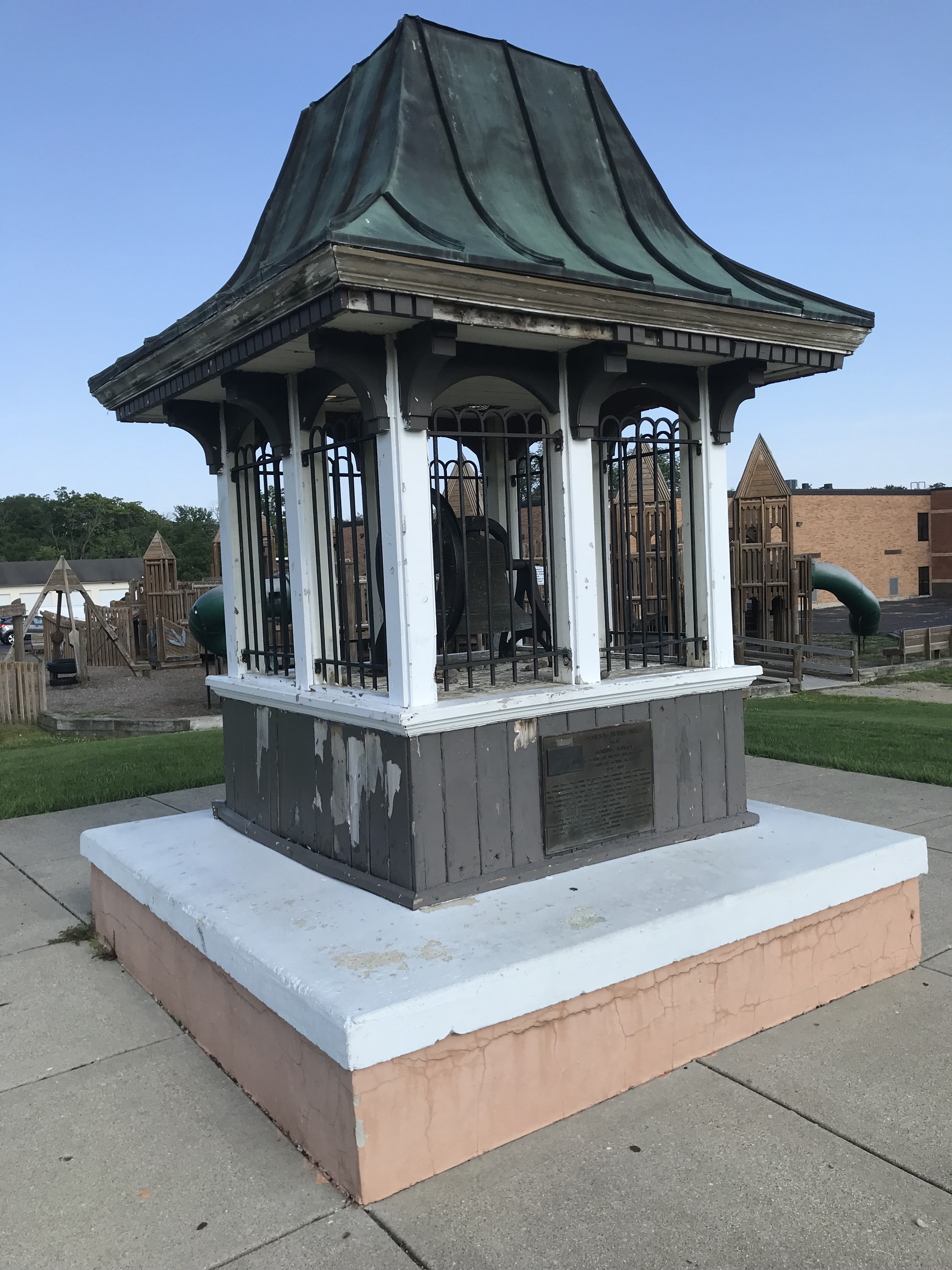
Erected by the Mokena Women’s Club in historic Pioneer Cemetery Cemetery in 1997, this monument details the life of Allen Denny. While commonly mistaken for a grave marker, Denny’s remains are buried in New York State. (Image courtesy of Mike Lyons)


   As the guns fell silent and the war ended in early 1815, life slowly returned to normal for the young Denny. Somewhere in this timeframe, as was a common source of entertainment and further education in his time, the merchant went to a public speech. The speaker was a gent from the New York State Temperance Society, a representative lecturing on the moral righteousness of the total avoidance of alcoholic beverages. Many were the adherents of the temperance movement in the America of yore, who blamed ardent spirits for every societal woe in the country, and those who believed in it placed its merits next to Godliness. Allen Denny heard the man’s talk and liked the cut of his gib, and thus was won over to the movement and became a lifelong devotee to teetotalism. So strong were his thoughts on the matter, that he immediately stopped carrying whiskey in his store, and with five others in tow, formed his own temperance society. 


   While Allen Denny took Connecticut lass Lucy Herrick as his wife at some long-forgotten date, history has not been kind, and has left us with no details as to her life, background, passions, or overall identity. Details on the children that graced their union have also become clouded with the passage of time. What can be pieced together, is that they had at least three; Herrick, a boy who died young, Alonzo, another son who was born around 1822 and survived well into the twentieth century, who in his middle age was a businessman in Mokena before eventually heading back to the east coast, and a daughter named Eunice, who may have been their oldest. She seems to have born around 1818 or thereabouts, and always stayed close to home, be it in New York or Illinois. Confusingly, Eunice was not enumerated with her father in the 1850 Census of Frankfort Township, where instead a 28-year-old daughter named Emma is listed. This begs the question, did the census taker simply mishear Eunice’s name and adjust her age? Or maybe she was just living elsewhere at the time, and Emma is a “lost” family member? In any case, this is the only instance in recorded history where an Emma Denny is shown as the daughter of Allen. After spending many years in Mokena, Eunice went back to Chautauqua County to live with her brother Alonzo, and disappeared into the mists of time in the 1880s.


   With the War of 1812 in the distant past, another great turning point in the life of Allen Denny came in 1834, at which point as a 44-year-old he moved home and hearth to what would become Mokena, in the heart of the untamed West. His reasons for moving have disappeared into the past like a mirage in the fog, but it is known that his trek was made in tandem with the Asher Holmes family, who would come to figure prominently in the history of New Lenox Township. At this time, the Black Hawk War, which had had so stirred our neighborhood, was freshly over, with hostilities having ceased two years previously. In the days in which the Dennys arrived in these environs, it is vital to understand that there was no Mokena, no Frankfort Township, not even a Will County, as we were still part of southern Cook County in that era. No railroads existed to quickly transport people and goods. Chicago and Joliet were mere hamlets in 1834. If any Mokenians of the 21st century would be transported back in time to those days, we’d be totally out of place in an unrecognizable, alien world. The thoroughfare we now know as Wolf Road existed, but was known as Theak-a-Kee Ty-Yan-Ac-Kee (or “The Trail of the Wolf through the Wonderful Land”) in the local Potawatomi tongue, who in their abundance had to traverse the path single file due to its narrowness. Allen Denny and his exceedingly few neighbors broke the prairie soil without the aid of a steel plow, which had only just been invented the year before by John Lane of the Yankee Settlement, in the neighborhood of today’s Homer Glen. All water came from the rushing streams of Hickory Creek, timber for the rough-hewn logs for the pioneer’s cabin homestead was supplied by the lush forests on its banks, and wild game was plentiful. With Denny’s 1834 arrival, something as simple as a trip to the post office required a journey to Billy Gougar’s, six miles to the east, until another post office was established at Chelsea, near today’s Frankfort in 1837. All of the lands encompassing the future site of Mokena were owned by the federal government, and upon choosing a claim, an early settler would later have the right to buy it when it would come up on the market. 


   When Allen Denny first set foot on our terra firma, he could only count the tiniest number of near neighbors in his midst. The Atkinses of Vermont got here the same year, while Tilford Duncan and the family of Francis and Keziah Owen arrived from Kentucky around the same time. The John and Nancy McGovneys, probably the Dennys’ closest neighbors, got here first in the fall of 1831, and as they were residents of three years standing, were the longest ones for the neighborhood, however they had fled to the safety of Indiana during the Black Hawk War. Matthew Van Horne, who was affectionately called a “Mohawk Dutchman”, lived a trifle closer to where Frankfort is now, along with Foster Kane, who purportedly stayed in the Hickory Creek timber during the war, but within a generation, eyebrows would be raised at this claim. 


   The Dennys were by no means alone in our neck of the woods, as some of their kin soon came to join them here. Lysander Denny, a brother to Allen eight years his junior, relocated here in the same decade. A millwright by trade, he built one on Hickory Creek, which at that time flowed with enough gusto to power the mill’s saw. Brother Alanson Denny was also an early citizen and came into possession of a tract of land near the future site of Mokena, however the details of his life have been scattered by the winds. Sister and brother-in-law Hepsibah and Samuel Haven made their way as well, Samuel having been a charter member of Allen’s temperance society back in New York. The Havens are a family whose name is writ large in the history of our neighbors in New Lenox, and were the owners of a house later known as the “Old Brick Tavern”, which graced the Lincoln Highway for a century and a half, until an unscrupulous developer destroyed it in the 1990s, in what amounted to a colossal waste of a priceless historic landmark. 


  The members of this hardy pioneer clan were also joined by their patriarch and matriarch Charles and Lucinda Denny in 1838, who in the sunset of their lives, wanted to be closer to their children. Both passed in the summer of the following year, when Allen broke ground to inter them on a peaceful rise on his corner of the prairie. As time went on, other relations came to follow them in what became our first cemetery. 


   A mere six years after his arrival in what came informally to be called the Hickory Creek Settlement, Allen Denny found himself intimately involved with one of the most electrifying occurrences in the early history of eastern Will County. Early on a summer morning in 1840, he happened across the corpse of a man in a millpond near where New Lenox now stands, it being clothed only in a brown cotton shirt and displaying signs of a “high state of putrification.” Freshly cut lengths of rope and clumps of hair were found, along with suspicious wheelbarrow tracks. Denny alerted his neighbors, and before long the whole affair blew up into what would be remembered for decades as the Van Horne murder case, in which an early resident attempted to frame a member of the aforementioned family for the deed. Allen Denny’s testimony was key at the forthcoming inquest, which contain some of the earliest written records painting a picture of his life in our region. 


   Denny’s decision to stay in Will County was cemented when he began formally purchasing the land upon which he was living and farming. On May 20th, 1841, he purchased two eighty-acre tracts of land, for which the paperwork was deposited in the general land office at Chicago. By and by the documents were forwarded to the then-called Washington City where they were signed by President John Tyler. The lands encompassed in his purchase were pure, unbroken prairie; one of the wide expanses began at what is today the northeast corner of Wolf and LaPorte Roads and stretched a ways to the north, while the other, situated a tad further to the north, centered on what we now know as the northwest corner of Wolf Road and 187th Street, continuing past the route of modern day Interstate 80. These acquisitions were a harbinger of the future, for it was upon this first tract that our village would later be borne by Allen Denny’s hands. 


   As the days passed and the 1840s continued, tragedy struck the Denny household when Lucy Denny passed away in the frigid January of 1844. As it was exceedingly hard to live as a single man in the unforgiving pioneer’s life our forefathers knew, Allen Denny took local widow Polly Marshall as his second wife in August of that year. Herself a fellow New Yorker, Denny did well to marry her, as Polly’s former in-laws were prominent residents and also early settlers to our area, living on the border of the future Frankfort and New Lenox Townships. 


   With Allen Denny comfortable as an established resident of the Hickory Creek Settlement, America was being rent apart by the issue of slavery. He became active in the newly formed Liberty Party, a short-lived political group dedicated to eradicating the institution, and was high-profile enough to be nominated on this ticket as their candidate for Will County Sheriff in 1844. (Alas, he didn’t win the election) Denny was also a long-time subscriber and ardent supporter of the Western Citizen, a paper published in Chicago that was the premier abolitionist publication in what we now call the American Midwest. He also spent time and great effort raising money for the cause, such as at the end of the year 1851 when he was collecting pledges in our area for the Illinois Anti-Slavery Society. Many are those who foster beliefs, will stand behind them and speak up for them till the cows come home, but Allen Denny put his money where his mouth was, and became a man of action. He would be remembered as a man who was “zealous” in his mindset. Pioneering Will County historian George H. Woodruff quoted the sentiments of Denny and those like him, in that “to help a man who was fleeing from bondage was a duty – that to aid in his capture was a crime against God and man.” 

     In time, Denny would come to operate the only documented station in today’s Frankfort Township of the famed Underground Railroad, likely working in tandem with his brother-in-law, Samuel Haven, who ran a station on his own homestead two miles distant. Whether Denny shuffled three escaped slaves on their way to Canada or three hundred, he got caught. While Illinois was indeed a free state, the Fugitive Slave Act was on the books in the north, which forbade giving assistance to refugee slaves. Once again, the exact details of these legal proceedings, and what exactly his punishment was, have disappeared into the pages of posterity. 

    As an aside, many are the tall tales of Underground Railroad activity that have spread through Will County in the century and half since its existence. However, that of Denny and Haven’s is an authentic one, as verified by none other than historian Woodruff himself. Looking back from a safe distance thirteen years after the end of the Civil War, the Joliet pharmacist turned scribe wrote that he “knows of some who paid midnight visits to both stations. A midnight ride with one or two fugitives was an exciting thing in those days, not without danger of being prosecuted at least.” Going back even earlier than Woodruff’s account, is a piece that appeared in the Fredonia Censor in 1871, a paper from Allen Denny’s old stomping grounds in Chautauqua County, New York. Its writer interviewed Denny while he was visiting his son Alonzo, and stated that in his Illinois home he had “kept an acknowledged underground railroad station for the accommodation of sojourners in quest of inalienable rights.” 


   These hair-raising tales of the days before and during the Civil War beg the question, where in Mokena was Allen Denny’s station kept, this erstwhile beacon of freedom? A legal document from the later years of Denny’s life describes a 19-acre piece of land that was specifically named as his homestead, a place through the middle of which Scott Street would be built in the 1950s. As late as 1911, when queried, Mokenians of a certain age readily identified the spot as being very near where the Schacht family then lived; they being long-standing residents of the vicinity of today’s Grace Fellowship Church. In any case, after the passage of more than 160 years, it remains impossible to say with certainty. 


   As the intricacies and perplexities of Mokena’s history have long since swallowed up so many of the details of life in Allen Denny’s day, we also do not have a crystal-clear vision of what his house looked like. It can be surmised that his first homestead in our midst was of the rustic, yet determined type of domicile that matched the personalities of our forefathers, it likely being built out of hand-fallen Hickory Creek timber and lacking many conveniences. As time went on and success smiled on the Denny family, they probably upgraded into a somewhat more comfortable residence, as was often the pattern among our forebears. Maybe he incorporated the old structure into the new, repurposed it into an outbuilding or even reused the original building material into a new project. 


      In the 1850s, Allen Denny began the process of filing a claim for a pension from the federal government for his service in the War of 1812, as did so many of his former brothers in arms. A long process filled with hoops to be jumped through in proving one’s claim, it wasn’t without vexation for our old veteran. First, the muster rolls of the company in which he served went missing, then bureaucrats in Washington City had no written record of his discharge from the militia, and as Denny couldn’t remember the numeric designation of his regiments, he had to write back to an old war buddy in New York to help jog his memory. The man turned out to be of not much help, as his recollections was also foggy, but being a part of the same process, empathized with his former comrade by closing his letter with a cheer, noting “success to us and all who put shoulder to the wheel.” In trying to piece back together the events of four decades previous, Allen Denny looked back at the war and wrote that “it seems more like a dream than reality.” All in all, he got his pension, and by the time he was 81, was getting eight dollars a month from Uncle Sam, or around $200 in today’s money. Like many 1812 veterans, in addition to his monthly stipend, Denny also received at least one 80-acre parcel of undeveloped land in Iowa around the time Mokena bloomed for services rendered, but as the pioneer felt rooted to his home among us in eastern Will County, within a short time he sold the property to a third party. 


     So it was in this era that the great iron horse was expanding across America and opening doors that had previously never been imaginable. New railroads were sprouting up across the land, ferrying goods and passengers to points far and wide, something that in our neighborhood had only been possible with ox-drawn conveyances on days-long treks through the roughest of conditions. One of these wondrous new roads was the Chicago, Rock Island and Pacific. After much doing, the company was officially organized in 1851. As their right of way was being surveyed across the prairie from Chicago to Joliet, a long stretch was due to be built through the northern half of the newly formed Frankfort Township, and more specifically, straight through Allen Denny’s pasture. He and his wife Polly sold the Rock Island the strip of land needed for the right of way, with a clause in the legal paperwork stating that if the company were to go defunct within five years, the property would revert back to their ownership. 


   The company staked out a spot in a central point in his acreage where a depot would be built, with only one other in the works between Chicago and Joliet at Blue Island. Allen Denny could see which way the wind was blowing, saw that new people would be coming hither and thither, that tradesmen would want to be near a new railroad, and sensed money was to be made. Therefore, in a moment filled with meaning, he subdivided a plot of land around which the depot was to be built. Thus in the planting of this first seed, a great shift occurred in history and our village was born. Denny’s plat contained two principal streets running from west to east parallel to the railroad tracks, known today as Front and First Streets stretching from modern Wolf Road to Division Street, sandwiching therein 38 lots of various sizes. Jeddiah Woolley, chief surveyor of Will County, did the legwork and the plat was filed on May 26th, 1853. The new subdivision was named Mokena; but by whom, be it Allen Denny, the Rock Island, or someone else, remains a mystery. 
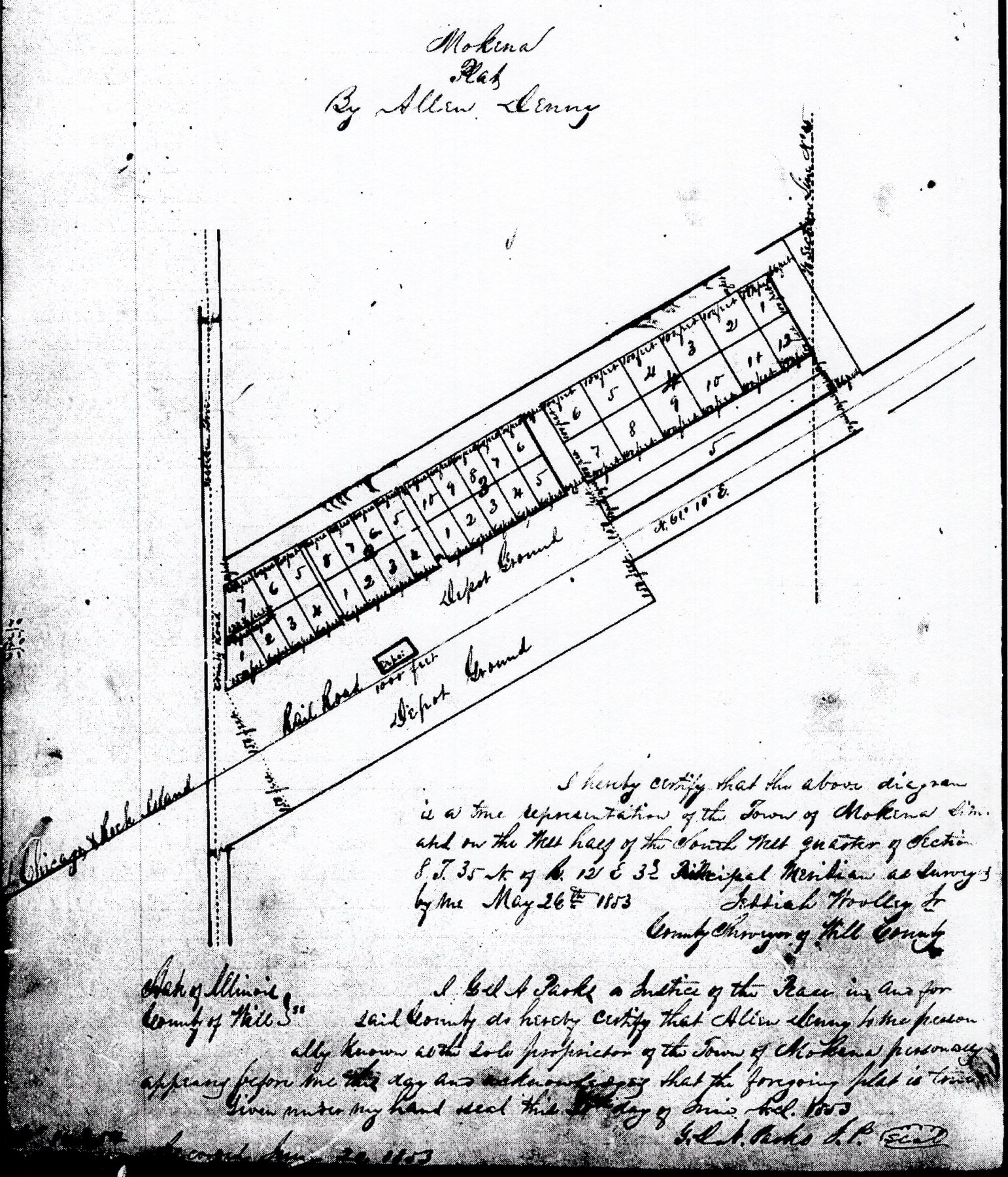


Allen Denny’s original plat of Mokena, as done by Jeddiah Woolley. 


   After some skepticism from area residents that a train would ever run over the rails, pressure was applied to the company and the first passage through Mokena was made on Sunday, October 10th, 1852, as a grandiose woodburning locomotive named The Rocket puffed over the prairie. At this time, the depot was less than half built, and otherwise our hamlet was composed of merely two buildings, with a third slated to go up within a month. Mokenians were so excited by the trains that spunky 18-year-old Julia Atkins published the times of their arrivals in her handwritten Mokena Star, our first journalistic endeavor. So revolutionary was the new railroad connection, that two decades later, historian Woodruff wrote that “now we could go from Joliet in the morning, buy half the city (if we had the dimes) and return at night.”


   Allen Denny came to gather a nest egg of no small means by selling off his lots to those who came to be near the new railroad and make their own fortune. Among these initial ventures was a store housed in a small, rustic stone building ran by Warren Knapp and a man remembered only as Smith, which sprouted up just before the subdivision was complete, as well as a nearby inn built by Carl Gall, who catered to the men who laid the iron rails. Blacksmith William McCoy followed by opening a workshop around the same time. Within a few years, the arrival of learned carpenter Bernard Folman of Luxembourg led to the construction of the first houses in Mokena. It’d be impossible to reconstruct exactly how much money Denny made by selling his lots, but what is sure, is that his name appears in graceful, swooping antebellum script on dozens if not hundreds of indentures filed in the Will County Recorder’s Office. 


   Soon after Allen Denny’s initial subdivision was laid out, neighbor John McGovney platted his own addition adjoining Denny’s to the east, with the new street running between the two being dubbed Division Street. As time went on, Denny tacked on more of his own additions, such as a large one in Christmastime 1853, which composed an area where a steam-powered mill would shortly thereafter be built east of the newly-named Mokena Street and south of the Rock Island tracks, as well as good sized parcels on the north side of First Street, as well as the areas along Second and Third Streets west of Division Street. Next came a second addition on the south side of the railroad, encompassing McGovney Street (known in Denny’s day as South Street) from today’s Wolf Road to Mokena Street, as well as a third addition in 1855 south of what came to called Denny Avenue. 


   One can view Allen Denny’s further sticking on of new additions to his town as an effort to maximize his profit in lot sales, but money wasn’t his sole goal, as is shown by his designation of a public square in 1855. A piece of ground surrounded on three sides by modern day Second Street, Union Street, and Third Street, legal papers from its release say it was “originally intended by the proprietor of Mokena as a plat for the erection of churches and other public buildings, required for the convenience of the inhabitants thereof, and the improvement of said village.” The document was signed by 25 male Mokenians and one lady resident, Abigail Gremmer. 


In what is the oldest known photograph of Mokena, Allen Denny’s public square is seen around 1870. The first building to be erected on it was the village’s schoolhouse in 1855 at far left, followed by the German United Evangelical St. John’s Church in 1862 at far right, and the Methodist Church at center in 1867. St. Mary’s German Catholic Church, seen in the distance, was not part of the square. 


   Allen Denny was also one of the first businessmen in Mokena, running a dry goods and grocery business with one F.C. Herrick, possibly a relative of his first wife. All in all, fortune didn’t favor the partnership, and it fizzled out in the fall of 1854. Nevertheless, there are indications that Denny kept up the enterprise on his own at least into the Civil War days, but like most of the finer points of life in Mokena in his time, details of this concern are exceedingly hard to pin down. As Mokena was being born, our founder was still active in the temperance movement, a cause that had been near and dear to his heart for decades by this point. Serving as Vice President of the Mokena Temperance Society, Denny presided over a rollicking meeting held at the schoolhouse near John McGovney’s place on January 12th, 1854, where the new Maine Law was debated by two speakers. A pioneering piece of legislation that banned sales of alcohol in that state except for medicinal purposes, the society resolved that “the Maine Liquor Law is just, expedient and constitutional, and we pledge ourselves to use all honorable means to aid its enactment in Illinois.” Before the meeting wrapped up at 11 0’clock that night, 40 new members were added to the rolls of the society. 


   A man of no small stature in our young community, Allen Denny was often called on to wear many hats in Mokena, as was the case when his neighbor John Atkins passed away in 1864. As the LaPorte Road resident’s estate was being settled and the paperwork was being filed in the county seat, Denny was asked to help appraise certain pieces of the deceased’s property, first and foremost being a valuable set of bee hives. Within a year, the Civil War was over, and the dust settled in America. In 1871, Allen Denny went to New York and took up residence with his son Alonzo, where he stayed put. After more than a century and two score since his departure, his reason for reason for leaving Mokena is unclear. However, it does not appear that his wife Polly went with him; in fact, a legal document from the following summer stated that the two were “living separate and apart.” Were marital strains what drove him back to the Empire State? In any case, assigning any reasons to his move would only be speculation at this late date. So it came to pass that Allen Denny spent his final years back in Chautauqua County, where he passed away in his 85th year on October 29th, 1875. His demise was noted back in his Illinois home of Mokena, where our correspondent to the Joliet Republican sent in the news to the paper, hailing him as the “original founder of Mokena.” Denny’s bones rest in Chautauqua County, far from his adopted home in the Land of Lincoln and the community he built. Ashes to ashes, dust to dust. All the comforts, blessings and good fortune of our hometown are the legacy of Allen Denny. Our comfortable existence in one of Will County’s foremost communities we owe to his vision, this man who made the wilderness to blossom as the rose. He is the Father of Mokena, and may his memory reign supreme in our consciences.

Saturday, December 2, 2023

Tillers of the Soil, Hearts of the Community: The Story of Lence and Lydia Kohl

    A wide, grey band, stretching through our midst, 191st Street is one of the main avenues traversing through Mokena. In the days when local roads were casually named after those who lived on them or where they led, it was known as Tinley Park Road. On its western side, 191st Street is primarily residential, with homes either fronting on it or subdivisions being directly in the neighborhood. As one comes upon Fire Station 2 and draws closer to Route 45, the mood becomes more business-like, with enterprises of various types abounding, sterling examples being Schillings and the expansive warehouse for Darvin Furniture. Nowadays, 191st Street bears the honorary name of Cpl. Robert Stanek, a Mokenian who lived on this road and made the ultimate sacrifice in 1968 as a Marine in the Vietnam War. 

    In the days of yesteryear, long before Robert Stanek and most of the rest of us, this road was a country farm lane that cut through the landscape like a ribbon through a cradle of agriculture. A prominent, recognizable remanent is now known as the Brandau Farmstand, but a century ago was the Henry and Ida Yunker farm, while directly to the southeast, where Import Exchange now stands, was the Louis and Elizabeth Lauffer estate, now obliterated from the landscape. Large dairy barns and tall silos once dotted the landscape here. Many faces play into the rich history of this road, and it would be impossible to recall the flavorful narrative of this one-time rural idyll without that of a sturdy and storied Mokena family, that of Lawrence and Lydia Kohl. 


   Our matriarch first saw the light of day as Lydia Emma Geuther on April 19th, 1896, born to this world here in Mokena. She came from good Frankfort Township stock; the Geuthers could proudly count themselves as among the first families of German heritage to settle in the yet-unnamed township in 1848, while her mother’s clan, the Bauchs, were also early arrivals. Jacob Bauch, a great uncle of Lydia’s, was a 19th century store keeper in Mokena.

   Lydia was born on the family farm along the Tinley Park Road, on the north side of today’s 191st Street just east of LaGrange Road, a corridor where her family had tilled the soil at least as far back as the Civil War, when her grandparents Johann Georg and Elisabeth Geuther planted and harvested crops there, all the while also running a small cheese factory. Lydia’s father, Charles Geuther, was also a farmer, and in his day came to be something of a prominent citizen in Mokena, where he held a seat on the local school board for many years. Lydia Geuther had an older sister, Mabel, who was three years her senior, and sister Olive came on her heels two years after her own birth. Two brothers came along later, Milton in 1902, while the baby, Harold, didn’t make his appearance until 1909. Among Lydia Geuther’s earliest memories was of seeing a newspaper on her kitchen table bearing the details of President William McKinley’s assassination in September 1901, while she also remembered many years later that Saturdays were bath nights on the farm, all done in a tub that was heated on the kitchen stove. Lydia was an exceptionally sharp girl, having learned her times tables up to twelve before she started school at the age of five, having learned from atop a stool as she watched her mother sew.


   The Geuthers were stalwart members of the German United Evangelical St. John’s Church, of which Pastor Carl Schaub would visit the farm a few times a year and be served wine from a pitcher. So it was, that when Lydia was not quite nine years old, her family decided to move to town, and when a sale was held at their farm, on a stormy day in February 1905, it was a huge success for the family, with some of the cows fetching as much as $55. When all was said and done, $1,500 had been netted. It helped that buyers and looky-loos had been drawn to the happenings by a big basket of donuts that was on hand for the taking. Charles Geuther had bought two five-acre tracts in the northeast part of Mokena by this time, and as the family moved from the farm outside town in this era, they had a commodious house and barn constructed in the village proper. The stone for the foundation was hauled to town by teams of horses from a Joliet quarry, ultimately being laid by J.G. Oswald, a local concrete man and stone mason, while town carpenter Adam Barenz raised the walls of the new house. A big cistern was built under the new kitchen for the Geuthers’ water use, while the family also had a cow, two horses and a barn stocked with hay. Charles Geuther secured wood for use at home from a local forest, had it chopped, which his family then sorted into an outbuilding on their property. Also on their acreage in town was a 40-foot-high windmill and a verdant garden, along with a plot upon which the Geuthers cultivated corn.


   In an uncommon move for a young lady in her time and place, Lydia Geuther received a higher education, having attended one year of classes beginning in the 1912 school year at the teachers’ college in DeKalb, this institution now being known as Northern Illinois University. Upon the completion of her courses, the newly made educator came back to Mokena and took a teaching position at the now all but forgotten one-room Marti School on the northeast corner of today’s Wolf Road and 187th Street. A tiny, primitive building by our 21stcentury standards, Lydia’s 1916 class consisted of eleven students, all of whom lived on nearby farms. Lydia took a salary of $60 a month until she gave up the spot in 1919. 


The Geuthers of Mokena, seen here around 1916. Standing in rear row, left to right, are Mabel (Krapp), Milton, and Lydia (Kohl). Seated in first row, left to right, are Charles, Olive (Stellwagen), Harold and Sarah. (Image courtesy of Amy Donoho)


   It was a past time of Lydia’s in those years leading up to the First World War to watch baseball matches from a two-seat swing in a shady spot of the Geuther lawn, which provided a commanding view of Erickson Park across the road, on the sight of today’s First Court. These local games were no trifling, small-time affair; on the contrary, nothing that exists in today’s village can be compared to them. The Mokena team was composed of crack hometown athletes who drew crowds of hundreds, especially when they played their arch rivals, Frankfort. One of our players was a robust lad named Lawrence Frederick Kohl, who everyone called Lence. Eight years Lydia’s senior, he was born in the southern reaches of Orland Township on a farm in the vicinity of what is now called 104th Avenue. Like the Geuthers, the Kohls were agriculturists, and no fresh arrivals to our environs, having first set foot in Frankfort Township by way of Chicago and a village called Fliessen in the Austrian Empire during the antebellum years. 


   Along the way, Lydia and Lence got to know each other better, and two paths merged as one when they were married in February 1920. Theirs was a small, intimate ceremony held in the Geuther house in Mokena, officiated by Rev. William Kreis of St. John’s German Evangelical Church. After the wedding, the new Mr. and Mrs. Kohl left on an evening Rock Island train bound for Chicago, amid, as the village News-Bulletin put it, “a copious shower of rice.” The couple moved to the Mokena farm of Lence’s parents after they tied the knot, a sprawling place on the north side of today’s 191st Street at the intersection with Schoolhouse Road. The whole estate was nothing to sneeze at, as it took up 160 acres. Lence’s Dad and Mom, Anton and Elizabeth Kohl, acquired the place from the widow Helena Schiek in 1895, which contained a spacious two-story farmhouse built not too long after it came into the Kohls’ hands. At one point during the early years of the Kohls’ ownership, the construction of a southern extension of what we now know as 108th Avenue threatened to bisect the farm, and in order to thwart the dissection of their property, the family built a large dairy barn in the path of the projected road in 1908, and as draconian eminent domain statutes didn’t exist in those days, the matter was dropped. 


Newlyweds Lence and Lydia Kohl. (Image courtesy of Amy Donoho)


   Three children would come to grace the home of Lence and Lydia Kohl, namely Roy Everett, who was born July 15th, 1921, next came Marvin Lawrence on May 23rd, 1925, who Mokenians always knew as Miff, and rounding out the family was Dorothy Mae, who came into the world on May 23rd, 1932. When she was a baby, Lence Kohl would rock his daughter in her cradle via a string tied from the cradle to his leg, so as not to take him away from card games in the next room with his friends. Musical talent ran strong in the Kohl family; Lydia played an upright Bauer piano that, upon her marriage, was shipped to Mokena over the Rock Island from Chicago. All in all, it cost $600, which she financed with her salary from the days teaching at Marti School. Lence played the violin, and Roy Kohl became a masterful and moving singer in his time. Dorothy Kohl was nothing short of a musical prodigy, taking up the piano in her earliest childhood before going on to take lessons from a teacher who traveled to Mokena from the county seat once a week. She eventually added the organ to her repertoire, and was playing local weddings by the time she was 16. So in demand was her talent, that she generally played nuptials every Saturday, and some days even two. Sharing her natural gift with not just Mokena, Dorothy also became a paid organist at New Lenox and Tinley Park churches, and continued her musical tradition even after she moved away in later years. 


   At her 191st Street home, Lydia Kohl was a hardworking farm wife. She used a wood-burning stove, and in the words of her daughter Dorothy, she “baked homemade bread, pies, cakes and did the washing and ironing.” The Kohls didn’t have indoor plumbing or electricity until May 1932, the midst of the Depression years. In these rough days, Robert Hohenstein worked for the family, a young nephew of Lence’s who had lost his mother at a young age. All vegetables in the household came from the Kohl garden, along with all fruit from the orchard, which would be made into jams and jellies. It was a true farm to table lifestyle, with all meat being butchered on site. 


   For the Kohls, Mokena wasn’t just a place to live, but a locale where they directed their hearts back into the community. Lence was one of the founders of the Will County Farm Bureau, and was especially active in local school matters, having served on the board of District 159 for many years. As the Second World War was ending and the recent closure of Mokena’s two-year high school was fresh on all minds, the idea began to be kicked around of forming a new high school district encompassing Mokena and Orland Park. Within a few years, this initial concept grew and transformed into a plan to combine Mokena, Frankfort, Lincoln Estates, New Lenox and Manhattan into a new district. Thus the seed was born for the creation of Lincoln-Way High School, of which Lence Kohl played an integral role, first taking a place on the survey committee, and then ultimately on the new school’s first board of education. As the groundwork was being laid, Dr. William Reavis of the University of Chicago’s School of Education came to our neck of the woods to give his advice, and after all was said and done, the doctor presented Lence with an august cane of hickory in honor of his work establishing the new high school district, which ensured the future of Mokena’s students. As he got on in years, Lence Kohl was honored by the Mokena Chamber of Commerce in 1963 for his service to the village, not only recognizing him for his work with our schools but also for his involvement with the Mokena Planning Commission, having a seat thereon since its inception in 1952.

    Lydia Kohl was also devoted to Mokena, having served not only on the 1963 historical committee that produced the lively booklet The Story of Mokena, but also gave much of her time to 4H matters. To this day, she is still lovingly looked back upon by the Mokenians that she mentored in their youth, remembered as a leader who was kind and caring, hardworking, and available to all who needed her.  


The farm of the Kohl family on 191st Street in the era following the Second World War. (Image courtesy of Amy Donoho)


    Lence Kohl crossed the great beyond in May 1976, in his 88th year. Another pall was cast when the stately dairy barn and silo on the Kohl farm were consumed by fire at Thanksgiving time 1978, Lydia being greatly saddened by their loss, lamenting that her home no longer looked like a farm without them. The incident was whispered in town to have been arson by an outside party; an eerie reminder of a similar fire that happened on a frigid February night in 1969 when unknown hands placed an ignited street flare against the wall of a corn crib. Luckily, in this first occurrence, passing motorists saw the flames, managed to awake Lence Kohl and together they put out the blaze before serious damage could be done. 


   As her Mokena slowly lost its rural atmosphere in the sunset of her years, Lydia Kohl continued to live in her idyllic home on 191st Street where she kept busy crafting braided and hooked rugs. She departed this world in Joliet a few weeks after New Year’s 1990, in which year she would have turned 94. The Kohl farmhouse disappeared from the landscape not long thereafter; an earthen mound at the northern head of Schoolhouse Road is all that remains of the family homestead. Lence and Lydia Kohl along with their children are now gone from our midst, but they all are fondly remembered by countless village folk. The Kohl legacy lives on in the Mokena that was greatly touched by their having been a part of it. May their memory live eternal in our community. 

Sunday, October 8, 2023

A Slice of Mokena: The Story of 11000 Front Street

   In the pre-dawn hours of an autumn morning in 1974, as darkness enveloped the village and her denizens slumbered, a disastrous fire pummeled Front Street. The alarm was sounded, and the Mokena Fire Department was quickly joined by the brigades of surrounding towns to battle the blaze, and after hours of sweating out the fight, the conflagration had been vanquished. As the sun rose, nothing but a burnt out, smoldering hulk remained of the edifice that the flames consumed. Mokenians were shocked, and in the space of a few hours, over a century of our community’s memories went up in smoke. Some of the faces tied to this storied property were fleeting, tying themselves to this place in the blink of an eye, while others left their mark over the course of decades. The old building had many sides, for half a lifetime it was a watering hole where occasionally rough characters mingled, and at other times it was a place of trade, with everything from general goods to hardware being had here. To revel in the collective patchwork of Mokena’s narrative, one would be remiss not to look closely at the northwest corner of Front and Division Streets. 

   Looking back to the exciting days of Mokena’s youth, a time when horse-drawn carriages owned the streets and colossal iron locomotives puffed coal soot into the air as they roared through the village, it can be seen that the earliest venture at this location may have been a saloon kept by George Treuer. Nevertheless, a dearth of precise sketches of life in our community in those first few jubilant years after the Civil War make it hard to pin down with certainty. What is sure, however, is that Treuer was among the bravest of the brave, having earned the right to call himself a veteran after serving the Union in the war with the 20th Illinois Volunteer Infantry. He faced the traitorous ranks of the enemy at Fort Donelson, Tennessee in the bitter early months of 1862, where he took a ghastly wound in his leg that would pain him for the rest of his days. 


   In a moment of economic necessity, George Treuer and his young wife Anna sold this corner lot and the one adjoining it on the north to 29-year-old Nicholas Schuberth, with the paperwork for the transaction being filed in the county seat on the last day of July, 1869. The whole action cost Schuberth a pretty penny, to the tune of $2,350 dollars. The high cost of the sale was due to the fact that a substantial building already stood on this corner property, one possibly built by its previous owner. It was a plain, wood frame structure, like countless others resembling it on any given nineteenth century American Main Street. It featured two stories, with commercial space on the street level and living quarters above, big front windows, and a whimsical half circle window in the attic overlooking Front Street, sticking out like a single eyebrow. 


   Like George Treuer, Nicholas Schuberth was of German birth, and came with his family to the New World as a seven-year-old in 1847, settling in what became Frankfort Township not long thereafter, and by 1862 the Schuberths had become established enough to own a large farm northeast of town on today’s 191st Street. Readers of these pages will be familiar with this old Mokena clan, as Nicholas’ older brother John was intimately attached to the history of a Front Street estate a few doors to the west of the place in question. Nicholas Schuberth inscribed his own name on our narrative at this spot on the corner when he opened his own saloon and inn here around 1870, christening it the Union Hotel and joining multiple others in town in quenching the thirst of his fellow Teutons, who made up most of Mokena’s population at the time. Running a watering hole in postbellum Will County required the adherence to a certain number of complex yet strict laws on the books in those days, one of which Schuberth ran afoul of shortly after New Year 1871, when he was indicted in the county court for “keeping open a tippling house on the Sabbath day.” He plead guilty and was hit with a fine of $50 and costs. Nevertheless, business kept up, and ironically, Nicholas Schuberth became a Frankfort Township constable around this time, becoming so proud of the title that he personalized his business letterheads with it. As will be seen at this location, the young man was himself a victim of the sometimes coarse nature of his livelihood. On Christmas night 1876, while making change for a customer, cruelly sarcastic farmhand Adolph Bimer “politely informed the landlord” that he had been holding onto an express envelope for long enough, and that he would be helping himself to it. The thief made off with 65 dollars, which the pages of history don’t indicate whether Schuberth ever got back. 


   Nicholas Schuberth was a married man, his wife being young Caroline Wagner. Together the two welcomed four children into the world. Tragically, Caroline Schuberth died of brain inflammation in 1882 at the age of 34. So respected was she in Mokena, that St. Mary’s German Catholic Church was thronged to capacity at her funeral, with many being unable to gain admittance. In this timeframe, shreds of evidence exist that Nicholas Schuberth may have conducted his business elsewhere in town. Nevertheless, a year after Caroline’s passing he was back at the old spot on the corner, when he “neatly papered and re-fitted his place in a manner which adds greatly to its appearance.” In reporting on the local saloonist, Mokena’s correspondent to the Will County Advertiser wrote that “Nick always runs an orderly house, and all that he needs now is a charming Frau. Get there, Nick.” Within a year, barkeep Schuberth fulfilled the prophecy and took Charlotte Metzger of Joliet as his wife, upon which three more children came into the family’s fold.  


   The Schuberth saloon was a hub of social activity in our village, a typical example of the festivities found there was the grand masquerade given by the local Männerchor, or men’s choir, in February 1884. Life in 19thcentury Mokena was far from easy, and so it was that 52-year-old Nicholas Schuberth departed this mortal coil on July 24th, 1892. The specifics of his passing have been lost to the ages like grains of sand to the wind. His mortal remains were interred next to those of his first wife in the country churchyard of St. Mary’s German Catholic Church, the congregation his family had helped found 28 years before. In the aftermath of his death, Charlotte Schuberth was left to sort out the estate, which included numerous debts to, among others, a Blue Island cigar merchant, and a Chicago wine and liquor dealer. Not quite three years after the loss of her husband, Charlotte disposed of the Front Street property plus the lot adjoining it to the north to Jolietan Henry Piepenbrink in the spring of 1895 for $1,045, less than half of what her husband paid for it two and half decades previously. 


   Not quite a year after this transaction, the property wound up in the hands of Simon Hohenstein.  31 years old in 1896, Hohenstein was a member of a storied and long-established Frankfort Township family, a prominent Mokenian who held many posts in his day. By the time the sun had set on his life decades later, he had at different times called himself Frankfort Township Supervisor, Assessor, and School Trustee, Mokena Village Trustee and Postmaster. No wonder one of his village peers called him “quite an outstanding citizen in his day.” In April 1896, Simon Hohenstein threw upon the doors of the watering hole on the corner and opened his own saloon. Whether business wasn’t good or a better opportunity arose elsewhere, he turned around and sold the building as well as his supply of spirits to a Chicago Heights firm at Christmastime 1898, but through the twists and turns of fate, he found his way back to the business and the old corner within a year, as the taker of the 1900 federal census recorded him here as a saloon keeper then noting that his wife Louisa served as his bartender. 


Pictured in one of the oldest known views of Front Street, Simon Hohenstein’s saloon stands triumphant on the northwest corner of Front and Division Streets in the latter part of the 1890s. Seen left to right are Dan Hohenstein, Louisa Hohenstein, Amanda Hohenstein, saloonkeeper Simon Hohenstein, blacksmith Robert Turner, Dr. William Becker, Herman Gieger, John Aschenbrenner, Jack O’Neill, and brothers Edward and William Stellwagen. 


   In a wave of improvement in the first years of the 20th century, barkeep Hohenstein had the interior of his taproom freshly painted not long after New Year 1902, while later the same year he built an addition to the north side of the building and tore down an old shed that had stood in the way, re-using the old building materials to build a new coal and wood shack. A local scribe writing to the Lockport Phoenix-Advertisercontently noted that Simon Hohenstein was “one of our citizens who does things”, although coal was slow coming to the new outbuilding due to an ongoing strike. Getting his two cents in, Hohenstein told the correspondent that if the strikers had “any consideration for him, they will now settle and allow him to coal up.” Soon thereafter, the outside of the main building was given three coats of new paint, making it a regal dark green with white trim. In these early years, the Hohenstein corner was home to a special gas-powered street lamp that was installed on trial by the village board. It shone so brilliantly in the dark night that our same author noted that Mokenians thought “a Rock Island engine had jumped the track and run its headlight into the street.” So brilliant was it, that the top of the neighboring iron village water tower was even lit up. 


   In a move that was illustrative of the times in which he lived, in the yule season of 1901 Simon Hohenstein along with his neighbor a stone’s throw to the southwest, butcher Paul Rinke, had a small, old house moved to Rinke’s property where they converted it into an icehouse. An oft forgotten facet of the lives of our forefathers, icehouses were small outbuildings where gargantuan cakes of ice would be stored in straw throughout the year, often seen in the years before electric refrigeration would be stored. Hohenstein made good use of his, as a Mokena saloonist serving warm beer would be out of business in less time than it takes to hitch a horse. 


   One of the village’s premier capitalists around the turn of the 20th century, Simon Hohenstein also went into the buggy business, aside from already being a handler of farm implements. He was the Mokena agent for the famed McCormick Harvesting Company, and later also moved Singer sewing machines. Hohenstein hung up his beer spattered apron for the last time on March 1st, 1905, when he sold his saloon business and property to John L. Groth. The historic record indicates that Groth and his young family originally hailed from Manhattan, and like his predecessor, he was a leader in Mokena, having held a village trustee’s seat from 1915 to 1917. 


   Business carried on as usual at the old stand, and while it may strike a modern reader as quaint to think of a neighborhood tavern in an early 20th century farm town, it was sometimes anything but. Nothing indicates that John Groth himself was a hard man, but his beer hall was more than once the scene of alcohol-fueled mayhem. Around 4 o’clock in the afternoon on the last day of August 1914, a large crowd of boozed-up railroad hands gathered at the corner. World War I had just flared up in Europe, and national pride for the nations involved was at a boiling point. Somehow or other, the war came up in conversation, and in the words of Mokenian Bill Semmler, “the argument got pretty warm, and soon resolved itself into a genuine battle.” Five brawling men took to the middle of Front Street, and beer bottles and rocks were used as weapons, one of the former fracturing the skull of a Hungarian. Our one-man police force, Officer Conrad Schenkel, soon clapped the belligerents into the town calaboose a few doors to the east, and the injured man was taken to the office of Dr. F.W. Searles, who in turn sent him to a Blue Island hospital. The man’s fracture was so grave that the doctor thought there was a good chance he wouldn’t make it, and frankly recommended to Officer Schenkel that the man responsible should be held, that is, if he could be found – of all the arrestees, none of them would admit who dealt the blow. 

   Another incident a little over two months later at the Groth saloon involved Mokena fixture Dick McGovney and some bacchanalian Swedes. Once again, Bill Semmler painted a vivid picture, describing how the two young Scandinavians, who worked as local farm hands, “came to town to celebrate” and how after bouncing down Front Street from saloon to saloon, they


“had an overabundance of the stuff that cheers, and they wanted more, and when the saloonkeepers turned them down, they showed fight.”


They went on a rampage through town looking for more, and upon getting to Groth’s corner, they confronted Dick McGovney as he tended to his horses, and threw stones at him and the equines. Without getting into detail, scribe Semmler said that “Mr. McGovney gave the belligerents a lively time” and gave them a taste of their own medicine. Again Officer Schenkel was on the scene and locked up the two overnight, a little worse for the wear, all the while begging to be let go, as they had to husk corn the next morning.  


   The advent of Prohibition in 1920 threw a once lucrative venture out of business. Andrew E. Wachter, a nephew of Nicholas Schuberth, was running the show here in those years, and got creative with his menu, serving such non-alcoholic drinks as Green River and Soda Fruitola, as well as some beverages called Mokena Dream and Mokena Sizzler. Those first few years of the 1920s turned a new leaf in the business life of this historic building, and for the first time in its existence it was not used as a beer hall. After briefly housing the general stores of John Grogan and then Walter Fisher in this era, Krapp Brothers came onto the scene in October 1922, whose influence would prove to be significant. Lifelong village residents, young Milton and Roy Krapp were the sons of Mokena’s premier livestock shipper, and not only opened the Mokena Hardware Company at this location, but also greatly remodeled and expanded the old building. The work got under way the following May, and called for a large addition to the west side of the structure, measuring 45 by 50 feet, as well as a small wing to the new construction to house the village post office, which had already made its home in the original building for nearly two years. New apartments were built for the second floor of the main structure, which were modern in every way, having electricity and village water piped in. Such a project was a big one for 1920s Front Street, and our town paper, The News-Bulletin hailed it as “the most important business improvement in Mokena this spring.” By the time the brothers were done with building work in October 1923, the place was totally unrecognizable from its old self. So it would stay, the façade a Front Street mainstay for decades to come. 


Looking west down Front Street from Division Street, the Mokena Hardware Company stands prominently on the right around 1925.


   Anything imaginable in the hardware line could be had from the Mokena Hardware Company, including appliances, such as the Universal full enameled gas stove, which a customer could have for $85, or around $1,500 in today’s money. Milton and Roy Krapp ran a very modern business, as is evidenced by the radio department that they opened, making them the first dealers of this article in Mokena. In charge of that corner of the store was local adolescent Everett Cooper, then a fresh-faced young man, who would later go on to be Mokena’s mayor from 1945 to 1949. Mokena Hardware Company was known to often stage demonstrations of its products, and one highlighting the brothers’ paint and washer demonstration on Saturday evening, April 4th, 1927, drew in a staggering 200 onlookers. Part of the event was a guessing game involving a rooster named Hungry Hank, who belonged to the local poultry farm of Marti Brothers. Spectators made their guesses as to how many corn kernels he would eat, and by the time all was said and done, Hank managed to nibble away 205 kernels. Mary Eddy of Alpine guessed that he would manage 210 kernels, and as her guess was the closest, she won a washing machine. 


A crisp autumn day on Front Street. This snapshot, taken October 23rd, 1928, shows the Mokena Hardware Company with the post office at left. (Image courtesy of Richard Quinn)


   The Mokena Hardware Company was also known seasonally for the lavish Christmas display in its front windows, typical was their showcase of Yule season 1926. An entire farmyard idyll moved in, all sized down to scale. The News-Bulletin described it as 


A large farm house, barn, garage, a team of horses pulling a wagonload of corn, the old familiar farm pump, are all shown true to life, all set in a mantle of imitation snow. At night the scene is made very beautiful by a cute lighting effect.


The show windows also proved attractive to burglars, as was shown in the darkness of the early morning of November 2, 1927. Unknown thieves smashed panes of glass in three of the windows around 3:00am and made off with two shotguns that were part of a hunting display. The guns themselves were worth around $40 altogether, or nearly $700 in 21st century funds, but the real damage was in the windows, as replacing them ended up costing exceedingly more. Mokena was titillated, as it was thought that the robbers, whoever they were, were connected with the murder of a lawman in northwest Indiana, as the suspects were seen heading our way. Be that as it may, no one was ever prosecuted for the burglary. 


   Milton Krapp bought his brother Roy’s share of the Mokena Hardware Company in the summer of 1926, and both brothers went their separate ways in business, before Milton sold the store in its entirety to Emil Tewes of Frankfort in the autumn of 1935. Nevertheless, Milton Krapp retained ownership of the building itself for many years thereafter, and in the shaky days of the Great Depression, Irv Howes kept his Royal Blue grocery store here. With Mokena and the rest of our country in the midst of joyous triumph at the end of the Second World War, the corner property switched hands and came into the fold of Edwin A. Dunham, who opened a new  hardware store here. The 37-year-old was initially a newcomer to Mokena, but after he set down his roots in our village, Dunham would prove to be an old standby at this location. Edwin Dunham spent his first years in Iowa, after which grew up as a farm boy in Colorado, before ultimately graduating high school in Evanston and working as a telegrapher. Dunham and his wife Luella along with their three sons, Richard and twins Thomas and Theodore lived in the rooms above the store. 


   Just as this new enterprise was getting off the ground, it almost all went up in smoke. On the wintry morning of Monday, January 14th, 1946, a blaze broke out in the attic of a small addition to the larger building. In an eerie harbinger of future events, Edwin Dunham was at a distinct disadvantage, as not only was he lacking water, but he also had no phone hooked up in the building with which he could call for help. As the fire ate its way through the attic, Dunham made haste for a neighbor who was able to rouse up the Mokena Fire Department, who quickly were on the scene with their new state of the art engine, with which “a few well directed shots of water from the high-pressure hose” made short work of the conflagration. At the end of the day, more damage was done by smoke and water than the flames themselves. 


   The Dunham Hardware Store was in business for decades, and lived on in the memories of countless Mokenians. Edwin Dunham himself is widely remembered as a very easy going and likeable man; his shop on the other hand, was not known for the organized way in which it was kept. As such, many was the time when a customer couldn’t find a certain item after traversing the creaky wooden floors of the store, only to be told by the proprietor in his locally famous words “I just sold the last one!” or “It’s coming tomorrow.” Luella Dunham was also a presence on this corner, having maintained a section of the store where she sold gifts. 


   So it was that history ended on this distinguished Mokena corner on a shadowy Thursday morning in September 1974. A calamitous fire tore through Edwin Dunham’s hardware store, to which the Mokena Fire Department turned out in full force, in what turned out to be one of the worst blazes seen in town for a long time. Such was the magnitude of the disaster that the firefighters of neighboring towns also came to bolster our local brigade. Not only did those battling the blaze have to deal with the stifling flames and suffocating smoke, but also the peril of live ammunition cooking off, which was sold in the store. Despite the ardor with which the fire was fought, the old building was a complete loss, and not long thereafter, the remnants of its charred husk were mercifully removed. In time, a new building was erected on the site of the old saloon turned hardware store. While there may be no trace left of the original structure, the legacies of those tied to this historic site live on in our village. 


The aftermath of the conflagration at Edwin Dunham's hardware store in the autumn of 1974.

Saturday, August 5, 2023

Reading, Writing and ‘Rithmetic: Mokena Public School, 1872-1929

    The names of our village’s roads are a peek into our history. Some bear the names of founding fathers, such as Denny Avenue and McGovney Street, while others recall mayors, such as Everett Lane and Swanberg Lane. After all, the name of Wolf Road, originally a Potawatomi path, hearkens back to none other than Theak-A-Kee, Ty-Yan-Ac-Kee, or their word for Trail of the Wolf Through the Wonderful Land. Schoolhouse Road also makes an appearance, not only being one of our main thoroughfares, but also taking its name from a local institution of many years’ standing. However, in our fast-paced 21st century world, how many modern Mokenians actually reflect on the place from which the road gains its namesake? For over half a century, the ornate, two-story Mokena Public School stood on the northwest corner of Front Street and today’s Schoolhouse Road, a place that loomed large in the lives of generations of villagers. 


The Mokena Public School on the northwest corner of Front Street and today's Schoolhouse Road, as it appeared circa 1910 in a tinted postcard.


   While it was the grandest school in our history, it was far from the first, that honorable designation going to the schoolhouse that was the inaugural building constructed on our Public Square in 1855, three years after the arrival of the Chicago, Rock Island & Pacific Railroad. A small, low-slung Greek Revival building boasting of one classroom, lightning rod and modest bell, it also served as a meeting place for Mokena’s newly formed religious congregations and whoever else needed the space. By the time the Civil War ended in 1865, the ten-year-old building was already bursting at the seams with students. It was time to upgrade, and mirroring the up-and-at-them post-war mood in our neck of the woods at the time, no expense was spared. On the edge of town at the northwest corner of Front Street and today’s Schoolhouse Road, then an unnamed farm lane, a magnificent, two-story wooden eminence began to grow. Built under the leadership of local contractor and native Englishman James B. Eason and the assistance of carpenter George Schweser, the new school bore touches of Italianate architecture, then in vogue in this part of the state, with the elaborate brackets supporting the roof and window frames, complete with its bell tower standing triumphant, which before the completion of our first water tower in 1898, was the highest point in town. All in all, the new structure measured in at forty-five by seventy-eight feet. Inside, two sets of winding stairs led down from the second floor. The meat of the structure were its two large classrooms, one upstairs and one down, each measuring in at twenty by sixty feet. Two round wooden pillars supported the ceiling in each room, although in later years more walls would be built to subdivide each room. 


   By the time construction was complete, the final cost of the new school plus its furnishings came out at $10,000. In those early years it was widely considered to be one of the crown jewels of Will County’s school system; only five years after its opening, eminent Will County historian George Woodruff stated that “it is a flourishing school, ably-managed and well-attended”, while years later the Mokena News-Bulletin humbly wrote that it “was the talk of the town and surrounding country in its day.” So acute was the need for the new building that it was in use before it was even finished; with the ground floor being open for students in the fall of 1872 while the second was still under construction. When the doors first opened, none other than George Kimball was one of the first pupils, who would be remembered as “the real bad boy of the school.” He was an orphan who lived with the Brumund family south of town, and he was “said to have been a great tobacco chewer and could spit the farthest of any boy.” 


The pupils of Mokena Public School, circa 1880.


   Through the muddle of time, it is agreed that Prof. Harris Smith was the new school’s first principal, a man whose life in Mokena’s history remains nebulous at this late date. Who the other firsts were, leaves room for debate. Whenever the subject came up in the decades thereafter, memories were fuzzy; however, it can be certain that Miss Sarah Baldwin, Miss Sarah Mather, Miss Clara Williams, Mr. and Mrs. Buck, Mr. Harrower and Mr. Rulison, were all there in the early days, although the first names of the latter educators are long since lost to the ages. In the beginning, the stately school housed grades one through eight, while around 1908 the passing of a state law proved fortuitous to local pupils. The long and short of it provided a rural student’s home school district to pay tuition for a high school of choice, thus opening the door to a high school education in a time and place when young Mokenians would not normally have had it. Some village youth took advantage and commuted by train to Blue Island in this era, a stretch further down the Rock Island. At this time, most of these pupils were girls, as local boys were needed to do farm work. A little later, Mokena’s own two-year high school was rung in in 1913, under the leadership of Prof. S.J. Eakle, an accredited chemist. Holding class in the Front Street building, a third year was added to the high school in a period of prosperity, having existed in the blink of an eye from 1925 to 1927. In this inaugural year these upper classes counted nine students, to which another teacher was added, bringing the total number of educators in the bygone school to five. 


   For many in the village, their day began with the 8:30 tolling of the school’s bell, which could be heard anywhere in Mokena. Peeling around eight to ten times, town folk grew accustomed to hearing it, and would even set their clocks to it. Mamie Bechstein, member of a well-known local family who served as principal at the school from 1910 to 1912, painted a vivid picture of the bell. Years later, she would describe feeling its weight when she pulled the inch-thick rope that came down from the school’s ceiling that took “quite a jerk” to set into action. As the day came to life, all pupils walked to school, some coming from as far as two miles away. On rainy days, those who marched over the muddy rural roads to get to school were allowed to take their boots off and wear house slippers inside. At nine o’clock the school day officially started, which was heralded with three or four more strokes of the bell. The fifth through eighth grades held court in the upstairs classroom, which had space for about sixty students, while the room on the main floor had space for fifty children of the lower grades. Each classroom had a platform upon which the teachers’ desk stood, with bench seats being available for the pupils, who came to the front of the room to recite their studies.  


   Unlike today, there was no organized lunch system at the school, with the children bringing what they could on their own. Mamie Bechstein remembered that “some brought it in buckets and some brought it in their pockets”, with some of the farm children often bringing a chicken leg and homemade bread. The spacious building on the corner was heated entirely with coal, the ashes of which would be dumped in the road. A janitor was employed whose job it was to build the fires, although throughout the day the teachers would add to it from lumps of coal in buckets. The coal was originally stored in the school’s basement, but later on a storage building was put up on the west side of the grounds, which decades later was moved and turned into a small residence just west of town on Francis Road. Running water inside the school was a luxury that could only be dreamt of. There was a shallow well on the property, water from which was blamed for any outbreak of the grippe which swept through the school in early 1911, and was also the root of rumors a year later that it was causing jaundice. So powerful was the innuendo that local hardware merchant and school board member William Niethammer had a sample of the stuff tested by two separate laboratories in Chicago, who pronounced it safe to drink. As it was, the well was also known to be finicky, not to mention the fact that older students had to help the younger ones operate the stiff pump, so many of the pupils brought their own tin cups that they filled at the John Erickson family handpump just east across today’s Schoolhouse Road. 


Seen here around 1920, the village schoolhouse was a landmark for generations.


   On a normal day, an early recess would be had from 10:30 to 10:45, with more ringing from the regal bell. Girls had ample space to play crack the whip, while boys would play baseball, which led to the occasional problem of a ball flying across the Rock Island tracks, and being unretrievable due to traffic on the railroad. Around the turn of the 20th century, boys would also play shinny, an informal kind of hockey. Nevertheless, casualties mounted, and the powers at the school came to find the game “too rough and dangerous,” which ultimately led the school board to ban it in November 1910. Bill Semmler, our correspondent to the Joliet Weekly News, carried the word in his Mokena column, to which the editor chipped in:


“Ah, what a wealth of memories the game of shinny brings forth! Who has not landed in the game in time to get the battered tin can in the face, or the hickory club in the shins… Better call it golf and let the lads have all they want of it, so long as the teacher keeps out of harm’s way.”


   And after a day’s learning, the pupils would gather their books and head home at 4:00, with two or three more strokes of the bell. Aside from the drudgery of their studies, the school could be a lighthearted place. Pupils were known to slide down the black walnut railing of the building’s staircase, and music was supplied by a Julius Bauer piano installed in the upstairs room in the spring of 1911, paid for by two plays staged by the students. Not to be outdone, eleven years later in the spring of 1922, two Victrola phonographs were purchased for the school, an improvement which the News-Bulletin hailed as “never dreamed of.” At the same time, new playground equipment was put up, consisting of teeter-totters, slides and the like, the cost of which was footed by dozens of Mokenians who helped raise the money. In describing these new niceties, the News-Bulletin proudly stated that “more improvements have been made this fall than have been made in the last 20 years.” 


   Nevertheless, as nice as the new playground was, it could also be a risky place. In the spring of 1927, an unimaginable accident befell ten-year-old Iris Hamilton, when in using the slide, a long, jagged sliver of wood drove itself into her leg. The school’s principal, Prof. Clarence Uhl, was quickly on the scene, and hastily determining that two arteries had been cut, stanched the flow of blood by pressing his thumbs against them. Iris was transported to Front Street’s Cooper & Hoster Ford agency with the sliver still in her leg until professional medical help arrived 45 minutes later. The News-Bulletin monitored the happenings closely, and stated that “the quick action and thought of Prof. Uhl was the only factor that prevented the child from bleeding to death, and his many friends here say he is worthy of a Carnegie medal for saving a life.”    


   The pupils at the Mokena school were generally happy, however, an incident from 1913 stands as a stark contrast on the record of the years. In February of that year, the halls of learning “came nigh being the scene of a strike” when some of the students threatened to walk out and not come back until their complaints were taken seriously. The scholars told their parents of “petty annoyances” and bristled at what they felt was discipline that was too strict. In many cases, the parents backed up their children. Luckily for all, “cooler heads prevailed (and) the trouble was smoothed out.” Mokenian Bill Semmler, our village’s correspondent to the Joliet Weekly News, was of the opinion that overindulgent parents were to blame, writing that “over fond parents are often a hindrance to the welfare of a child and such parents cannot see the faults of a child as well as a teacher can” and that “when tales of petty annoyances are told at home, parents should investigate ere giving the child their opinion.”


   A similar incident occurred at the end of the 1917 school year, when some of the high schoolers, in their class publication The Blab, raked the board of education’s members over the coals. Bones of contention were the aforementioned pump and the lack of running water in the school, the fact that the entire building had yet to be electrified (with the honor only belonging to the upper room at that point) and the absence of screens in the school’s windows. A defender of the board rallied to their aid, and in the latter point, retorted that “an epidemic hasn’t yet made apparent of screening the rooms to protect the children against the flies that swarm there during the fall months.” Going on, this individual said that The Blab’s comments were “entirely uncalled for and (the) paper should be discontinued for its sarcastic remarks.”


   So it was that pupils occasionally had grievances against the school’s leadership. On the other side of the coin, for a good span of the building’s life, punishment was dealt out with a rod and switch. In Florence Pitman’s seminal 1963 work The Story of Mokena, she recalled that 


“in the nineties it was the universal policy of parents to start their children to school with the admonishment, “If you get a whipping at school, you will get another when you get home.””


   Nevertheless, there was a limit. As far back as the spring of 1874, when the school on the corner was a brand-new structure, Prof. Harris Smith, the school’s first principal, landed himself in trouble for dealing out chastisement that was a touch too heavy handed. He struck a small boy with a hickory whip stock for refusing to get a scuttle of coal, to which the Joliet Republican snidely remarked “that strictness cost him the little sum of twenty five dollars” or the equivalent of about $665 in today’s money. As it were, Smith was not a popular man in Mokena, the same paper’s town correspondent a few weeks letter penning that “Mokena has one of the finest school buildings in the county. It is wished that we had half as fine a principal to run it” while going on that “the man who tries to run it now says, “if you don’t like my style, keep your children at home.” Our local writer estimated that two-thirds of Mokena’s parents were doing just that. 


   In addition to being a house of learning, the school also served as a community showcase, with countless entertainments being given there over the decades. Typical was the exhibition given on Saturday evening, February 24th, 1883. The weather that night was less than ideal, but Mokenians braved the muddy roads and turned out in full force. Music was supplied by the Mokena Cornet Band, backed up Mrs. N. Enders and Miss Lizzie Brumund on the organ. An opening song was given by the school, followed by various recitations, readings and dramatic pieces, such as “Johnnie Schrimp’s Idea of Amusements”, “Watermelon Pickles” and a pantomime called “A Temperance Story”, all of which were put on by the students and teachers. When a final tableau titled “Comfort” was due to be framed, school directors John A. Hatch, George Schweser and Robert H. Turner were called to the stage, where they thought they were being asked to speechify. Much to their surprise, it turned out they would be taking part in the tableau. An elegant chair was placed for each of them on the stage, each one a gift from the teacher and students, “thanking them for their kindness and interest manifested in making things comfortable for them.” One who was there said that the three men “were so overcome they could not find words to express their gratitude.” When all was said and done, the proceeds netted from the night’s festivities were $25.75, or around $835 in modern funds.


   Alas, the good old days weren’t always good, as is demonstrated by a peculiar incident that occurred in the fall of 1908. On Wednesday morning, October 14th, twelve-year-old Viola Hansen opened the schoolhouse doors and went upstairs by herself. Upon doing so, she happened upon a strange, unknown man lying on a bench in a side room next to the library. She thought he appeared to be asleep, but couldn’t be sure. Viola was thoroughly shaken up by her discovery, and sprinted back to her Front Street home, and when others came to investigate, the stranger was gone. It was gathered that he gained entrance to the building through a downstairs window. 

   The school was also subject to extreme temperatures during the more inhospitable months. For most of the building’s history, it had no central heat to speak of, with warmth being provided by two coal burning stoves in each room. Local sage Clinton Kraus would recall that he and his fellow students in pre-World War I days would gather around the stoves and study, with the best-case scenario being that the pupils near them would be in torrid heat, while those farther away would freeze. Such was life until 1911, when the school board had a state-of-the-art heating system installed, being the first school in Will County to be so equipped. On the other hand, air conditioning was still decades away, and is something the school would never boast of. 


   At the beginning of the school year in 1893, an unlucky combustion of coal stored in the basement ignited a fire that “caused quite a little excitement for a time.” Luckily, things were quickly brought back under control and the flames made no serious headway, but nevertheless, the starkness of the situation was lost on no one. Talking to the Joliet Republican, Mokena village leader Ozias McGovney grimly said that if the fire had gone unchecked, the whole building would’ve been lost. 

   Flames again reared their uninvited head on a school day in the winter of 1922, when on February 6th the ashes in an overheated stove set the floor of the upstairs room ablaze. Pupils were marched into the cold outdoors, (some of whom, purportedly, were unaware a fire was happening) and the flooring torn up, once again preventing a small fire from becoming a serious one. Indeed, concern over fires was a deep one for the school board. After the infamous inferno at Collingwood, Ohio in March 1908, it was resolved that a fire escape would be built on the exterior of the aging structure, and by the following August, a Joliet concern had finished the steel stairs. The school’s main doors facing Front Street were also fixed, now they opened outward instead of inward, which to that point had been the case. When the first official fire drill was carried out toward the end of 1910, the pupils expertly used the escape, even though a few of them felt some initial trepidation. 


   As the decades came and went and life went on in Mokena, the school was beginning to show its age. By July 1922, the house of learning had sagged to such a degree that an architect from the county seat was called out, who was greatly alarmed at the way the stone foundation on the east side of the building had bulged outward. To remedy this, it was recommended that 21 concrete piers, each three feet square, be built underneath the school. Alas, it was only a temporary fix. As the decade progressed, talk in town heated up about constructing a new school, and after 57 years of serving Mokena’s youth, the grand old landmark was ready to be taken out to pasture. The last classes were held here in June 1929, the same year the new school on Carpenter Street opened, which now serves the community as our city hall. Pupils were happy to make the move, with one being exuberant about “getting to the new school house away from the noise of the railroad, where (we) will have more room to play.”


   So it was that America plunged into the Great Depression, and the grand old school sat vacant for the next four years, during which time conjecture swirled about its future. At Christmastime 1933, Will County superintendent of schools and Mokena native August Maue advised our school board to let it stand, citing his experience that “in every district in which the old schoolhouse was sold or torn down has been that very soon thereafter the building was needed for regular school purposes.” In the spring of 1934, the question was posed to Mokenians during the annual school election as to whether the building should be sold or not. The village’s News-Bulletin was firmly in the former camp, writing that the place was “abandoned and facing ruin” and that the community would be better off with the school board profiting from the sale of the property. The election came, and Mokena’s voters gave the green light for the building to be sold at auction on Tuesday, May 15th. Before the sale, the school’s old iron bell, installed in 1881 and the work of Philadelphia’s McShane Foundry, was removed from its tower and stored at Front Street’s village hall. There it was held onto for safe keeping, with the News-Bulletin deeming that “it may come in handy for future use.”


   As the sales calls were cried and bids cast into the air on that spring day, Lester Schiek came out as the winner, beating out everyone else by offering $325 for the old school. Schiek will be known to readers as Mokena’s genial dairyman, who was also a member of the school’s first high school graduating class in 1914. Incidentally, one of the school’s outhouses was sold to J.M Yunker for $5, and the other to Ed Marshall for $7.50. Teaming up with his brother-in-law Byron Nelson, Lester Schiek set about to disassemble the landmark at the end of May 1934. The two men were of an admirable generation that didn’t waste, and set forth to use the school’s robust lumber, of which it was reckoned there was at least three boxcars’ worth and just “as good today as the day it was first used” to build some new houses in town. This author is aware of at least six houses in Mokena, including his own on Midland Avenue, that claim to come from school lumber. Alas, with the unmerciful passage of time, it is impossible to verify which claims are authentic. The deconstruction of the school turned out to be a veritable trip down memory lane. When the blackboards were taken out in the spring of 1929, the back of one of them was found to be covered with writing bearing the date September 21st, 1902. On it were enumerated the names of the board of education, to wit Christian Bechstein, Simon Hohenstein, and Erwin McGovney, as well as teachers W.J. Cunningham and Leah Smith, not to mention carpenters J. Bigger and Charles Maue, indicating that the moment preserved in time must have taken place during a renovation project. As the walls came down bit by bit, a book on grape growing published in 1850 was discovered between them, as was also a hammer with a broken handle, lost by some ancient workman. Incidentally, the process of taking apart the old building was helped along by what was deemed a “baby twister”, which struck town in early July. “Shingles, laths, and pieces of lumber” were described as flying through the air, all of which sent Byron Nelson running south of the Rock Island tracks to the Conoco oil station for shelter.


   The work was completed in the last week of July 1934, with our News-Bulletin heralding on its front page that the “old Mokena school (is) a thing of the past.” While those venerated halls of education have long since disappeared from our landscape, their legacy lives on in some very tangible, everyday ways, such as the road named after the school and the houses built from it, all of whom are just as sturdy now as the day the school first went up in 1872. Not to be forgotten however, is the fact that the school’s erstwhile bell, a very important part of life in the Mokena of our forefathers, still remains here in town and can be readily visited. As the years went on, the old bell made its way to the fire department, who trooped it out occasionally on parades. In 1979, the bell was rediscovered in our midst, and as the 1980s carried on, interest in the historic relic bloomed. School Superintendent Ray Garritano came up with a plan to build a new bell tower in town much in the style of the old school’s, and after a period of brainstorming, the bell and its new home were officially dedicated on September 12th, 1985 to the students past, present and future of Mokena Public School. Thus the bell, whose strain had echoed over the rooftops of the village for decades, was given a new place of honor on a sunny knoll between the library and schools. A neat ceremony was held, complete with the pledge of allegiance led by Craig Yunker, the recitation of the Eleanor Farejon poem “School-Bell” by Amy Danielewicz, and a releasing of balloons by third grade students. 


The 1881 bell of the Mokena Public School in its current home. 


   The bell still reposes there to this day, a small piece of one of the grandest schools Will County ever knew. It is the legacy of hundreds of Mokena children who attended class in our town in the buoyant days after the end of the Civil War, spanning the years until just before the start of the Great Depression. Their ways of life are today but a distant memory, almost lost in the haze of time. May this august iron bell serve as a permanent reminder of their stories.