Saturday, August 5, 2023

Reading, Writing and ‘Rithmetic: Mokena Public School, 1872-1929

    The names of our village’s roads are a peek into our history. Some bear the names of founding fathers, such as Denny Avenue and McGovney Street, while others recall mayors, such as Everett Lane and Swanberg Lane. After all, the name of Wolf Road, originally a Potawatomi path, hearkens back to none other than Theak-A-Kee, Ty-Yan-Ac-Kee, or their word for Trail of the Wolf Through the Wonderful Land. Schoolhouse Road also makes an appearance, not only being one of our main thoroughfares, but also taking its name from a local institution of many years’ standing. However, in our fast-paced 21st century world, how many modern Mokenians actually reflect on the place from which the road gains its namesake? For over half a century, the ornate, two-story Mokena Public School stood on the northwest corner of Front Street and today’s Schoolhouse Road, a place that loomed large in the lives of generations of villagers. 


The Mokena Public School on the northwest corner of Front Street and today's Schoolhouse Road, as it appeared circa 1910 in a tinted postcard.


   While it was the grandest school in our history, it was far from the first, that honorable designation going to the schoolhouse that was the inaugural building constructed on our Public Square in 1855, three years after the arrival of the Chicago, Rock Island & Pacific Railroad. A small, low-slung Greek Revival building boasting of one classroom, lightning rod and modest bell, it also served as a meeting place for Mokena’s newly formed religious congregations and whoever else needed the space. By the time the Civil War ended in 1865, the ten-year-old building was already bursting at the seams with students. It was time to upgrade, and mirroring the up-and-at-them post-war mood in our neck of the woods at the time, no expense was spared. On the edge of town at the northwest corner of Front Street and today’s Schoolhouse Road, then an unnamed farm lane, a magnificent, two-story wooden eminence began to grow. Built under the leadership of local contractor and native Englishman James B. Eason and the assistance of carpenter George Schweser, the new school bore touches of Italianate architecture, then in vogue in this part of the state, with the elaborate brackets supporting the roof and window frames, complete with its bell tower standing triumphant, which before the completion of our first water tower in 1898, was the highest point in town. All in all, the new structure measured in at forty-five by seventy-eight feet. Inside, two sets of winding stairs led down from the second floor. The meat of the structure were its two large classrooms, one upstairs and one down, each measuring in at twenty by sixty feet. Two round wooden pillars supported the ceiling in each room, although in later years more walls would be built to subdivide each room. 


   By the time construction was complete, the final cost of the new school plus its furnishings came out at $10,000. In those early years it was widely considered to be one of the crown jewels of Will County’s school system; only five years after its opening, eminent Will County historian George Woodruff stated that “it is a flourishing school, ably-managed and well-attended”, while years later the Mokena News-Bulletin humbly wrote that it “was the talk of the town and surrounding country in its day.” So acute was the need for the new building that it was in use before it was even finished; with the ground floor being open for students in the fall of 1872 while the second was still under construction. When the doors first opened, none other than George Kimball was one of the first pupils, who would be remembered as “the real bad boy of the school.” He was an orphan who lived with the Brumund family south of town, and he was “said to have been a great tobacco chewer and could spit the farthest of any boy.” 


The pupils of Mokena Public School, circa 1880.


   Through the muddle of time, it is agreed that Prof. Harris Smith was the new school’s first principal, a man whose life in Mokena’s history remains nebulous at this late date. Who the other firsts were, leaves room for debate. Whenever the subject came up in the decades thereafter, memories were fuzzy; however, it can be certain that Miss Sarah Baldwin, Miss Sarah Mather, Miss Clara Williams, Mr. and Mrs. Buck, Mr. Harrower and Mr. Rulison, were all there in the early days, although the first names of the latter educators are long since lost to the ages. In the beginning, the stately school housed grades one through eight, while around 1908 the passing of a state law proved fortuitous to local pupils. The long and short of it provided a rural student’s home school district to pay tuition for a high school of choice, thus opening the door to a high school education in a time and place when young Mokenians would not normally have had it. Some village youth took advantage and commuted by train to Blue Island in this era, a stretch further down the Rock Island. At this time, most of these pupils were girls, as local boys were needed to do farm work. A little later, Mokena’s own two-year high school was rung in in 1913, under the leadership of Prof. S.J. Eakle, an accredited chemist. Holding class in the Front Street building, a third year was added to the high school in a period of prosperity, having existed in the blink of an eye from 1925 to 1927. In this inaugural year these upper classes counted nine students, to which another teacher was added, bringing the total number of educators in the bygone school to five. 


   For many in the village, their day began with the 8:30 tolling of the school’s bell, which could be heard anywhere in Mokena. Peeling around eight to ten times, town folk grew accustomed to hearing it, and would even set their clocks to it. Mamie Bechstein, member of a well-known local family who served as principal at the school from 1910 to 1912, painted a vivid picture of the bell. Years later, she would describe feeling its weight when she pulled the inch-thick rope that came down from the school’s ceiling that took “quite a jerk” to set into action. As the day came to life, all pupils walked to school, some coming from as far as two miles away. On rainy days, those who marched over the muddy rural roads to get to school were allowed to take their boots off and wear house slippers inside. At nine o’clock the school day officially started, which was heralded with three or four more strokes of the bell. The fifth through eighth grades held court in the upstairs classroom, which had space for about sixty students, while the room on the main floor had space for fifty children of the lower grades. Each classroom had a platform upon which the teachers’ desk stood, with bench seats being available for the pupils, who came to the front of the room to recite their studies.  


   Unlike today, there was no organized lunch system at the school, with the children bringing what they could on their own. Mamie Bechstein remembered that “some brought it in buckets and some brought it in their pockets”, with some of the farm children often bringing a chicken leg and homemade bread. The spacious building on the corner was heated entirely with coal, the ashes of which would be dumped in the road. A janitor was employed whose job it was to build the fires, although throughout the day the teachers would add to it from lumps of coal in buckets. The coal was originally stored in the school’s basement, but later on a storage building was put up on the west side of the grounds, which decades later was moved and turned into a small residence just west of town on Francis Road. Running water inside the school was a luxury that could only be dreamt of. There was a shallow well on the property, water from which was blamed for any outbreak of the grippe which swept through the school in early 1911, and was also the root of rumors a year later that it was causing jaundice. So powerful was the innuendo that local hardware merchant and school board member William Niethammer had a sample of the stuff tested by two separate laboratories in Chicago, who pronounced it safe to drink. As it was, the well was also known to be finicky, not to mention the fact that older students had to help the younger ones operate the stiff pump, so many of the pupils brought their own tin cups that they filled at the John Erickson family handpump just east across today’s Schoolhouse Road. 


Seen here around 1920, the village schoolhouse was a landmark for generations.


   On a normal day, an early recess would be had from 10:30 to 10:45, with more ringing from the regal bell. Girls had ample space to play crack the whip, while boys would play baseball, which led to the occasional problem of a ball flying across the Rock Island tracks, and being unretrievable due to traffic on the railroad. Around the turn of the 20th century, boys would also play shinny, an informal kind of hockey. Nevertheless, casualties mounted, and the powers at the school came to find the game “too rough and dangerous,” which ultimately led the school board to ban it in November 1910. Bill Semmler, our correspondent to the Joliet Weekly News, carried the word in his Mokena column, to which the editor chipped in:


“Ah, what a wealth of memories the game of shinny brings forth! Who has not landed in the game in time to get the battered tin can in the face, or the hickory club in the shins… Better call it golf and let the lads have all they want of it, so long as the teacher keeps out of harm’s way.”


   And after a day’s learning, the pupils would gather their books and head home at 4:00, with two or three more strokes of the bell. Aside from the drudgery of their studies, the school could be a lighthearted place. Pupils were known to slide down the black walnut railing of the building’s staircase, and music was supplied by a Julius Bauer piano installed in the upstairs room in the spring of 1911, paid for by two plays staged by the students. Not to be outdone, eleven years later in the spring of 1922, two Victrola phonographs were purchased for the school, an improvement which the News-Bulletin hailed as “never dreamed of.” At the same time, new playground equipment was put up, consisting of teeter-totters, slides and the like, the cost of which was footed by dozens of Mokenians who helped raise the money. In describing these new niceties, the News-Bulletin proudly stated that “more improvements have been made this fall than have been made in the last 20 years.” 


   Nevertheless, as nice as the new playground was, it could also be a risky place. In the spring of 1927, an unimaginable accident befell ten-year-old Iris Hamilton, when in using the slide, a long, jagged sliver of wood drove itself into her leg. The school’s principal, Prof. Clarence Uhl, was quickly on the scene, and hastily determining that two arteries had been cut, stanched the flow of blood by pressing his thumbs against them. Iris was transported to Front Street’s Cooper & Hoster Ford agency with the sliver still in her leg until professional medical help arrived 45 minutes later. The News-Bulletin monitored the happenings closely, and stated that “the quick action and thought of Prof. Uhl was the only factor that prevented the child from bleeding to death, and his many friends here say he is worthy of a Carnegie medal for saving a life.”    


   The pupils at the Mokena school were generally happy, however, an incident from 1913 stands as a stark contrast on the record of the years. In February of that year, the halls of learning “came nigh being the scene of a strike” when some of the students threatened to walk out and not come back until their complaints were taken seriously. The scholars told their parents of “petty annoyances” and bristled at what they felt was discipline that was too strict. In many cases, the parents backed up their children. Luckily for all, “cooler heads prevailed (and) the trouble was smoothed out.” Mokenian Bill Semmler, our village’s correspondent to the Joliet Weekly News, was of the opinion that overindulgent parents were to blame, writing that “over fond parents are often a hindrance to the welfare of a child and such parents cannot see the faults of a child as well as a teacher can” and that “when tales of petty annoyances are told at home, parents should investigate ere giving the child their opinion.”


   A similar incident occurred at the end of the 1917 school year, when some of the high schoolers, in their class publication The Blab, raked the board of education’s members over the coals. Bones of contention were the aforementioned pump and the lack of running water in the school, the fact that the entire building had yet to be electrified (with the honor only belonging to the upper room at that point) and the absence of screens in the school’s windows. A defender of the board rallied to their aid, and in the latter point, retorted that “an epidemic hasn’t yet made apparent of screening the rooms to protect the children against the flies that swarm there during the fall months.” Going on, this individual said that The Blab’s comments were “entirely uncalled for and (the) paper should be discontinued for its sarcastic remarks.”


   So it was that pupils occasionally had grievances against the school’s leadership. On the other side of the coin, for a good span of the building’s life, punishment was dealt out with a rod and switch. In Florence Pitman’s seminal 1963 work The Story of Mokena, she recalled that 


“in the nineties it was the universal policy of parents to start their children to school with the admonishment, “If you get a whipping at school, you will get another when you get home.””


   Nevertheless, there was a limit. As far back as the spring of 1874, when the school on the corner was a brand-new structure, Prof. Harris Smith, the school’s first principal, landed himself in trouble for dealing out chastisement that was a touch too heavy handed. He struck a small boy with a hickory whip stock for refusing to get a scuttle of coal, to which the Joliet Republican snidely remarked “that strictness cost him the little sum of twenty five dollars” or the equivalent of about $665 in today’s money. As it were, Smith was not a popular man in Mokena, the same paper’s town correspondent a few weeks letter penning that “Mokena has one of the finest school buildings in the county. It is wished that we had half as fine a principal to run it” while going on that “the man who tries to run it now says, “if you don’t like my style, keep your children at home.” Our local writer estimated that two-thirds of Mokena’s parents were doing just that. 


   In addition to being a house of learning, the school also served as a community showcase, with countless entertainments being given there over the decades. Typical was the exhibition given on Saturday evening, February 24th, 1883. The weather that night was less than ideal, but Mokenians braved the muddy roads and turned out in full force. Music was supplied by the Mokena Cornet Band, backed up Mrs. N. Enders and Miss Lizzie Brumund on the organ. An opening song was given by the school, followed by various recitations, readings and dramatic pieces, such as “Johnnie Schrimp’s Idea of Amusements”, “Watermelon Pickles” and a pantomime called “A Temperance Story”, all of which were put on by the students and teachers. When a final tableau titled “Comfort” was due to be framed, school directors John A. Hatch, George Schweser and Robert H. Turner were called to the stage, where they thought they were being asked to speechify. Much to their surprise, it turned out they would be taking part in the tableau. An elegant chair was placed for each of them on the stage, each one a gift from the teacher and students, “thanking them for their kindness and interest manifested in making things comfortable for them.” One who was there said that the three men “were so overcome they could not find words to express their gratitude.” When all was said and done, the proceeds netted from the night’s festivities were $25.75, or around $835 in modern funds.


   Alas, the good old days weren’t always good, as is demonstrated by a peculiar incident that occurred in the fall of 1908. On Wednesday morning, October 14th, twelve-year-old Viola Hansen opened the schoolhouse doors and went upstairs by herself. Upon doing so, she happened upon a strange, unknown man lying on a bench in a side room next to the library. She thought he appeared to be asleep, but couldn’t be sure. Viola was thoroughly shaken up by her discovery, and sprinted back to her Front Street home, and when others came to investigate, the stranger was gone. It was gathered that he gained entrance to the building through a downstairs window. 

   The school was also subject to extreme temperatures during the more inhospitable months. For most of the building’s history, it had no central heat to speak of, with warmth being provided by two coal burning stoves in each room. Local sage Clinton Kraus would recall that he and his fellow students in pre-World War I days would gather around the stoves and study, with the best-case scenario being that the pupils near them would be in torrid heat, while those farther away would freeze. Such was life until 1911, when the school board had a state-of-the-art heating system installed, being the first school in Will County to be so equipped. On the other hand, air conditioning was still decades away, and is something the school would never boast of. 


   At the beginning of the school year in 1893, an unlucky combustion of coal stored in the basement ignited a fire that “caused quite a little excitement for a time.” Luckily, things were quickly brought back under control and the flames made no serious headway, but nevertheless, the starkness of the situation was lost on no one. Talking to the Joliet Republican, Mokena village leader Ozias McGovney grimly said that if the fire had gone unchecked, the whole building would’ve been lost. 

   Flames again reared their uninvited head on a school day in the winter of 1922, when on February 6th the ashes in an overheated stove set the floor of the upstairs room ablaze. Pupils were marched into the cold outdoors, (some of whom, purportedly, were unaware a fire was happening) and the flooring torn up, once again preventing a small fire from becoming a serious one. Indeed, concern over fires was a deep one for the school board. After the infamous inferno at Collingwood, Ohio in March 1908, it was resolved that a fire escape would be built on the exterior of the aging structure, and by the following August, a Joliet concern had finished the steel stairs. The school’s main doors facing Front Street were also fixed, now they opened outward instead of inward, which to that point had been the case. When the first official fire drill was carried out toward the end of 1910, the pupils expertly used the escape, even though a few of them felt some initial trepidation. 


   As the decades came and went and life went on in Mokena, the school was beginning to show its age. By July 1922, the house of learning had sagged to such a degree that an architect from the county seat was called out, who was greatly alarmed at the way the stone foundation on the east side of the building had bulged outward. To remedy this, it was recommended that 21 concrete piers, each three feet square, be built underneath the school. Alas, it was only a temporary fix. As the decade progressed, talk in town heated up about constructing a new school, and after 57 years of serving Mokena’s youth, the grand old landmark was ready to be taken out to pasture. The last classes were held here in June 1929, the same year the new school on Carpenter Street opened, which now serves the community as our city hall. Pupils were happy to make the move, with one being exuberant about “getting to the new school house away from the noise of the railroad, where (we) will have more room to play.”


   So it was that America plunged into the Great Depression, and the grand old school sat vacant for the next four years, during which time conjecture swirled about its future. At Christmastime 1933, Will County superintendent of schools and Mokena native August Maue advised our school board to let it stand, citing his experience that “in every district in which the old schoolhouse was sold or torn down has been that very soon thereafter the building was needed for regular school purposes.” In the spring of 1934, the question was posed to Mokenians during the annual school election as to whether the building should be sold or not. The village’s News-Bulletin was firmly in the former camp, writing that the place was “abandoned and facing ruin” and that the community would be better off with the school board profiting from the sale of the property. The election came, and Mokena’s voters gave the green light for the building to be sold at auction on Tuesday, May 15th. Before the sale, the school’s old iron bell, installed in 1881 and the work of Philadelphia’s McShane Foundry, was removed from its tower and stored at Front Street’s village hall. There it was held onto for safe keeping, with the News-Bulletin deeming that “it may come in handy for future use.”


   As the sales calls were cried and bids cast into the air on that spring day, Lester Schiek came out as the winner, beating out everyone else by offering $325 for the old school. Schiek will be known to readers as Mokena’s genial dairyman, who was also a member of the school’s first high school graduating class in 1914. Incidentally, one of the school’s outhouses was sold to J.M Yunker for $5, and the other to Ed Marshall for $7.50. Teaming up with his brother-in-law Byron Nelson, Lester Schiek set about to disassemble the landmark at the end of May 1934. The two men were of an admirable generation that didn’t waste, and set forth to use the school’s robust lumber, of which it was reckoned there was at least three boxcars’ worth and just “as good today as the day it was first used” to build some new houses in town. This author is aware of at least six houses in Mokena, including his own on Midland Avenue, that claim to come from school lumber. Alas, with the unmerciful passage of time, it is impossible to verify which claims are authentic. The deconstruction of the school turned out to be a veritable trip down memory lane. When the blackboards were taken out in the spring of 1929, the back of one of them was found to be covered with writing bearing the date September 21st, 1902. On it were enumerated the names of the board of education, to wit Christian Bechstein, Simon Hohenstein, and Erwin McGovney, as well as teachers W.J. Cunningham and Leah Smith, not to mention carpenters J. Bigger and Charles Maue, indicating that the moment preserved in time must have taken place during a renovation project. As the walls came down bit by bit, a book on grape growing published in 1850 was discovered between them, as was also a hammer with a broken handle, lost by some ancient workman. Incidentally, the process of taking apart the old building was helped along by what was deemed a “baby twister”, which struck town in early July. “Shingles, laths, and pieces of lumber” were described as flying through the air, all of which sent Byron Nelson running south of the Rock Island tracks to the Conoco oil station for shelter.


   The work was completed in the last week of July 1934, with our News-Bulletin heralding on its front page that the “old Mokena school (is) a thing of the past.” While those venerated halls of education have long since disappeared from our landscape, their legacy lives on in some very tangible, everyday ways, such as the road named after the school and the houses built from it, all of whom are just as sturdy now as the day the school first went up in 1872. Not to be forgotten however, is the fact that the school’s erstwhile bell, a very important part of life in the Mokena of our forefathers, still remains here in town and can be readily visited. As the years went on, the old bell made its way to the fire department, who trooped it out occasionally on parades. In 1979, the bell was rediscovered in our midst, and as the 1980s carried on, interest in the historic relic bloomed. School Superintendent Ray Garritano came up with a plan to build a new bell tower in town much in the style of the old school’s, and after a period of brainstorming, the bell and its new home were officially dedicated on September 12th, 1985 to the students past, present and future of Mokena Public School. Thus the bell, whose strain had echoed over the rooftops of the village for decades, was given a new place of honor on a sunny knoll between the library and schools. A neat ceremony was held, complete with the pledge of allegiance led by Craig Yunker, the recitation of the Eleanor Farejon poem “School-Bell” by Amy Danielewicz, and a releasing of balloons by third grade students. 
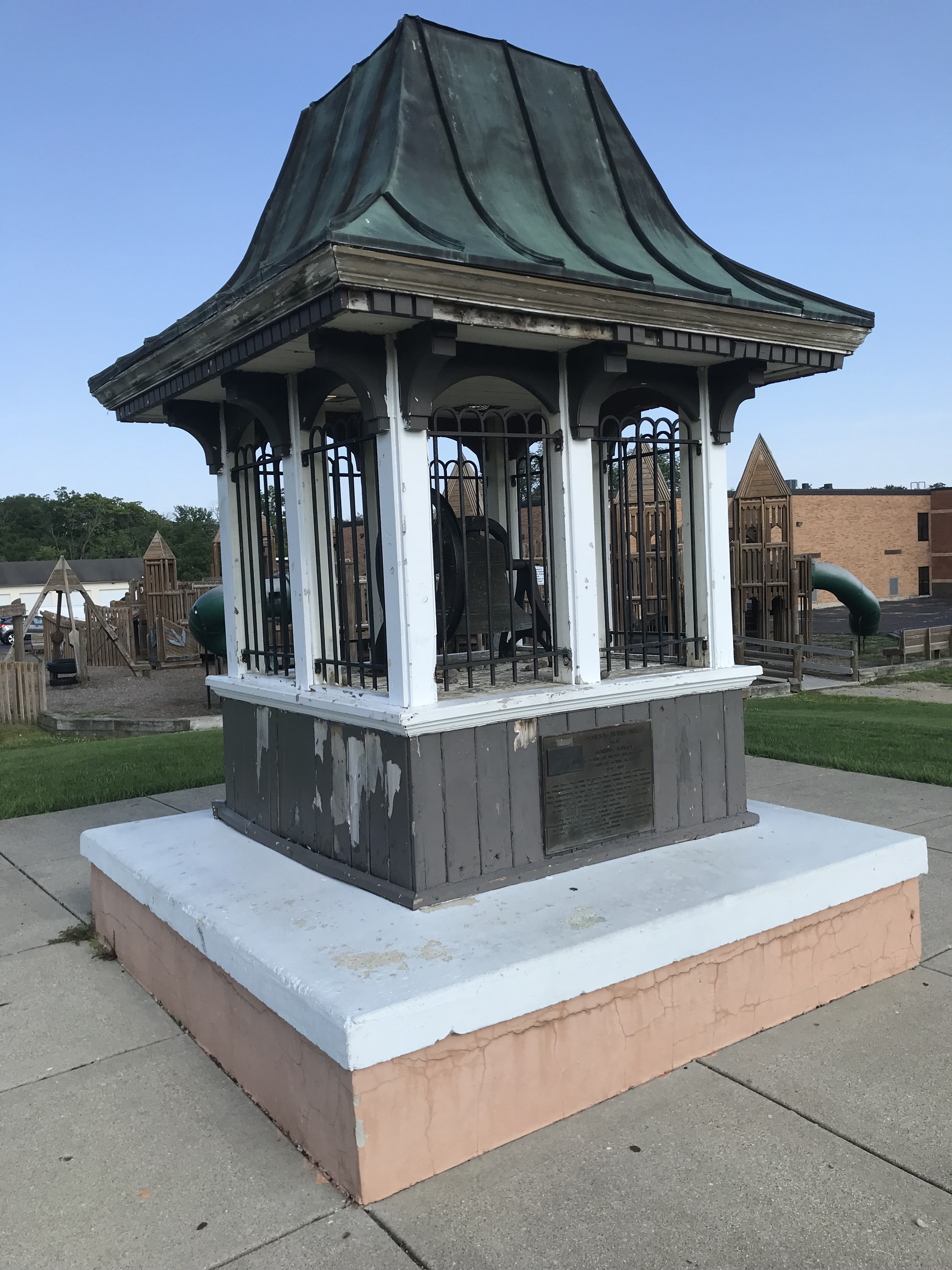


The 1881 bell of the Mokena Public School in its current home. 


   The bell still reposes there to this day, a small piece of one of the grandest schools Will County ever knew. It is the legacy of hundreds of Mokena children who attended class in our town in the buoyant days after the end of the Civil War, spanning the years until just before the start of the Great Depression. Their ways of life are today but a distant memory, almost lost in the haze of time. May this august iron bell serve as a permanent reminder of their stories. 

Sunday, July 9, 2023

Greater Treasure: The Story of the Semmler Family and the Mokena News-Bulletin, Part 4

   The News-Bulletin was also used as platform from which to defend the rights of others and stand up to bullies. With World War II in full swing in Europe, but still more than a year before the United States entered the fray, the summer of 1940 found no small amount of chatter swirling around Will County concerning spies and other nefarious elements. Joliet citizen Otto Ehtor, editor of a paper called The German-American, got mixed up in the hearsay, and the Semmlers came to their fellow newsman’s rescue. In a long article called “Don’t Believe or Repeat Everything You Hear” that appeared on July 12th, 1940, it was detailed that a “poisoned tongue whispering campaign” had leveled charges of Ehtor’s being involved with anti-American activity, and that he had even been taken into custody by the FBI. The reports were soundly quashed by the News-Bulletin, the Semmlers stating outright that “All the stories about him are idle gossip.” The column went on to explain that Ehtor had “ample proof that he has never been engaged in any subversive propaganda and he is 100 percent for his adopted country. There has not been one word of truth in the yarns broadcasted about him.”

     An even wilder tale was also making the rounds in the county seat, where one Paul Schoene found himself under attack based on his ethnicity. The German-born hotel proprietor was also supposed to be under the investigation of government agents who allegedly had found Nazi flags and uniforms in his possession. Speaking on Schoene’s behalf, the News-Bulletin printed that “This yarn was just one big lie from start to finish. Mr. Schoene has been a citizen of this country for many years and has always been a loyal American citizen, one whose integrity has never been questioned.”

    The column had the final word by gently reminding Mokenians “that a person’s good name and reputation, which has taken years to build up, can be blasted and ruined overnight. This is a sin none of us should be a party to. Jealousy, hate and loose tongues are the cause of ill-founded yarns…Let us be really and truly Americans in every sense of the word. Do not be a scandal or war monger.”


   Showing great foresight, Bill Semmler was a champion of the preservation of the old Denny Cemetery on the southern edge of Mokena. Bill had taken an interest in the historic site, then a forlorn, overgrown heap, as early as the World War I era, when he was still a young beat reporter for the Joliet Herald-News. Interred at the hallowed grounds were the remains of Revolutionary War soldier Charles Denny, whose original 1839 gravestone was weather-beaten and crumbling by the early 20th century. Applying valuable experience gained while securing a government-issue grave marker for local Civil War veteran John Van Horne, buried at Marshall Cemetery in 1909, Semmler helped to get a new headstone for Denny in 1916. The marker arrived in Mokena via the Rock Island railroad in the dead of winter, and was stored inside W.H. Bechstein’s grain elevator until the weather broke. Years later, Margaret would call the marking of Denny’s grave one of her husband’s proudest moments. The Mokena Garden Club set out to clean up the tangled mass of weeds and overgrowth in the old family cemetery in 1939, and the News-Bulletin was their biggest supporter. That Armistice Day, Bill was given the honor of bestowing a new name on the site, which thenceforth was known as Pioneer Memorial Cemetery.


Bill Semmler triumphant in Wolf Road's Pioneer Memorial Cemetery, a name bestowed to the old Denny Cemetery by him in 1939. 


   In the same vein, the paper was instrumental in causing the observance of Memorial Day to become a yearly occurrence in Mokena, where heretofore it had been an intermittent rite. At the early date of 1921, the Semmlers propelled local residents to action by publishing an impassioned column called “What About Memorial Day?” in which it was alluded that the neighboring communities of Frankfort and New Lenox could be counted on to have a full program, where “in the Mokena cemeteries lie soldiers who fought not only in the Civil War, but also in the Revolutionary War, and must their graves be allowed to be overgrown with weeds instead of flowers and with brush instead of flags just because we are too indifferent, or might we say not patriotic enough, to honor their memory?” 

   The next year, using flags and flowers procured by the Semmlers, the News-Bulletin sponsored a smart ceremony, wherein the local soldiers’ graves were decorated and various speakers were invited to town. It went over well, and starting in 1928, a regular program was carried out annually, with the Semmlers spearheading it. Later, the Boy Scouts helped ease the burden of their work, and while down the line the Mokena Civic Association took over the day’s activities, Bill Semmler still served in a place of honor as chairman of arrangements. 


   Perhaps Bill Semmler’s most enduring contribution to Mokena was his tireless activism for the improvement of Wolf Road, arguably the village’s most important thoroughfare. Much like those leading away from the heart within the human body, a vital artery is the lifeblood of a community, the vibrancy of a village depends on it, as do the livelihoods of the merchants therein. An impassable road spells stagnation and despair for any neighborhood, and no one was more aware of this than Bill Semmler. Through his resolute, unflagging work, Wolf Road went from a muddy path to a modern passage. 

    For much of Mokena’s early existence, what would later be known as Wolf Road was barely more than a rural farm lane, known as Marti Road after a family that farmed along it. Well into the 20th century, Bill and Margaret’s daughter Ada remembered how, in anything less than perfect weather, the road “was real muddy, rocky and tough.” Bill Semmler loathed these conditions with a passion, often risking getting morassed in Wolf Road while traveling north to Orland Park to collect news. 


   Thus began his personal quest to bring the road into modernity. Through his local networking skills, Bill was able to win over important allies in this drive. In his corner were Charles Hirsch, a cattle man and farmer along the road, and J.V. Hall, a neighbor to Hirsch who kept a small restaurant. Other influential friends of Semmler’s who pitched in to help were L.G. Bruder, a Chicago businessman and Mokena resident, and Emil Cappel, a local farmer who also served as Frankfort Township Highway Commissioner. Together these men, with Bill Semmler as their leader, formed the Mokena Development and Hard Road Association in the early 1920s.


   By December 1926, not only did the Mokena territory not have any hard roads to speak of, but it also had the dubious distinction of also not being connected to any. The Association held regular evening meetings at the village schoolhouse, and through much perseverance, succeeded in convincing property owners north of town in Cook County that the concreting of Wolf Road would benefit them. Through lobbying on their part, the neighboring county’s Board of Commissioners was persuaded to include the section of the road from 143rdStreet south to the county line on a paving program. 

   All things considered however; this new hard road still tapered off well north of Mokena. Bill Semmler and his fighters triumphed when a Will County bond was passed for the paving of the rest of the length through town. With the task ready to be completed, what the News-Bulletin later called a “spirited fight” broke out over which route the new road should follow. One local bloc supported the construction of a brand-new artery following a convoluted route from east of New Lenox, through Mokena along Front Street, then continuing further eastward until it linked up with Kean Avenue, or today’s Route 45. 

   Bill Semmler and by extension the News-Bulletin found this route totally unreasonable, and tirelessly promoted staying with the plan of completing Wolf Road south to the Lincoln Highway. In the words of his daughter Ada, in this period the entire project became a “political football”, with strife abounding between Mokena factions and the Will County Board of Supervisors, which ultimately held up the paving of the gap for several years. 

   Meanwhile, the first concrete was poured north of town on October 15th, 1930, and when the section was finished a month later, a special ribbon cutting ceremony was held at St. Mary’s Hall. Bill still worked to have the last segment from Hickory Creek south to Lincoln Highway finished, but the dust wouldn’t ultimately settle until the autumn of 1936 due to a property dispute of epic proportions with farmer Clarence M. Cleveland. 


   During the trying days of World War II, the Semmler family opened their hearts to the community and made sure that every local serviceman and woman had a friend. Partnering up with the Auxiliary to the William Martin Post of the VFW, they saw to it that every Mokena soldier, sailor or marine regularly received a free copy of the News-Bulletin. By Christmas time 1943 this operation had become so big, that area residents were flummoxed as to how the Semmlers were pulling it off. Many curious requests were coming in to the News-Bulletin wondering about the details, so a column that appeared in the December 17th edition gingerly said that an explanation had heretofore been held back as “we do not care for credit, our only aim and satisfaction being to know that our boys in the service of our country are receiving the paper and are enjoying it.” However, to satisfy its readers, the piece did go on to lay out how it was all done. Aside from the News-Bulletin, the Semmlers’ Orland Park Herald and Tinley Park Times were also being posted, and while there had been some reports of hiccups with delivery, generally the papers were finding their recipients. 

   In the very beginning of the effort, Adeline and Ada Semmler handled all of the addressing of the papers’ wrappers themselves, with some help pitched in by Margaret. As the project grew, this part of the work was taken over by local volunteers. On every Thursday evening, the papers would be packed into the addressed wrappers by more town volunteers, among whom were some patriotic Mokena children who gave their time to the effort. Ever thankful for their time, Margaret rewarded the kids with hot chocolate at the News-Bulletinoffice. The postage for all of the papers, no trifling amount, was taken care of by the village’s Auxiliary to the VFW. 


   At the conflict’s height, about 700 complimentary copies of Semmler Press’ papers were being sent to all corners of the globe, wherever fighting men and women from Mokena and the neighboring communities were located, be they well behind the lines or at the front. During the course of the war, touching thank you letters flooded Mokena for the Semmlers, many of which came enclosed with photos of the service people who wrote them. 

   On June 12th, 1943, Pvt. Sherwin Liess penned a note that partially read “Dear Mr. Semmler, This is the first I have written to you, although I should have done so long ago. I am now in North Africa and have received two News-Bulletins since I have been here. Altho (sic) they meant a great deal to me in the States, they mean so much more now.” On December 28th of the same year, Navy man and village trustee John Marti wrote from Mare Island, California. A few lines read “Dear Bill, it sure is swell when Tuesday comes around, for that is the day the Bulletin arrives. I always look forward to reading all the news from home town folks. You are sure doing a grand job for us fellows in the service, as it sure means a lot to us to hear what’s going on in the old home town.”


   By the time the autumn of 1944 rolled around, the News-Bulletin was reporting on service men and women so much, that it was beginning to push out other local news. On September 21st, Bill personally authored a column assuring readers that other news was still wanted, deeming “if the news rates first page, it will be put there anyway”, but kindly asked the neighborhood sports teams to simply summarize their games, as the scores were taking up too much space. It was signed “Yours for Victory and until our boys eat hamburgers in Tokio, (sic) Wm Semmler, Editor.”


   As the years and decades marched on, the paper grew exponentially, and by 1943, it could proudly boast a circulation of around 3,000 in eastern Will County. Meanwhile, the Tinley Park Times was doing so well, that it was necessary to open a separate office there in 1941. The publications of the Semmler Press had become such a time-honored institution that at the end of 1944, they were bestowed with the Certificate of Merit from the Illinois Press Association. 


   Bill Semmler lost a hard battle with cancer on June 8th, 1946, at the age of 59. Thence ended a chapter not only for the Semmler family, but also for Mokena. Upon the news of his passing being made public, tributes poured into town. Illinois Senator Richard Barr called Bill a “true American”, while Will County Clerk Joseph Hartley rued “I don’t know a man I thought more of than Bill Semmler.” Everett Cooper, mayor of Mokena, the scene of so many of Bill’s labors of love, said that “In Bill’s passing, the community has lost one of its most loyal citizens and a very true friend.” Obituaries for him appeared in papers as far off as Alton and Decatur, while on June 14th, the News-Bulletin itself dedicated most of its large front page to their editor in black-bordered reportage under the title 30, which in journalistic parlance, signifies an end. At the time of his passing, Bill Semmler was a member of the Illinois Press Association, the Cook County Publishers’ Association, the Lions Club of Frankfort, and was also the chairman of the Mokena Civic Association’s publicity committee. That year, he was also included in Who’s Who in Chicago and Illinois


William Semmler, circa 1945. He will be remembered by history of as one of Mokena's greatest residents.


   It was the final wish of Bill that Margaret take the helm as editor in chief of the News-Bulletin, which she faithfully did, maintaining “a good newspaper, worthy of fine American principles.” Running the publication was a herculean effort, so a managing editor, Oliver Gedeist, was hired by the Semmler family in early 1947. He was introduced to Mokena and the surrounding territory in a column of the paper, where Margaret reassured her neighbors of his journalistic bona fides, and kindly urged readers to co-operate with him. Showing the homey spirit of Mokena at the time, she invited subscribers to personally call her with questions and also wondered if there might be a house in town for Gedeist to rent.

   Soon after, Oliver Gedeist announced himself in a section of the paper, and well aware of his status as a new comer in the small town, warned Mokenians that he was bad with names. Gedeist was also acutely cognizant that he was following in Bill’s footsteps, writing that “In coming into this new responsibility, it is my purpose to carry the responsibility in such a way that the memory of William Semmler will be integrated in and be a basis for every business transaction conducted. The Semmler standard shall never be lowered.” And that he did, for week after week, the paper was the same quality as it always was. 


   Meanwhile, the News-Bulletin marched forward into the future. In 1947, an addition was added to the east side of the historic office to house two new linotype machines and a Miehle press. Business continued to boom, and another extension to the old place, this time on its northern side, was finished in the spring of 1953 to house a Duplex press. The new press weighed in at a colossal 13 tons, and took a pair of workers a month to install. Their labor was worth it in the end, for the new equipment carried an output of 3,500 8-page papers an hour. 


   As editor in chief, Margaret Semmler won well-deserved laurels for her work. After publishing a special souvenir edition of the News-Bulletin for the Mokena Homecoming in the summer of 1949, the Illinois Press Association bestowed upon her the Mate E. Palmer award for that year, while the next year she received the prestigious first prize from the National Convention of Press Women at Reno, Nevada. After decades of selfless service to Mokena, Margaret semi-retired in the spring of 1955, whereupon Glenn F. Logan of Joliet took over as managing editor. At this time, the News-Bulletin counted a circulation of about 3,500, and maintained a staff of ten.


Margaret Semmler receives an accolade in 1959. She dedicated her life's work to Mokena, and is remembered with reverence to this day. 


   Margaret Semmler ultimately sold the paper in 1958 to Kenneth Johnson, a Lemont-based publisher who put out that community’s Lemonter as well as the Lockport Herald. In addition to these publications, Johnson would also later found newspapers in Downers Grove and Naperville. In 1960, he set up the Frankfort Leader, and that year added Mokena to the News-Bulletin’s title. After continuing to print the News-Bulletin for most of the rest of the decade, Johnson sold his holdings to Field Enterprises, who in June 1969 merged the News-Bulletin and the other local papers into the Southwest Graphic. After having been in print for 50 years, no small feat for a publication with such humble beginnings, the last issue of the News-Bulletin came off the press on June 4th, 1969. Its front page contained stories touting the new Graphic and bemoaning high tax rates, and thus, when the reader finished the last page, it was the end of an era. 


   While staying in the hands of the Semmler family, the paper’s old office on Mokena’s Front Street would go on to house a cork company, and met an untimely end in the fall of 1977, when it was forever erased from the village’s landscape. Margaret Semmler spent her later years in a Joliet retirement community, always keeping her trusty typewriter at hand and surrounded by scrapbooks of her and her late husband’s achievements. She has gone down as one of the most influential ladies in Mokena’s history, and to this day, she hasn’t been equaled. She passed away on March 4th, 1988, having reached 98 years, the doyenne of the village. 


   The Mokena of the modern age, in all of its progress and improvement, is the legacy of the Semmler family and the News-Bulletin. The village owes their memory the highest attention and devotion. As we honor our history, the work of the Semmlers has become a Rosetta stone to the village’s past, without whose long efforts over the decades, this chronicle would be dark and uncharted. Through the News-Bulletin and their passion for Mokena, the Semmler family’s achievements have brought them immortality. 


Sunday, July 2, 2023

Greater Treasure: The Story of the Semmler Family and the Mokena News-Bulletin, Part 3

   (be sure to read Part 2 of this story, posted last week!)

  The News-Bulletin was no small town gossip rag. Aside from covering all local happenings, it also carried four or five serialized novels a year, as well as national and international news illustrated with photographs. A representative example would be a piece that appeared in an August 1931 issue that showcased the construction of the Empire State Building.

   Zesty flavor came from numerous bits of humor that appeared in the News-Bulletin’s pages, such as an early series of columns called People of Our Town, which lampooned various personalities found in rural communities. Characters such as the irate reader, a “man who has found something in this paper that he doesn’t like” who is “going around to bawl out the editor” were highlighted. Also featured was the “classy loafer”, who was “waiting for a good job to turn up, when he is going to blow this hick town.” Another piece of whimsy was “Stille Nacht”, a re-printed column that appeared in the June 21st, 1929 issue that not only pastiched two men looking for a speakeasy, but was also partially written in German. 


This dapper fellow appeared in the People of Our Town column, a parody of various characters to be found in a typical small town of the 1920s. 


   In December 1924, the Semmlers ushered in a column called The Clearing House, in which Mokena residents were encouraged to write in to the paper and share their opinions on issues of the day. The zeitgeist of the era springs forth from these columns, in which townspeople voiced their views on the prohibition-related crime wave that plagued the countryside around Chicago, decrying everything from hard roads which made “escape very easy for the bandits in their high powered cars” to mail-order guns which “often times arouses some cracked brain nuts to start on a hold up career.” Bootleg liquor also stood in the crosshairs, which in the words of one village resident, was being sold to “weak minded fools to drink and kill themselves with.”


   At the end of the 1930s, a series of fictionalized letters were printed in the News-Bulletin under the title Uncle Hy Says. These had a lighthearted humoristic bend, and were loaded with political jabs and inside jokes about Mokena business people. In the same era, a thinly veiled editorial column named Bugle Calls existed in the form of pieces written under the nom de plume of Zeb Potter. Another column called Voice of Vox Pop appeared with some regularity. In a March 17th, 1939 piece dripping with local satire, one “Back Alley Spike” wrote “Boy, oh boy, Mokena has a real crisis. Europe has been hogging every crisis, but now we have one right here… Why, it’s the biggest scandal since Hitler took Austria!” The piece went on to parody stodgy Mokenians whose feathers were ruffled by a political new comer running for local office, with the monikered author glibly adding “Why, the nervy young so-and-so, he hasn’t been living here 75 years yet.”


   The true flavor of the News-Bulletin came from the great American tradition – the snide letter to the editor. An early example of towny salt was the communication printed by the Semmlers in July 1921, in which a resident complained about the less than optimal condition of village streets, a subject that would later prove to be a big one for Bill. The writer asked “What are the streets of Mokena for? Are they a garbage pail?” and admitted that “my temper gets the best of me when I have to drive my clean machine over egg shells, muskmelons and lemon shells, corn husks and muddy slop holes…” Referring to Bill Semmler’s status as village clerk at the time, the anonymous writer threw a barb his way when he snarled “Say, Mr. Editor, maybe you will scrap this as you are a member of this board, but if you do, there are other papers.”


   The many letters received by the Semmlers weren’t all grumbly, many were laudatory. Typical were the words sent by John H. Cappel of faraway Mattoon. Cappel had spent his formative years in Mokena, and like Bill, could trace his heritage to the founders of the village. In March 1926 he dropped a line to the News-Bulletin office reading “I want to congratulate you for the good paper you are putting out. As I enjoy reading of the old hometown very much, I can hardly wait until the paper comes…The people of Mokena and vicinity ought to be proud of the paper you publish.” Closing on a touching note, Cappel wished “that you may prosper in your work, is my prayer.”

   Another representative bouquet came by way of an unidentified writer to the Joliet Spectator in 1939. In what surely must’ve left their editor a touch confused, the correspondent breezily complimented the publication only then to quickly heap praise upon the News-Bulletin, expressing “I like our Mokena paper. It is a well printed and newsy country weekly, far above the average country weekly in get-up and print. I want to congratulate the editor of the Mokena News-Bulletin for his fine paper. ”

   The Semmlers also received a bouquet from none other than the Chicago Tribune. During the euphoric period immediately after the end of the Second World War, Norma Lee Browning of the prestigious publication found herself in Mokena, vividly profiling local residents and life in the village. Upon examining the News-Bulletin, she declared that “its make-up has dignity; its reportorial style has a cosmopolitan touch.” 


     Mokenians used the News-Bulletin as a forum to quash rumors, the bane of small town existence. A wave of malicious hearsay that had been spreading in the area regarding farmer George Hauser induced him to write to the paper in the spring of 1933. Facing foreclosure on his farm, he wrote “I would like to get a few lines in the News-Bulletin and let the public know the truth about the gossip that has been going on about me.” Addressing each piece of the story individually, he eventually came to the nastiest part of the episode. Hauser stated “There was also some gossip being circulated that I threatened a shooting and this is a lie. I did not come from fighting stock.”

   Those who were on the starting end of hearsay also got a chance to speak.  During a period in October 1924 when some burglaries had recently taken place in town, hardware storekeeper Milton Krapp sold some keys to residents Peter Homerding and Aloys Perschera. Finding the purchases suspicious, Krapp tipped off village constable John Frisch. Later realizing his mistake, the shopkeeper wrote a note to the newspaper, which reprinted it on the front page under the heading “An Apology.” Explaining what had happened, the Mokenian made his realization clear that the event had “cast a serious reflection on the characters of both Mr. Homerding and Mr. Perschera, and as they are entirely innocent in this matter, I hereby publicly extend my apologies to them for the statement that I made to Officer Frisch concerning them.”


   Bill and Margaret Semmler weren’t simply journalists reporting the news, they were also arguably Mokena’s most passionate advocates, who used the News-Bulletin to lift the community in every way. A long column published in the February 11th, 1921 issue called “What Can Mokena Do?” addressed a shortage of housing in the village and a general sense of stagnation that had crept in. Bill penned the piece, which cheered “Mokena would have a future if everyone got together and pushed” and “Let us see how some small improvements can be made, which will lead to bigger ones.” While warning that “out of date customs do not work anymore”, he devotedly pushed for development, patronizing local businesses, and keeping up the town bandstand at Union and Third Streets.


   Bill Semmler’s editorials leapt off the page and forced the reader to take notice. In reading them, one came to see that his heart beat for Mokena. In response to later accusations that his paper was favoring the advancement of other nearby communities, Bill authored a front page editorial called “Mokena Needs Co-Operative Boost.” Appearing in the April 15th, 1926 issue, Semmler defended his stance that “The News-Bulletin always stands ready to boost any worthy project or undertaking that is for the betterment and welfare of any community, and to knock everything that knocks the town.” Coming straight to his hometown, he said “This town has the finest opportunity in the world to become one of the best towns along the Rock Island, but whether it does or does not, all remains not with its citizens, but with its business men!” Calling on Mokena’s tradespeople to band together and promote commerce in town, he also declared again that “The old petty jealousies that have dominated Mokena for years must be eradicated before the village will progress. At present we have too much of that old spirit. It doesn’t pay to nurse this spirit. Cut it out and let us all work for one goal – the upbuilding and progress of Mokena.”


   Another editorial, which appeared in the September 7th, 1928 edition, addressed a particularly prickly issue. A piece was printed detailing how some town boys had been caught in the basement of an abandoned Front Street building, allegedly in the act of setting it aflame. The young men later turned up at the News-Bulletinoffice down the street, claiming that they merely had the misfortune of being found with a kerosene lamp in their possession, and that they’d been spinning their wheels in the community, with nothing to do and nowhere to focus their energy. Titled “Youths Present Social Problem”, the subsequent editorial on this matter said “The fact of the matter is these boys are RIGHT…The youth of today will be the citizens of to-morrow. The old idea that a boy or girl must sow their wild oats is all the bunk….Let us wake up and do something for the youth of our community.”


(Stay tuned for the final part of this story!)

Sunday, June 25, 2023

Greater Treasure: The Story of the Semmler Family and the Mokena News-Bulletin, Part 2

 (be sure to read Part 1 of this story, posted last week!)

   When the Joliet Weekly News and the Joliet Herald became one in 1915, Mokena residents noticed immediately that the subscription for the new paper was a heftier price than that of the old News, and by and by, takers of the publication started to drop off the rolls. Local folk, who recognized Bill Semmler’s natural talent for scouting out newsy morsels, encouraged him to start his own sheet, and thus, in an extraordinary moment, sprouted in Bill’s mind the first seed of the idea to start his own newspaper that would serve the Mokena area. 

   In neighboring Tinley Park, businessmen who had enjoyed his coverage of their neck of the woods during his time with the News floated the idea of starting a stock company to help Semmler get a paper started. No small amount of money was raised in this endeavor, and Bill even looked over real estate there to house an office, but America’s entry into World War I threw a wrench into these plans, and they came to naught. At this point, he re-shifted his attention to Mokena, his hometown. 


   While the Mokena of this era was a small, rural place mustering up around 500 residents, it also boasted a rich journalistic history. The village’s first newsperson was a plucky 18-year-old named Julia Atkins, whose handwritten broadsheet, the Mokena Star, appeared in 1852, as the community was barely more than a handful of buildings along the newly built Rock Island line. The Mokena Advertiser was another early publication, helmed by Charles Jones, another young editor, from 1874 to 1877. At the same time, town correspondents using romantic monikers such as Bluebeard, Cupid, and Euripides sent in news to the Joliet papers, while in the 1880s, the Mokena Commercial Advertiser was printed in Lockport. 


   The Joliet Weekly News, and later its amalgamated form, the Joliet Herald-News could be counted on for Mokena reportage, especially under Ida Kiniry’s and later Bill Semmler’s tenure as contributors, but local columns were painfully short during the World War I years, often being edged out by news from the county seat. In this era, residents of eastern Will County found themselves without representation in the press. When the war ended in 1918, the question of a new, Semmler-led local paper started up anew in Mokena. A few town business people, such as auto dealer Elmer Cooper, harness maker Albert Hellmuth, insurance man Ona McGovney, as well as the Frankfort Grain Company and J.C. Funk of Tinley Park put their money where their mouths were, and promised their support in the form of advertisements. 


   The idea to forge ahead with a new publication was set into motion. As Bill and Margaret Semmler brainstormed what to call the paper, Mokena’s businesses were lined up on Front Street, with the Semmler print shop being a near neighbor to all. Among them were two blacksmiths, a feed shop, a livery stable, and three general stores. A grain elevator stood near the busy Rock Island depot, and Bowman Dairy maintained a milk bottling plant on Marti Street, the community’s main north-south thoroughfare. A two-story schoolhouse stood on the east side of town, while four churches provided for the spiritual and social life of the village.  


            So appeared Mokena on the eve of the debut of the Semmler's new publication. This view of Front Street looking east dating from the 1920s shows the pharmacy of Richard Hensel, which stood for years at today's 11112 Front Street. 


   Things started off modestly in the new concern; or as the Semmlers would later more candidly put it, on a “shoe string.” As their first issue was about to see the light of day in August 1919, its letters were set by hand at the Front Street office, after which the type forms were gently wrapped in paper, and then bundled into a suitcase. Bill and Clinton Kraus, a 15-year-old neighbor, hauled the luggage onto a Rock Island accommodation bound for Blue Island, some 13 miles distant. Once there, the two Mokenians took their cargo up a steep hill to an old press on Western Avenue, ownership of which Bill had recently come into. To their fortune, the press would eventually make its way to the printing office in Mokena, alleviating the drudgery of having to make repeated trips to Blue Island. Once all the newspapers had come off the rollers, they were brought back to Mokena via a return train, and addressed at the Semmler house. 


The Mokena office of the News-Bulletin, seen circa 1925. The historic building stood at the site of contemporary 10842 Front Street. (Image courtesy of Richard Quinn)


    On August 21st, 1919, the first issue of the newspaper was born to the world, bearing the heady title of the News-Bulletin. In a reflection of the epoch in which it was born, the News-Bulletin triumphantly heralded the return of Mokena boy Alfred Hatch from Germany, where he had been stationed with the Army of Occupation. In other happenings of the post-World War I era, the new paper eagerly reported that the village’s Camp Fire Girls had raised enough money to support a French orphan. 

   A week later, when the second issue landed in the hands of its subscribers, its front page held the flavorful story of Fred Steinhagen Sr., an irate Mokena farmer who had been arrested for firing a revolver at local baseball players, whose fetching of errant balls on his property he interpreted as trespassing. News from the neighboring communities of Frankfort, Marley, Matteson, New Lenox and Tinley Park was also included, along with farming and household tips, as well as some jokes thrown in for good measure.


    Composed of eight pages, (with five columns to a page) it could all be had for $1.75 a year. Those first editions of The News-Bulletin had about 200 subscribers, however, by the end of 1919, the Semmlers had upped their numbers, counting a whopping 900 people in Mokena and the surrounding territory. The dramatic uptick was due to a subscription drive brainstormed up by Bill and Margaret, the grand prize in which was a $900 1920 Overland touring car, the same ultimately being won by Mamie Kolber of Mokena. In a model that was kept up for a goodly portion of the publication’s existence, news was gathered by calling local families and outright asking for it, it was also asked for in the pages of the paper itself, reminding readers early on to “Send in your news items. We went them all. Perhaps you entertained company, know of a party, of a visitor from a distance, an accident, a social affair. All these things make good news items. Just bring or send them in. By doing so, you will help to make this paper a real spicy sheet.”


    By August 1921, the price of a yearly News-Bulletin subscription has gone down slightly, and would cost a reader $1.25. Touting the new price, and knowing full well that issues were being passed around Mokena from person to person, the Semmlers wrote that “…a paper is like a woman. Every man should have his own and not run after his neighbor’s.” The early period of the News-Bulletin’s existence was a tough one for the them, full of trial and tribulation. In their own words, it was a time when “the waves were high and the sea rough.” Their enterprise faced open animosity from select Mokena business people, and for reasons known only to them and lost to time, a handful steadfastly refused to advertise in the publication’s pages, who with a surly mien made it known that Mokena did not need its own paper, and openly urged Bill to quit. 

     The Semmlers also had to take on no small amount of debt to get the News-Bulletin off its feet; this being something that they were still wrangling with five years after the first issue came off the press, when Bill wrote that “everyone he is indebted to will be paid in full with interest to boot.” At this point in the paper’s young life, it missed its only issue. Due to a strike involving the Western Newspaper Union in Chicago, a supply of newsprint failed to make it to Mokena on time. The arbitration dragged on for a few weeks, but after having had his fill after the first week, Bill went to the city himself and scrounged up a supply of paper, which he carried back to the village wedged under his seat on a Rock Island train. After this episode, and having learned their lesson, the News-Bulletin office began to regularly carry large supplies of it.


   Bill and Margaret Semmler were the brains behind the News-Bulletin, but they had plenty of help from technology. An invaluable machine called the Line-o-Graph made its debut in Mokena on the last day of 1919, and while it wasn’t actually up and running at the office until January 6th, it revolutionized the Semmlers’ ability to print the news in town. Where the work of composing the paper’s type was once done by hand, the Line-o-Graph now did it mechanically. In showing off the contraption in the pages of the News-Bulletin, the Semmlers noted “We do not believe in boasting, but the fact is that this machine is a boost for the News-Bulletin, as it gives us fine equipment, such as is seldom found in a small town.” 

   For all the good it did, the early days of Line-o-Graph ownership were a source of a seemingly never-ending stream of vexation. One headache that cropped up were complications with the machine that resulted in the January 16th, 1920 edition coming out late. In an apologetic blurb, Bill wrote that he “felt much aggrieved that the delay had taken place” but then proudly stated that “we have now tamed the wild animal.” The new publication got another boost up when a two magazine Mergenthaler Linotype machine was installed in June 1923, it being a more prominent relative to the Line-o-Graph.


A 1923 view of the Linotype, a vital piece of equipment in the Semmlers' shop.


This depiction of the family's press appeared in a 1925 edition of the News-Bulletin.


     A major technical annoyance for the Semmlers was their old Diamond cylinder press, a contraption they loved to hate. In 1925, Bill wrote that it was behaving “like a balky mule” and that it could only be operated “by a wizard and hypnotist”, before adding that he “had lost much patience and religion in wrestling with this demon of a press.” 


   Another advance occurred in March 1925, when a new cylinder press, a Century Two revolution model, was set up at the Front Street office. This marvel was able to produce about 2,700 impressions in an hour, which saved the Semmlers and their employees much time, cutting their final production time in half. Prior to the installation of this machine, it would take almost five hours to print a run of the News-Bulletin, but with the new press, it came down to an hour and a half. 


   For a period early on, the Semmlers employed an assistant editor, having hired E.E. Turrentine in May of the paper’s first year. Things were still wobbly as the publication tried to find its footing in Mokena and the surrounding area, with more delays in publishing and a piece on the front page of the May 14th, 1920 issue that lamented the News-Bulletin “has had a thorny path to travel on account of a shortage of help” and also vaguely noted “some dissatisfaction among the subscribers.” In an instant, it looked as if everything might literally go up in smoke, when on August 6th, 1920, a freak gasoline explosion erupted in the paper’s Mokena office. For a few panic-filled moments, the situation looked utterly hopeless, but through the quick-thinking bravery of some neighbors and Bill’s mother Catherine, who lived in the rooms adjoining the office, the flames were tamped down. In a piece on the fire that appeared on the front page of the following week’s paper, Bill soberly described himself as having been “enveloped in flames” and having to beat the fire out of his clothes. Assistant editor Turrentine was unlucky enough to have his foot burned and back wrenched when the explosion, in a close call, wedged him between the Linotype and the cylinder press. All of that week’s news from Frankfort and New Lenox was lost in the blaze. In talking about the incident in the News-Bulletin, the Semmlers humbly thanked everyone who helped rescue them and their property.


   Being headquartered in a historic building had its share of problems, too. One was flooding, which occurred in the old cellar under the structure. On one occasion in March 1922, a clog in a drain caused fourteen inches of rain water to stand in the basement, requiring Chief Herman Schweser of the Mokena Fire Department to blast out the obstruction with the village fire hose.


   By the mid-1920s, the News-Bulletin bore the slogan “Cussed by Some – Discussed by Many – Read by All.” While the publication had a comfortable number of subscribers, all was not a rose pedal path for the Semmlers, as their straightforward sense of local journalism sometimes incurred the wrath of certain readers. A classic example would be the blistering fallout that reared up in the aftermath of a Prohibition era raid. In October 1930, a tip had reached the Will County state’s attorney that illicit booze could be had at a Mokena ice cream parlor, and when special investigators came to town, they discovered almost five jugs of moonshine and two barrels of beer on the premises. Edward Martie, a village trustee, future mayor and father of one of the shop’s owners, “grew violently angry” that his son’s name was published in connection with the police action, and “threatened dire vengeance” on Bill Semmler. In detailing efforts that had been made to cover up the news, Bill wondered on the News-Bulletin’s front page if Martie “favored the suppression of all news bearing on liquor raids, or does this suppression only apply to favored individuals?” while also stating that “Those who engage in illegal business must expect to stand the consequences.”  

     Another occurrence was particularly ugly. In the spring of 1931, when local tempers boiled over an issue regarding the installation of a central sewer, an unknown party attacked the News-Bulletin’s office under the cover of darkness and painted the windows yellow. In a front page piece on the incident, the Semmlers asserted that “dirty politics are being resorted to” and also that they knew who was behind the lark. Referring to the guilty party, it was written that “the opposition hates publicity, and because this paper dares to print the facts, they go around saying that only lies are being printed…” It was declared that the paint would stay on the windows until after the coming village election. 


   As the News-Bulletin’s readership grew, it could be solidly depended on for stories not just from its Mokena home, but also for the neighboring villages of Frankfort, Marley, New Lenox, Orland Park and Tinley Park, and sometimes even carried items from Green Garden, Homer, Matteson, and as far afield as Oak Lawn. Interestingly, by the end of the summer 1921, the paper counted at least one overseas reader in Germany. William Hoffman, a farmhand who had worked for Mokena brothers Charles and Julius Hirsch, had returned to the land of his birth and was receiving the publication there. In a happy letter back to friends in the village filled with no small amount of pride for his adopted community, Hoffman wrote that he “is very glad to get his home paper, greatly enjoys reading it and in showing it to his friends.”  


   This ability to drum up news from nearby communities was a keystone to the Semmlers’ success. In conjunction with the News-Bulletin, the family went on to found several other newspapers in Eastern Will County and Southern Cook County. One, the Tinley Park Times, was born in 1925, when business people and residents of Tinley Park began “clamoring for a paper of their own.” The community had long standing ties with Bill Semmler, having asked him to work there as early as the World War I era. The Times was so successful that the family opened a printing plant in the town in the spring of 1941. Another jewel in the crown of Semmler Press was the Orland Park Herald, which debuted in 1926. In terms of layout and content, these publications were very similar to the News-Bulletin, with the articles on the front page being swapped for eye-grabbing happenings of each respective community. 


   As the years carried on, the News-Bulletin became a Mokena mainstay, and as the country entered the Great Depression, the Semmler family and their publication were able to keep their heads above water. Reflecting the dark economic situation in the country, the columns of the paper charmingly noted in October 1931 that they were able “to help relieve the depression to a small degree” by remodeling and expanding the printing plant attached to their Front Street office to its new dimensions of twenty by forty feet. The News-Bulletin got a leg up on the afternoon of January 18th, 1933 when it, along with the Orland Park Herald and the Tinley Park Times, were boosted over the airwaves of radio station WCFL of Chicago. Bill himself gave a “community talk” on each of the communities served by these publications, which was in turn accompanied by a musical presentation. 


   The News-Bulletin office in Mokena was a veritable hive of activity. In addition to the newspapers that rolled off their machines under the umbrella of the Semmler Press, the family also continued to take on general printing work. In August 1940, after being in business for exactly 21 years, a column noted that “today the shop of the News-Bulletin is a busy place. Three weeklies, one bi-monthly, and two monthly papers are printed here” while also proudly stating that they could take on color work as well as the traditional black and white. At that time, the nearly 100-year-old building was home to a cylinder press, two jobbers, a casting box, stitcher, large paper cutter, electric saw, an addressing machine, and “loads of metal and wood type.” 


One of the most influential figures in the history of Mokena, Bill Semmler is pictured here at work in 1941. May his memory live eternal.


   While Bill Semmler’s name appeared in almost every issue as editor, the contributions of his family members to the News-Bulletin can’t be overlooked, for Mokena at large was lucky to have in its court three women who gave their all to the paper. Margaret Semmler was essentially the paper’s co-editor and her husband’s equal in the publication’s composition and management, for many years maintaining the social pages.  Referencing the famous editor of The Washington Post, another reporter would years later sublimely call her “the Katherine Graham of Mokena in her day.” 


   Starting in her teen years, Bill and Margaret’s daughter Adeline learned to operate the vital Linotype machine, while her sister, Ada Semmler, who felt timid around the printing plant’s loud, clanking presses, handled things in the office. On Thursday nights, getting the week’s paper ready for its Friday publishing date was a family activity. Reflecting on the late nights spent with tricky machinery, Ada would later say that “If all went well, we would go home around midnight! If not, it could take until 2:30 a.m. to finish.” Her mother Margaret also wryly wondered why they needed a house when the whole family spent so many nights toiling in the office.


Adeline Semmler in 1938.


A 1938 likeness of Ada Semmler.


(Stay tuned for Part 3 of this story!)