Sunday, May 15, 2022

Unwanted Visitor: The Cruel Case of George and Emma Klose

   It’s the story of a Mokena family. An elderly brother and sister who should’ve been living out days of peace in the sunset of their lives, when they were visited by a heinous crime, one that garnered headlines around Will County. The long timeline of our village’s history is flecked with dots of unsavoriness, which can be found if one pulls back the covers and knows just where to look. On the record of the years is the deadly 1864 riot, the 1926 murder of sheriff’s deputy Walter Fisher, and even the robbery of the Mokena post office in 1937. One that might very well join this nefarious list is the Emma and George Klose case of 1962. 

   The family at the heart of this event, the Kloses, were an old one, one that stood for all that was upright. They were rugged, hardworking farm folk; sons and daughters of the soil, who were a vital part of the social fabric of old Mokena. Patriarch Louis Klose first showed up as a middle-aged man within the borders of Frankfort Township by way of the Kingdom of Bavaria. Ours was a neighborhood were many of his fellow countrymen had already made their home, and while history has kept from us the exact date in which he first set foot here, all indications are that it occurred in the 1850s, roughly congruent with the time Mokena was born in 1852. At some point between his arrival in our neck of the woods and 1860, Louis Klose carved out a home for himself on a tract of land bisected by the new Chicago, Rock Island and Pacific Railroad in the northern reaches of the township, at a place that years later was known as the southwestern corner of Route 45 and 187th Street. 


   Over the years, while in the hands of subsequent generations of the Klose family, this quaint farm established by their forebear would come to encompass over 127 acres. As history would have it, by and by the geographical region in which the Klose estate found itself came to be called Summit Hill, in reference to its elevation relative to the rest of the township. In time, the large farm came into the hands of Louis Klose’s son John, who married Philipena Mast in 1871, the daughter of another long-established family. Like his father, John was a native of Bavaria, where he was born in 1850. The young Klose was brought to our environs as a four-year-old by his uncle Johann Zahn, who eventually would become an innkeeper in Mokena and no small figure in our burg’s narrative. 


   On his property northeast of the village, John Klose became successful raising livestock and running a dairy farm. He was an active Republican, served as a school director and was a member of St. John’s German Evangelical Church. He had a passion for horticulture, and transformed his farm into one of the most lush places in the Mokena area. He was called a “well-known, highly esteemed citizen of Frankfort Township”, while years after he passed in 1918, it would be said that “Mr. Klose had many friends in this part of the state who have the kindest recollections of him.”


   Any recounting of this pioneer family would be remiss not to detail the children of John and Philipena Klose. Their eldest was George, born in 1872, who never married and stayed on the family homestead. Next came Oscar in 1873, who moved to town around the turn of the 20th century and became our village constable, sporting a dashing uniform and patrolling the streets in the early 1900s. John Philip came onto the scene in 1875, he later married and ran a 100-acre farm of his own a little east of the old Klose place. Emma rounded them out in 1881. Like her brother George, she never married, and spent her days on the homestead with him. Emma Klose was possessed of a gift for music, and sealed her place in immortality by writing and publishing her magnum opus, the jaunty Mokena March and Two Step in 1910.


The Klose farm as it appeared in 1955. Route 45 can be seen in the right foreground, with 187th Street at the top of the image. Today this piece of land is the site of Thunder Bowl on Old LaGrange Road. 


   The apple didn’t fall far from John Klose’s tree with his children George and Emma, who inherited his love of plants and trees. They kept up the work he started, and in 1928 alone, George planted 50 evergreens on the property, while Emma was said to “devote many hours to her large garden of flowers and plants.” While the brother and sister lived pastoral lives, they were no strangers to crime. In 1914, a horse, buggy and double set of harnesses were brazenly stolen from their brother John Philip Klose farm, just a stone’s throw from theirs. All in all though, things were generally peaceful in their patch of Midwestern earth. The idyll was shattered on July 12th, 1962.


   On that terrifying, early Thursday morning, George Klose had already reached a respectable 90 years, while his younger sister Emma, was 81. The Route 45 the Kloses lived on in 1962 would be one completely unrecognizable to modern eyes. What is today a bustling suburban thoroughfare, was then a narrow road totally rural in character, rich in agricultural surroundings. Thick foliage in front of the Klose farmhouse shielded it to most passersby, which to the elderly siblings was a nice buffer from the outside world, but gave an upper hand to anyone with barbarity in his heart. 


   The first eerie red flag went up around 10 o’clock on Wednesday night, July 11th. A rap was heard on the Kloses’ door, and when Emma answered it, she beheld a stranger in the rain, who asked to come inside and out of the elements. Rightly spooked by the man, she refused to let him in. The episode appeared to be over, until brother and sister awoke sometime around 2:00 the next morning in great shock, when they found the same man in their living room. He was rather short; they estimated he must have been about five feet, three inches tall, who wore a long white coat that hid his body type. He was young too, looking to be in his 20s, with a round face.


   He preceded to squirt a bulb syringe in Emma’s face, dousing her with ammonia. She defended herself by knocking the device out of the intruder’s hand, to which he responded by punching the elderly lady in the face. The same treatment was dealt out to George, who was knocked down and suffered a fractured jaw in the attack. The intruder demanded to know where the money was from the farm’s sale. He was slow on getting the news though – the farm had been sold ten years before, and the money gained from the sale had long since been invested. Even as the two protested there was no cash around, the burglar refused to take them at their word, and tied them to a pair of chairs. 


   The stranger began torturing George Klose, “twisting and bending” his fingers back, until in desperation, the elderly man admitted that there was some cash in an upstairs safe. The thief found the small, antique contraption and threw it down the stairs in an attempt to break it open. That having failed, he was able to find the key and make off with the money inside, about $400, which in today’s figures would equal roughly $3,700. Adding insult to, quite literally, injury, he took the keys for a car sometimes driven by Emma and left the house. Here he encountered a hitch, for when he drove out of the yard, the back wheels sunk themselves into a hole, and try as he may, the car wouldn’t budge. The brutal bandit took off on foot, disappearing into the night. 


   The trouble had only just begun for George and Emma. They were left tied up, and after hours of struggling, Emma got free at around 6 o’clock in the morning. After untying her brother, she made the horrifying discovery that their phone line had also been cut. The 81-year-old, after having been roughed up and bound for hours, was forced in the early morning dew to walk to the home of Paul Smith. The only problem was, that Smith was on the same party line as the Kloses, so his phone was also out. He drove into Frankfort to the intersection of Routes 30 and 45, where he called the sheriff’s department, as well as a doctor and ambulance from a service station. 


   The shocking brutality of this episode was front page news in Mokena’s News-Bulletin, and was also written up in the county seat’s Herald-News, with both papers screaming the news from their front pages. Investigators from the sheriff’s office said the would-be yegg had gained entrance to the farmhouse by breaking the front door. As to the suspect himself, lawmen were tight-lipped to the press, cryptically noting only that the physical description given to them by the elderly brother and sister matched an individual from the neighborhood who had recently gone missing. Whoever he was, he was familiar not only with the layout of the farm and its surroundings, but also with the fact that the Kloses kept a dozen dogs on the place, and knew that they were not to be feared. 


   George and Emma were taken to St. James Hospital in Chicago Heights, where staff kept press photographers away from them. As far as the historical record states, no justice was ever served in this case. George Klose lived for a further five years after the brutal attack, reaching the impressive age of 95 before he passed in 1967, when he was joined by his sister Emma two years later. Both came to repose in their family plot at St. John’s Cemetery in Mokena, a burial ground that their family had been using for 100 years by this point. The last vestige of the Klose farm, its huge dairy barn, disappeared in the early 1980s. Let us remember Emma and George Klose not for the abhorrent act endured by them in 1962, but instead for the fact that they were a peaceful Mokena family, one who tilled the soil, as did their parents and grandparents at the same spot. They helped feed America, and turned their own corner of our community into one of its most beautiful places. 

Sunday, May 1, 2022

Down on the Corner

   It can be called the Times Square of Mokena. The intersection of Front and Mokena Streets is a place where countless town gatherings have been held; everyone’s been there, countless village residents pass through the intersection daily, and indeed, during the much-vaunted Christmas Fest parade, the crowd is thickest here. In the not-too-distant past, moveable letters would even be hung between opposite telephone poles here heralding the coming of big events in the village’s social calendar. Being such a prominent place in our community, it is naturally the site of no small amount of local history. A passerby’s attention is easily drawn to the old two-story Italianate house on the northeast side of the crossing, the old Blaeser building, indeed it’s been covered in depth on this page. Nevertheless, looking across the street to the southeast corner, we have another place that is rich in history. 


Steeped in local flavor, the southeast corner of Front and Mokena Streets has decades of local lore attached to it. 

   Cutting through the fog of ages, it can be seen that this corner has been part of the village since its earliest days, being charted as part of founding father Allen Denny’s first addition to Mokena in the first years of the 1850s. This lot, along with the few adjoining to the east, were spoken for at an early date by James Ducker, an Englishman who in 1853 established a general store in Mokena, it proudly counting itself as one of the first business enterprises in our newly born town. He came to prosper in our midst, and even though he moved his business to Joliet in 1874, the Ducker family still retained ownership of this property until just after the turn of the twentieth century. 


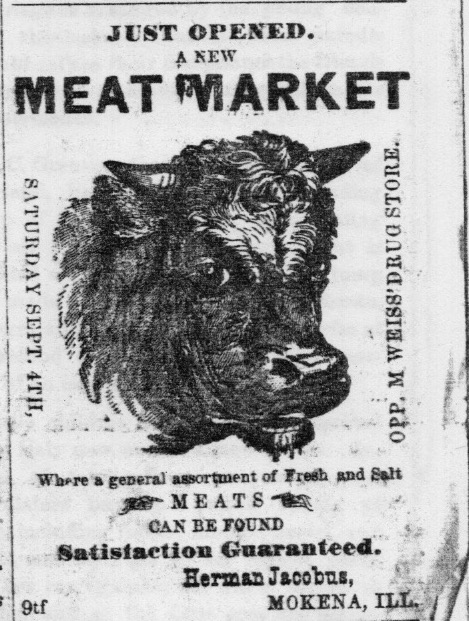
   Emerging through the blur of the past, a young man named Herman Jacobus is the first known entrepreneur to run a business on this corner. The earliest blip on the historic radar is an advertisement bearing the date September 4th, 1875 that appeared in an issue of the Mokena Advertiser that announced his opening a meat market here. The purveyor of “a general assortment of fresh and salt meats”, another insert from Jacobus appeared nearly a year later in the August 1st, 1876 issue of the same paper that further elaborated on his business, it talking of “smoked ham, bacon and summer sausage” while also promising cash paid for hides and tallow. 


An 1875 advertisement from Herman Jacobus,


  Before opening his doors here, the Prussian-born Herman Jacobus married Julia Scheer, a member of a well-known local family, in November 1873 at the German United Evangelical St. John’s Church, with whom he came to raise a family. Business hummed along here for Jacobus, and he found himself cited by the incipient Mokena Board of Health in the summer of 1883 for having excessive manure adjoining the hog pen near his slaughterhouse. Time has given us precious few details about life on this corner during Herman Jacobus’ tenure, and all signs indicate that he and his family packed up and left town at some juncture. 


   Painting a vivid picture of 19th century existence in Mokena is fraught with hurdles due to a lack of comprehensive records and thorough journalistic coverage, and as such the hazy early half of the history of this corner has left us with a mostly empty void until April 25th, 1892, when a disastrous fire, the scourge of our forefathers, struck the site. At the time, the building on the property housed the meat market of a Mr. Kennedy, and in reporting the blaze, the Joliet Weekly News bluntly stated that the fire was a “really bad thing for the village.” Having started between 3:00 and 4:00am, the conflagration began in the one-story property on the corner, and not only was it totally destroyed, but the flames jumped to a two-story frame building to the east, gutting it as well. The News described how “the whole town was quickly aroused” and that Mokena’s hand engine and a bucket brigade valiantly fought the fires and were able to save the rest of the village. 

   No one ever got to the bottom of what caused the fire, as was so often the case in those days, but most town folk figured it must have been the work of an ember from the funnel of a coal-fed locomotive. The loss of both buildings was heavy, and both were considered old landmarks at the time. The now vacant corner lot became something of a headache to the village dads, who in December 1894 notified Jeannette Ducker at her Joliet home that the hole where the building stood needed to be filled in, or at least fenced off. 


   The turn of the 20th century is remembered as a dark time in the annals of Mokena’s past. Various economical factors, such as the calamitous Panic of 1893, the worst financial crisis in our country’s history up to that point, had caused an exodus of local businesses and people, with a meager 281 residents being counted within the village gates in 1900. A rebound slowly took hold, beginning first in 1907 with the construction of Bowman Dairy’s milk bottling plant on today’s Wolf Road, along with the opening of Mokena State Bank two years later. An integral part of this bounce back was Dr. John J. Coady, who overturned a new leaf in the life of this corner in March 1911, when he had a cozy one-story building constructed on it. Measuring in at 16 by 32 feet, it contained the doctor’s office and a drug store. 


Looking southwest around 1909, this view shows the corner of Front and Mokena Streets shortly before Dr. Coady built his practice and drug store here. 


   A 37-year-old physician late of Iowa, Dr. Coady studied medicine at the Chicago College of Physicians and Surgeons, and upon his graduation in 1907, settled in Mokena. He was a medicine man of the old school, and made house calls to his patients by horse and buggy, which he often rented from the livery stable of Henry Stellwagen, further up Front Street. A reminiscence written years later said that “snowstorms, rain or blazing heat did not stop Dr. Coady when the sick needed his aid.” In the days after New Years 1910, he was so busy with measles cases that he couldn’t even stop to eat. 


   Dr. John J. Coady married Mokena girl Mildred Brinckerhoff in April 1908, and after having endeared himself to the rest of the town, the Coadys moved to Minooka in 1912, leaving behind the little building on the corner as their legacy. Before leaving our community, Dr. Coady opened an ice cream parlor in the drug store, which in time would come to be a popular meeting place for the players of Mokena’s crack baseball team. Before the doctor left town for good, he disposed of his practice and the drug store to another physician, Dr. Frank W. Searles of New Lenox. Even though Dr. Searles sold the building itself to Mokena State Bank cashier Frank Liess and local auctioneer Charles Moriarty in the spring of 1912, he kept up the pharmacy business here. It was by all means a modern one, as the physician had the place wired for electricity within a year, and had the honor of having a 240-watt lamp on the premises, which at the time, was the most powerful light fixture in town. 


   In the years between the world wars, this corner was home to various enterprises. One was the upholstering business of Albert Hellmuth, who counted no small part of his trade in the finishing of auto roofs, while others were a shoe repair shop by Fred Leonhardt in the 1920s, a small grocery store run by Burt Gillette, and the barber shop of Amos Bruns. In May of 1936, while hair was being cut here, John Yunker undertook some remodeling work on the building, having the place raised up and a concrete block foundation built under it, while an addition was tacked onto the structure’s east side, which was used as an apartment by the Bruns family. While all of these concerns were relatively short lived, Mr. Bruns would later establish a well-known and long-lasting restaurant in neighboring New Lenox. 


   After the long and rough years of the Great Depression and the Second World War, normalcy returned in 1945, and with that, another boom to Mokena. The village experienced an uptick in population, along with some new construction on Front Street. The old adage says that history repeats itself, and it did just that on the corner, for a new drug store opened in early 1946. However, before the first customer came, a new building was constructed. And thus, the modest old building from Dr. Coady’s day, at least the second to have stood at this spot, disappeared from the landscape. A local news report from November 1945 indicated that the old structure was moved slightly on the lot and incorporated into the new building, but in the same breath, Mokena’s most time-honored citizens remember the old edifice simply being torn down. 


   For the blink of an eye, Allan Cavett of Tinley Park kept shop in the new brick building on the corner, until Henry B. and Lillian Boleman bought the store in May 1947. Lately of Chicago, where he owned a drug store on the south side of the city, the 48-year-old Boleman was a native of Indiana and had learned his trade at Valparaiso pharmacy school. The Bolemans were perfect matches for our village, as were their daughters, Jeanne, Marilyn and Pat. The drug store on the corner was a very much a family affair, and every member had their time working there. The Bolemans resided in living quarters within the building, which housed a typical pharmacy for its time and place, which also included a soda fountain with the booths on the west side of the building. The pharmacy also boasted of a pay phone, one of only very few in Mokena in this era. Due to the drug store’s close proximity to the Rock Island tracks, it wasn’t uncommon for Mokenians to call the Bolemans to ask if a certain train had come through, but the family quickly got so used to hearing rumbling trains, so that they barely even noticed them. 


   After Henry Boleman’s untimely passing in May 1957, the pharmacy was still kept up by his family, with Pat Boleman bringing prescriptions to Allan Cavett in Tinley Park and then back to Mokena, all the while learning to drive along the way. The local business was sold on contract by the Bolemans to a pharmacist named William Geisler on December 1st, 1957, however he wasn’t in business here too terribly long, as he too passed in 1959. At this point Dan Kurber came onto the scene, and paid off the rest of the contract to Lillian Boleman in February 1960. Kurber found success on the corner, before moving further west down Front Street in 1966 to a brand-new building where he (and later his son) flourished for years. 


  Onward the timeline marched, and the red brick building underwent another transformation, this time from drug store to restaurant. In the 1960s, Ival (known affectionately as Doc) and Ruth White opened an eatery here, who will be fondly remembered by Mokenians of a certain age. In time the building would come to house a series of watering holes, counting gents such as Marty Clegg, Mr. Speedwell and Mel Weidner as proprietors, while in years later housing bars known as The Depot and St. Anthony’s Pub. 


  Meanwhile, in 2002, the building on the corner received a profound facelift, in which the entire structure was gutted, a new peaked roof raised up, and the old brick walls of Boleman’s pharmacy were sandwiched in fresh clapboard siding. In a masterstroke of reuse, the old place was given a new lease on life, and continues to stand triumphant today. Time has gifted modern Mokenians with 145 years of history here, and as the tides of time pass us by, we’ll have 145 more. 

Sunday, April 17, 2022

A Grave Mystery

    Who doesn’t love a good mystery? From the story of the Loch Ness Monster, to the riddle of extraterrestrial life, and even the puzzle of the Zodiac Killer’s identity, they keep us spellbound, whether they happened yesterday or over a century ago. While Jack the Ripper never prowled the streets of Mokena, this writer can do you one better, for we have a mystery in our own midst. We have to turn back the hands of time 83 years, to the summer of 1939, and set the stage at the historic Front Street office of our town’s erstwhile newspaper, the News-Bulletin.  

   That first week of August, the paper was being assembled for its publishing date of the coming Friday. Various stories were laid out for inclusion in the issue, such as taxes to be raised in Marley, a series of nasty car crashes in Tinley Park, and the loss of Mokena’s only ball field to a property transfer. One column easily bested all the others though, and it was the one on the front page labeled Here is a Deep Mystery. The family of William and Margaret Semmler, the paper’s proprietors, even used a special bold, attention-grabbing typeface for the headline that they rarely used. 


      On Saturday, August 5th, 1939, Local man Harry Barenz was busy on the Semmlers’ Front Street property digging a trench for a new cellar drain. He noticed something odd when the soil turned strangely soft after he had heaved through layer after layer of dark clay. As he stood in the five-foot-deep ditch, he noticed that the soft dirt was a mysterious dark shade that matched none of the others he had seen that day. As Barenz shrugged off the change and continued his work, he struck several pieces of wood. As he worked them loose, took them in his hands and picked off caked-on soil, he could tell that they weren’t pieces of root. Heavily rotten, he realized that one of them had a handle on it. A handle exactly like the kind used on old-fashioned coffins.

     This was something Harry Barenz couldn’t shrug off.


The office of the News-Bulletin on Front Street, the site of the mysterious grave unearthed by Harry Barenz in 1939. (Image courtesy of Richard Quinn)


     As a feeling crept over him that was probably a mixture of apprehension and curiosity, he kept digging, but this time a little more gingerly. Within a few minutes, he realized he was surrounded by pieces of something else. He picked up a brittle rib, some ancient pieces of leg bone, and fragments of what seemed to be a lady’s shoe, a type of antiquated square-toed shoe that hadn’t been popular since well before the turn of the twentieth century. 


    It became clear that in digging the trench for the new drain, Harry Barenz had happened across a grave. After also having recovered some large, rusted spikes and a few more planks, he hurriedly alerted Editor Semmler to his find. The two flabbergasted men examined the deep furrow that hugged the northwest corner of the News-Bulletin office, and seeing that there was more wood in the ditch’s wall, reasoned that Barenz had unknowingly broken into the lower side of the long-forgotten casket. Over five feet of soil sat on the rest of the coffin, and for the time being, Mr. Semmler decided not to have the rest exhumed. 


    The lot on which the bones were discovered in 1939 counts as one of the most historic in all of Mokena. Today the home of an apartment building at 10842 Front Street, local lore has it that a Hessian by the name of Johann Martin Heim may have built a small, two room house on that site as early as the late 1840s, predating the first plat of Mokena by several years. One of the area’s first German settlers, Heim ran a small store out of his home, and numbered the builders of the Rock Island railroad among his costumers. In 1852 he completed an addition to his home and opened a saloon. Due to the fact that Heim was Editor Semmler’s grandfather, many tales of happenings at the tavern have survived. As the Heim place became one of Mokena’s more well-known watering holes, members of the Semmler family later recalled that the building served as a hangout for Union soldiers during the grisly Civil War, and also a premiere ball location, where fiddlers serenaded boisterous parties that “ran into the wee small hours of the morning”. 


Pictured around 1870 in one of Mokena's oldest known images, is the saloon of Johann Martin Heim, who is visible in the doorway. This structure stood until the late 1970s, when it was removed to make way for an apartment building, which today stands at 10842 Front Street. (Image courtesy of Richard Quinn)


     Martin Heim seems to have run his saloon on Front Street until he died of pneumonia in 1886. Editor Semmler’s father, a Prussian cobbler by the name of John Semmler, worked from the building sometime after the turn of the twentieth century, and from 1919 until well into the 1960s, the Semmler family made the historic building the headquarters of our community’s voice, The News-Bulletin. In 1977, the old place was torn down, and Mokena lost one of its most meaningful landmarks. 


     By the time the mysterious grave was unearthed in 1939, ownership of the property had been in the same family for nearly 100 years. In spite of this fact, not one of the Semmlers had a clue who the fragile remains could have belonged to. In a special issue of the News-Bulletin twelve years after the fact, Margaret Semmler theorized that they could have been those of an early Potawatomi inhabitant of our area. While this can’t be ruled out, the fact that the bones were originally housed in a wooden coffin, and the presence of the shoe from a recognizable, yet heavily outdated fashion makes this idea improbable, as they reflect European American burial practices of the time.


      The earliest pioneers of what would later become Mokena didn’t always use organized cemeteries. At least two German families in this area used family plots on their farms, and it was alleged that a few children of early settler Tilford Duncan were buried in the vicinity of today’s Woodland Circle. To this day there are undoubtedly ancient graves hidden all over what is now Mokena, their exact whereabouts and the names of those within lost forever to the ages. 


     Maybe the bones uncovered in 1939 on Front Street belonged to a member of the Heim family? Interestingly, a check of congregation death records from the then-named German United Evangelical St. John’s Church revealed that a 12-year-old daughter of Martin Heim named Anna Maria died of rheumatism in 1875. While the remains uncovered in 1939 seemed to be female, they did not appear to belong to a child.  


     The cellar drain on the Semmler place on Front Street was eventually finished. Not quite sure what to do with the bones that Harry Barenz dug up, Editor Semmler displayed them in his office. Days and weeks went by. Summer turned into fall. The bones eventually faded into history and were lost. As a born reporter, Bill Semmler asked himself the who, what, and where about who was in the inadvertently discovered grave, but he never got any good leads. 83 years later, Mokena still hasn’t gotten any closer. In the words of the News-Bulletin, it has truly stayed a “deep mystery”. 


     However, it shouldn’t be easily forgotten that the grave wasn’t completely removed on that day in 1939. No evidence has since come to light that it was ever was, which leaves us with one question: Is it still there? 

Sunday, April 3, 2022

Stick 'Em Up: The 1924 Robbery of Mokena State Bank

    On dusty small town Front Street, the acrid smell of soot from coal-fed locomotives would have greeted a visitor to Mokena in 1924. Citizens doing business passed on the street, where every face was familiar and every personality known. The old Mokena State Bank, a beacon of stoic white Bedford stone and solid red brick, stuck out among a sea of wood frame buildings. Founded in 1909 by a group of influential Mokena businessmen, this institution came to reflect a rock of financial stability in the rural farm village. It was here on Tuesday, October 27th 1924, that one of Mokena’s most audacious crimes was committed. 

     At 31 years of age on that autumn day, Karl Krapp was a lifelong resident of Mokena and the bank’s assistant cashier. The son of one of the bank’s founders, Krapp found himself occupied with some bookwork behind the bars of his cashier’s cage. Perched atop a high stool, in his periphery he would have been aware of two men entering the building’s front door. In the matter of seconds, a .45 Colt pistol was shoved through the bars into Krapp’s face, and a brusque voice barked “Hands up!” The young cashier laughed at what he took for a mischievous joke, not an unexpected reaction in a small town where not much of note happened. Upon seeing the rage of the armed man when his order was not complied with, and that at least one of the men had a handkerchief wrapped around his face, Krapp realized the deadly seriousness of the situation. The bank was being robbed. 


     Also present in the bank at this time were local blacksmith Albert Braun and his brother-in-law Harry Peterson, as well as George Hacker, who not only was the bank’s cashier, but also served as Mokena’s mayor. Having held the small building in their firm grip, the two robbers herded Braun, Peterson, and assistant cashier Krapp into a rear room, where the bandits forced them to face a wall with their hands in the air. 

     The lead thief jammed his pistol into Krapp’s side and vulgarly threatened him as cashier Hacker was forced into the bank’s vault. Karl Krapp would later recall that the criminal’s weapon “felt like a cannon” and with his senses at their highest level of awareness, he expected a shot to ring out at any second. At the vault, bundles of currency were scooped into the second thief’s burlap sack; such was the robber’s haste that a packet of bills containing $200 burst onto the floor where it was abandoned.


Mokena State Bank on a better day. Pictured here around 1910 are, left to right, bank secretary W.H. Bechstein, John Cappel, cashier Frank Liess, and president Christian Bechstein. (Image courtesy of Richard Quinn)


    As quickly as they carried out their brazen task, the criminals bolted from the bank and into a large touring car, where three comrades awaited them, one of which was said to be armed with a shotgun. The auto disappeared as it roared westward down Front Street. The robbers’ loot equaled slightly more than $4,000, consisting of paper bills as well as gold and silver. Measured by the standards of today, the value of the heist would equal approximately $50,500.


    In the immediate aftermath of the robbery, Mokena and the surrounding countryside became alive with law enforcement personnel. After being notified by local telephone office manager Clida Deadmore, Will County Sheriff John Walker and deputies from Frankfort, Joliet, New Lenox, as well as Mokena took up the chase. Initially these men were unsuccessful in getting ahead of the robbers, until the tread of the getaway auto’s tires was followed in Front Street’s dust over rural roads to an abandoned farm outside New Lenox.


    Approaching the light brown touring car with trepidation, attending deputies found the auto to be devoid of life. Inside were discovered the empty billfolds of George Hacker and Karl Krapp, which had been snatched from them during the robbery, as was the handgun which had been employed in the attack. The thieves’ loot was nowhere to be found. Most ominously, more tire tracks along the dumped vehicle indicated that a second car escaped with the wanted men, from which all traces dissolved into oblivion. In a last attempt to nab the fugitives, two police German shepherds were used to track down the men.   While promising at the outset, the presence of farmers in the surrounding fields quickly threw dogs off the target scent. 


     The trail seemed cold until shortly after the robbery, when Sheriff’s Deputy Walter Fisher, a Front Street storekeeper, took George and Vernon Touzen into custody. Newcomers to Mokena and initially claiming to be brothers, Vernon supposedly had been held at gunpoint outside the bank during the raid. During questioning, he eventually confessed that his actual surname was James. Their kinship wasn’t the only part of their story to be bogus; a claim of being prohibition agents also fell apart under scrutiny.   


    Having made what were deemed “suspicious statements” about the robbery by our town newspaper, the News-Bulletin, James and Touzen were summarily locked up at the county jail. In their absence, authorities removed suitcases from their temporary place of residence in Mokena, inside which were found not only matching ammunition for the robbery gun, but also piquant letters from local girls. 


    The issue of James and Touzen intensified when it was discovered that the pair were known to be friendly with John Frisch, a Mokena railroad worker and the village’s constable. Many in town openly wondered about Frisch’s involvement in the robbery, as one of the suspected twosome had recently swapped pistols with him. So loud was the mistrust against Frisch that the Mokena Village Board was forced to investigate him until Deputy Fisher vociferously defended him, stating that James and Touzen had “pulled the wool over Frisch’s eyes as to their intentions.”


     As history notes, no charges were ever formally leveled against James and Touzen. There was simply no conclusive evidence, no smoking gun tying them to any involvement in the robbery of the Mokena State Bank. After their release from jail a short time later, James threatened to exact revenge on Deputy Fisher, and promptly disappeared along with Touzen into the untraceable void of time. 


   Mokena was a changed place after the heinous robbery, with all strangers looked upon with suspicion. An unknown face would be asked to explain his business in town, and if a satisfactory answer wasn’t becoming, would be hustled out of the village. The bank was quickly stocked with firearms, and the building itself was fortified. Within a year of the robbery, the cashier’s cage was completely surrounded with bulletproof glass, while all woodwork in the bank was backed with steel, not to mention the windows that got bullet resistant screens. The doors to the cashier’s space and the president’s office also got a treatment of steel, as well as an apparatus that allowed them only to be opened from the inside by means of an electric button. The directors of the bank weren’t about to take any chances on the supposedly bulletproof glass, and invited Deputy Fisher to give it a test. On the afternoon of Tuesday, November 24th, 1925, the deputy fired three rounds from his .38 caliber revolver into the glass. Not a single one made it through. The News-Bulletin was there, and noted that “the only effect on the glass was a whitening of the surface, same as seen on a piece of ice when it is struck.”


     Mokena may never know who was behind the robbery of October 27th, 1924. Loose ends existed that were never followed up on, and ringers for the crime were released without charge. What is sure, is that the crime resonated so deeply in the collective psyche of this sleepy railroad village of decades past, that it is still remembered with dread to this day. 

Sunday, March 20, 2022

The Currency of Time: The Early Days of Mokena State Bank

   Money makes the world go ‘round. While our streets have never been paved with gold, we’ve had a tidy financial institution within our village gates for well over a century that safeguards the treasures of our town folk. Weathering safe crackings, robberies, and global financial crises, it’s still with us to this day. What merged with the State Bank of Illinois in the first decade of the 21st century, was originally the Mokena State Bank, which found its beginning in the summer of 1909. 

   While the institution has been around for as long as any of us can remember, it is not the first bank to exist in town. 25 years before anyone even dreamt of Mokena State Bank, the Mokena Exchange Bank was on the scene. Time has not been kind, and the narrative of this institution has proven impossible to reconstruct through the fog of the ages. It’s hazily remembered that it was in the hands of father and son Ozias and Erwin McGovney for a time, and that future Mokena mayor and Chicago Board of Trade man Noble Jones was running it in 1882, when a failed attempt to dynamite the safe shocked the community. Sometime in those last two decades of the 19th century it went defunct, and nearly every trace of it was swept away by the ebb and flow of time. 


   At the dawn of 1900, Mokena found itself in something of a slump, with a mere 281 people living in the village proper at the time. Eastern Will County was still reeling after the nationwide Panic of 1893, which led many Mokena people and businesses to seek greener pastures. An increase in railroad commerce in the younger towns of Alpine, Marley and Orland Park that normally would have come our way also didn’t help matters, and neither did the lack of good roads in our neck of the woods. Starting in the autumn of 1907, Mokena underwent a rebound, first with the opening of the Bowman Dairy Company’s bottling plant on today’s Wolf Road, and then with the first inkling of a new bank in our neighborhood. 


   The roots of Mokena State Bank were planted as early as October 1907, when the state auditor issued a permit to Fred Ehlers, an enterprising merchant from Grant Park in Kankakee County, to form a bank in our village. Whatever his connection was to Mokena and his reasons for going into commerce here have long since been forgotten, but it stands on the historical record that he took three of our businessmen with him in the venture. However, the state of the economy was still a bit shaky at the time, and not totally conducive to establishing a bank, as William Semmler, Mokena’s correspondent to the Joliet Weekly News noted that a “financial stringency” was abounding in our midst. He went on to detail that “the people around here have not much faith in bank scripts and other bank paper money that is issued, so it is declared, will not accept any such money at any rate.” As such, the bank project went to sleep for a while. 


   It sprung back to life a little over a year later, when another mystery man came onto the scene. A Chicago attorney by the name of H. Gilbrath engaged himself promoting a state bank in Mokena. Over those last few weeks of 1908, the idea was looked upon quite favorably by village folk. Optimism was in the air, and in reporting on the developments for the Weekly News, William Semmler wrote 


“Our business people and prominent citizens, as well as dairy farmers have come to the conclusion that a bank in this town would not only greatly improve business facilities, but will also benefit the town, and as we hope, prove to be a stepping stone to future worthy enterprises.”


   Stock in this new institution was being subscribed for at such speed, that just before Christmas it was confidently declared that “For its size, the bank will be one of the strongest in the county.” The local investors set their calendars for their first meeting on Saturday, January 2nd, 1909. On a day filled with meaning, they chose 55-year-old Christian Bechstein as the first president of the Mokena State Bank. For many years a LaPorte Road agriculturist but lately a resident of the village, Bechstein had a seven-year term as mayor behind him when he took the president’s chair. He remained captain at the bank’s helm until the day he passed away in 1924. Filling the vice president’s position was George Cooper, member of prominent local farming family, while the secretary’s spot was taken by local grain merchant William H. Bechstein; President Bechstein’s nephew. Rounding them out was the youngest of the group, 31-year-old Frank Liess, who became cashier, a position akin to a modern teller. A further ten men were chosen for the new bank’s board of directors. 


   In early 1909, the new bank’s building committee was working on plans for their brand-new structure, and had engaged an architect named John Ahlschlager to draw up the plans. While he was a resident of Chicago, Ahlschlager had grown up on a farm a few miles southwest of town, while his family had been early members of St. John’s Church, proving that all roads lead back to Mokena. That March, after scouting for locations in the village, cashier Frank Liess bought a Front Street lot from elderly Franziska Stoll, that he in turn would sell to the bank for a handsome $550 before the year was over. The businessmen in charge of the concern couldn’t have asked for a better location, it being directly across the street from the Rock Island depot and smack dab in the middle of everything in Mokena. 


Mokena State Bank, as it appeared around 1910. Seen in the doorway are cashier Frank Liess (left) and president Christian Bechstein (right). This regal building stood on the north side of Front Street, about 75 feet west of Mokena Street. (image courtesy of Richard Quinn)


   As spring dawned, a fortuitous moment came when the bank’s building committee assembled at secretary William H. Bechstein’s grain office on Mokena Street and awarded the contract to Alfred Wenberg of Joliet to begin construction on the edifice. It would measure in at 36 by 22 feet, have solid brick walls and a regal façade of Bedford stone, containing stately columns and an august shield bearing the name Mokena State Bank. In May of 1909 ground was broken on the Front Street lot, and the first building materials began arriving over the Rock Island. The outlook was good, with the Mokena Phoenix-Advertiser boasting that “Mokena will have as fine a bank as any town of its size in the country.”  Another important contract was let in this time, namely for the bank’s steel lined vault, its burglar-proof door, an inner safe and 50 deposit boxes, all of which would be “of the best steel and workmanship.”


   As the walls rose on Front Street, last minute modifications were being made. A small addition was tacked onto the rear of the still-incomplete building to house its heating and lighting system in July, which proved to a month of great progress. Mokena concrete mason Julius G. Oswald and his workforce were busy plastering the walls then, while the character-rich stamped steel ceiling went in at the end of the month. In the first few days of August came the steel vault, which weighed in at 10,400 pounds, not reckoning in its door, which alone came out to 4,800 pounds. 


   All the finishing touches were being put on Mokena’s newest gem, and before the doors were finally thrown open to the public, all the modern conveniences such as an adding machine, a coal-fed stove for heat, and before long, a telephone were installed. Opening day came on Saturday, August 14th, 1909, and it was a very busy day indeed, as 500 souvenir fans were given away. No small feat, as the population at the time was only a touch over 350 residents! The next big rush came for the newly unveiled Lincoln pennies, as many town folk wanted them for souvenirs. 


Scenic Front Street looking east towards Mokena Street, circa 1915. Mokena State Bank is visible at left. 


   All in all, the Mokena State Bank cost $5,000 to build, and by the end of September, $30,000 had been deposited there, roughly equal to over $900,000 in today’s money. It was an institution of financial security, and one of the stateliest buildings to ever grace our village. The old building served us faithfully for 63 years, busy as a beehive, and emerged from the Great Depression without as much as a scratch. The historic edifice was substantially remodeled and added onto in 1956, in a way that one could almost describe as brutal, as all of the grace and dignity of the original building were obliterated. In the end, the bank was unceremoniously erased from our landscape in 1972. 


  Join me on April 3rd, when we will explore a watershed moment in the history of not just Mokena State Bank, but also the village at large, when we’ll go back to the fall of 1924, to the day gun-toting ruffians terrorized our town. 

Sunday, March 6, 2022

Up and Away: The Moving of Mokena Buildings

   Like it or not, we’re a society that doesn’t sweat throwing something away. While easily replacing many items might make life easier, it also has a bad effect on our environment and lends to shoddy craftsmanship. In stark contrast, our forefathers were of the “waste not, want not” cloth, and calling them resourceful would be an understatement. In foregone days across the country, as in Mokena, if uses for a property changed, a structure would sometimes be hoisted up and moved to a new location instead of being wastefully torn down. 

    Be it using teams of horses and log rollers, or much later, completing the process with trucks, Mokenians were avid building movers. As early the 1870s, the German United Evangelical St. John’s Church took on a project in which donations from the congregation moved the small, disused village schoolhouse and attached it to their newly-purchased parsonage on Third Street. Built in 1855 on the Public Square bounded by Third Street, Union Street, and Second Street, the school had first been vacated when a new house of learning was put up on Front Street, then came to fill St. John’s need for their own parochial school. While the move wasn’t a particularly long one, the little building having been lugged only around 300 feet, the old school got 50 extra years of use before it was detached from the parsonage at some point in the 1920s. It still stands at 11121 Third Street, one of the oldest structures in the village. 


    St. John’s was involved in yet another building relocation when two local brothers purchased the landmark house of worship, had it pulled a short distance, and converted into a duplex. When the then-named St. John’s German Evangelical Church opened their current, grandiose edifice in 1923, the days of usefulness for its original 1862-vintage sanctuary were over. After having acquired the church building, Milton and Roy Krapp had it moved in March 1925 from Second and Union Streets to a lot on the southwest corner of First and Division Streets, just behind their Front Street hardware store. 


    Not all cases of transplanting buildings were so lofty. A simple, by the books example is the example of Simon Hohenstein and Paul Rinke, saloon keeper and butcher respectively, scooting a small residence down Front Street in 1902. The two promptly converted it into an icehouse. Another typical case is that of farmer Dick McGovney, who in 1916 moved another Front Street structure, the village’s small wooden jail, to a spot south of today’s LaPorte Road, where it became his rustic home. 


     The transplanting of buildings didn’t always go smoothly. In the first days of 1908, local general merchandise firm Liess Brothers resolved to set down a barn behind their store building, which stood at the location of today’s 11018 Front Street. The structure originally stood south of the Rock Island tracks near the grain elevator, and as it was gingerly rounding the corner of Front and Mokena Streets, its roof got snagged on some telephone wires, and their pole snapped under the pressure like so much kindling. According to a story passed down through the generations, in roughly the same era the Bostrom family had their domicile moved down LaPorte Road, only to have the house get bogged down in a low spot. In frustration at the hiccup, the family had the house set down near that point. 


    Our village forebears didn’t necessarily have historic preservation in mind when they moved buildings to and fro across the village, but their ingenuity has enabled us to still count significant historic landmarks in our midst. When the old St. John’s church was moved in 1925, a long piece on its history and its proto-recycling appeared in Mokena’s News-Bulletin. Nostalgically taking the building’s 1862 construction to mind and looking brightly into the future, the paper stated that “Barring fire or storm, this building can be of service for 62 years or more.” 62 years have long come and gone since these words were first written in 1925, and the sanctuary turned house still stands solidly. Instead of wanton destruction, Mokenians of yore re-used. We would do good to learn from them.

Friday, February 18, 2022

Everyday History: The Story of 11106 Front Street

   It doesn’t strut about Front Street like a peacock, nor will it be noticed for its architectural detail or outward flair. While those interested in the antiquity of our community may at first be drawn to such higher profile locales as Little Al’s Tavern, the former Paul E’s restaurant or Wolf Road’s Denny Cemetery, few places in Mokena are as richly steeped in local flavor and history as the old landmark at 11106 Front Street. A century and a half have come and gone, and this place has weathered the test of time, standing on our town’s main street like an old friend. 

The historic property at 11106 Front Street has seen over a century and half of life in our village.


   As we look backward through the ages, and follow the thread of the building’s past through the twists and turns of the decades, it’s hard to find the exact beginning, as is often the case with places of such an age in Mokena. In its earliest life, the place must have been an inn, as in days of yore the second floor was configured with a central hallway running the length of the building, with a series of small rooms situated on each side. Whoever might have run this establishment, and in what era, remains nebulous. What can be concretely reconstructed in the thick fog of time is that Johann and Helena Schiek sold this lot and the one adjoining it to the north to Wilhelm Jakob on November 10th, 1868, the latter gentleman having paid $2,400 for it. It is likely that today’s structure was already there at this point, a time and place far in our past.  


  Wilhelm Jakob is a figure that goes hand in hand with the early days of Mokena. Born July 14th, 1822 in the German grand duchy of Hessen-Darmstadt, by the time he was a young man he had immigrated to America’s shore and made a home in Chicago. There he was married to fellow Hessian Catharina Köhler, and together they experienced life in the blooming midwestern metropolis in the heady days of its youth. In 1850 the Jakobs lost their first-born child, an infant son, and within a year, struck out from the city into the verdant prairie surrounding it, and so it was that in 1851, they made their home in the freshly formed Frankfort Township. Part of the great Germanic wave that settled eastern Will County in this era, the Jakobs were here in 1852 when the steel rails of the Chicago, Rock Island and Pacific Railroad were laid and witnessed the birth of Mokena, while the same year, Wilhelm and Catharina welcomed their daughter Philippine to their home. 


   By 1860, the family patriarch had Americanized his name to William Jacob, and was tilling a small farm in the far northeast portion of the township. In the first few years after the end of the Civil War, Jacob put away his plow and moved to Mokena, upon which he acquired the Front Street property and opened a beer hall there to sate the thirst of his fellow German citizens. 


   The Jacobs’ everyday life was marred by a harrowing experience in the summer of 1876. A mere three days after our country’s centennial, and a week and half after General George A. Custer’s brutal defeat in the Montana Territory, a burglar gained entry to the Jacob premises.  

That early morning of Friday, July 7th, the would-be thief pried open a back window, and slithered into the saloon. Helping himself to William Jacob’s gold pocket watch and chain, a revolver, and twenty dollars in cash, (or about $527 in today’s money) he was caught red-handed by the barkeep himself. In the darkness, Jacob fumbled for a way to attack the prowler. He picked up a chair and went to strike, but in the inky night and swirling confusion, he wasn’t able to see his target properly, and clubbed his wife Catharina instead. The housebreaker escaped with his loot, and was eventually caught in Chicago due to the dogged pursuit of Henry Stoll, a fellow village resident. The watch, chain, and revolver were recovered, although the historical record is unclear if William Jacob ever had his money returned. 


   While Jacob may have been a Hessian by birth, he was nevertheless a patriotic American in his adopted land, as is evidenced by the dance he threw for George Washington’s birthday in February 1876. He gave a “German ball” the Monday after Christmas 1875, and on New Year’s Eve, he held what was called his first “American ball.” For the latter it was noted that Jacob would close his saloon, and without mincing his words, the Mokena correspondent to the Joliet Republican stated that “Mr. Jacob…says he will have strict order.” These words wouldn’t have been taken lightly, as this watering hole could occasionally be a rough and tumble place, as was evidenced by the soiree that was held here on Friday, October 1st, 1875. In a post brawl report, the Republican wrote that the gathering “went off nicely, until some beer soakers disturbed the party; a little boxing, cuffing, scratching and the likes of such, which is generally found at a beer place.” A more subdued time was had at the New Year’s Eve ball held a little later, when Mokenians rang in 1876 with dancing until dawn. 


   By 1878, Mokena was veritably beer soaked, with seven saloons counted in the village that year, one of which was William Jacob’s. By the summer of 1883, the Will County Advertiser indicated that the barkeep was re-opening his doors after a period of having been closed, which was possibly due to the death of his wife Catharina, who expired from a blood disorder that May. In perusing the records of dram shop licenses issued by the newly-formed village government, it seems that William Jacob finally shuttered his tippling house sometime around the summer of 1890. 


   Enter to the stage at this point William and Catharina Jacob’s daughter Philippine, who is integral to the history of this property. Shortly before she turned nineteen in 1871, she married Mokena farmer Robert Bechstein, who tragically died of smallpox in the prime of his life ten years later. It would later be remembered that some member of the Bechstein family ran a store here at the end of the 19th century, but any details have long since dissipated into the mists of time. 


   Regardless of what business was being carried on, at the turn of the 20th century Philippine Bechstein and her now elderly father continued to live at this spot. A curious incident occurred in November 1901, when the elder Jacob narrowly averted a disaster. He was on the wooden front porch taking in the autumn air, when he struck a match to light his pipe. Tossing the match aside, the hot stick combined with the dry wood caused a fire that had taken on some size by the time he noticed it. In hurrying to grab a pail of water, Jacob was able to put out the flames before they caused serious damage. 


   So it was that William Jacob departed this mortal life on August 24th, 1905 at his Mokena home, after a long battle with dropsy. His obituary praised him as being “possessed (of) those sturdy qualities which make the Teuton a good man and a valuable citizen.” Philippine Bechstein retained ownership of the building in the era after her father’s passing. Within a few years, it had been converted into a multi-purpose space which came to be known around town as Bechstein Hall. Known by this moniker as early as 1913, it was used by everyone from the Mokena Friendship Euchre Club and the Royal Neighbors, to the Modern Woodmen of America. Typical of the happenings at Bechstein Hall was the banquet held by the Young People’s Association of St. John’s on Saturday night, March 11th, 1916. It was put on by the boys of the group, for the sole purpose of feting the Association’s girls. 

   The youth had assembled at the Mokena Street home of Christian Bechstein, Philippine Bechstein’s brother-in-law, from whence the group made their way to the hall. Upon entering the building, the girls had to pass through a lane comprised of the boys, who were clad in yellow and white and donning white caps. The hall was fancifully decorated in yellow and white, with yellow daffodils adorning the tables. The young men cooked the entire menu themselves, but in the end did get a little help in making pies for dessert. At the end of four courses, the teens were entertained by Miss Charlotte Marouse, who acted as a fortune teller. All in all, Bill Semmler, Mokena’s correspondent to the Joliet Herald-News deemed the evening “one of the most pleasing church functions of the season.”


A window into a forgotten world: Front Street circa 1910. Today's 11106 Front Street is at third from right. 


   For eight years in the era leading up to the First World War, Dr. Elizabeth L. Ireland, a Joliet dentist, kept her office here. She was open to patients a couple days of every week, and years later, local scribe Clinton Kraus would remember in plain, direct words that “she used old fashioned methods.”


   Shortly after New Year 1917, August Pfleger purchased the building as well as the large barn that sat on the lot for $2,400, after the property had been in the hands of the Jacob and Bechstein families for nearly half a century. This changing of hands was no small news, and in reporting the sale local newsman Bill Semmler wrote that “the property in question is an old landmark in Mokena and considerable local history is attached to it.”


   Like William Jacob before him, August Pfleger was a native of Germany, having made his way to the United States in 1905 at the age of 19 after having done a stint in the army of his homeland. An early employee of Bowman Dairy’s bottling plant in Mokena, he married 28-year-old Helen Braun in the spring of 1916. A resident of the village since she was four years old, Helen’s brother Albert Braun was a Mokena fixture, who kept a well-known blacksmith shop a few doors west of their property. Upon moving into the Front Street building in 1917, the Pflegers opened an ice cream parlor here, which around 1924 gave way to a grocery store.


   While Front Street was already home to two other full-service grocery stores in these years, the Pflegers and their young daughter Genevieve were nevertheless able to carve out a niche for themselves in the fabric of our community. Their store was just a fraction of the size of the others in town, and while they only carried a handful of groceries, meat was what the Pflegers were known for. While they tended not to advertise their business in the local News-Bulletin, Helen Pfleger was no less a go-getter, being known to place friendly calls to Mokena’s mothers, reminding them that mighty good liver was on hand at the store. She was a pleasant lady, with a grandmotherly air to her personality. In addition to being remembered for her salesmanship, many are the fond memories that still exist of the large potted palm tree that stood in the store. 


    As August and Helen Pfleger aged, activity at the shop began to slow down, and in the spring of 1949 a sale was held to sell off stock and some of their equipment, such as show cases and counters. An era ended when Helen Pfleger passed away as the result of a stroke on March 1st, 1951. Just over a month later, her husband held another sale, this one organized by local auctioneer Charles Erickson, where all of the fixtures from the store, such as shelving, the cash register, scales and slicers, and a commercial ice box, found new homes. August Pfleger continued to live at this locale until he too passed, in January 1954. 


   By and by, the historic old building was converted to apartments; two of the early families to live there were the Erdmanns and the Logans. The storefront was vacant for quite a long time, but in later years would come to house such enterprises as Kay Travel in the 1980s, in addition to various other short-lived ventures. If these time-honored walls could talk, they’d regale us with tales of weary travelers laying their heads to rest, of high-intensity barfights, of times of great mirth, and neighbors coming together. This old landmark is a priceless relic of the earliest days of Mokena, and deserves our veneration as such.