Friday, January 28, 2022

A Carnival of Blood: The Mokena Riot of 1864. Part I

   Never before or since, has our land seen such a trying time as the Civil War. With our nation torn asunder, it was a period of great meaning not only for the entire country, but also for our village. Dozens of Mokena’s men and boys were marching in Abraham Lincoln’s army and facing danger every day, while our community was paying a heavy price to preserve the Union. Local souls were heavy. A great letting of blood was happening in far off fields, and one summer day a tumult came to our door that was just as great an atrocity as anything seen at the front. On August 15th, 1864, a taste of the war came to our village. 

The Man in the Middle


     At the center of this story stands a man named Johann Georg Adam Schiek. Born to this world on June 1st, 1825, Schiek first saw earthly light in a modestly sized village called Neckarbischofsheim, in the Grand Duchy of Baden. Today a part of the southwestern German state of Baden-Württemberg, this region of gentle hills, small villages and green countryside was the home of Johann’s parents, Heinrich and Rosina Schiek. Including himself, Johann was one of 11 children born to the couple; by all means a large family, but one not unusual in its time and place. A hearty farmer, the elder Schiek would have surely counted on young Johann’s help in the fields during planting and harvest. 


     What was already a rough and grueling life took a turn for the worse in the late 1840s. During Johann’s young adulthood, Europe was thrown into violent revolution. By 1848, brutal political turmoil was widespread in most of the German-speaking world, and in the ensuing uprisings, countless protesters were killed across the continent. Later generations would claim that the elder Schiek was a revolutionary, and like many of his countrymen who found themselves in a dangerous position when the tide turned against them, he fled Baden with his family in tow. 


     Along with his parents and siblings, Johann Schiek first set foot in the United States in August 1848. Upon their arrival, the immigrant family found their way to Chicago, where a sojourn of several days was made. From this Midwestern metropolis, the Schieks set forth into a dense wilderness of prairies, negotiating rough terrain by foot the entire way, and camping in the open during the nights. The family eventually reached Joliet, and soon after, made their permanent home on the site of today’s Mokena.


     Having in 1848 been the home to settlers of European descent for a short 17 years, Johann Schiek would have fit in well with his few neighbors; as the yet unnamed township was already being settled by many pioneers of German birth. Heretofore Frankfort Township had been home to roughly a dozen families of eastern American origin, hailing from such places as New York, Ohio, and Vermont. The 1840s heralded an ethnic shift in this portion of eastern Will County, with most new arrivals to the vast wilderness of the area being of Germanic descent, the majority of them being Bavarians and Hessians, geographic neighbors to the Schiek’s Baden home. So strong was the German influence on the area, that according to early Will County historian George Woodruff, an early Teuton settler named the township for his Hessian home, Frankfurt am Main.


    With the birth of Mokena in 1852, the young man soon found an opportunity for profit in the new rural community; establishing an inn in the rural locale within several years of its start. An early Will County directory first records Schiek’s establishment, the Western Hotel, in 1859. J.H. Quinn, a federal census taker who visited Mokena on July 3rd, 1860, recorded five male laborers residing in Schiek’s hostelry, possibly employees of the Chicago, Rock Island and Pacific Railroad. Having by this time Americanized his name to John Schiek, he and his wife Helena, along with their four young children, were well known in the new community. Schiek’s place in Mokena was respected by his friends and neighbors, one later mentioning that his “energy was equaled by his business veracity”. 


    This era marked the end of the last semblance of normalcy that Mokena and the rest of America would see for the next five years. The Civil War loomed ominously on the horizon, and Schiek and his contemporaries were entering a time of great carnage and despair. In 1864, it would reach a highpoint in Mokena. 


Mokena, 1864 AD


     In the summer of 1864, as the Civil War raged for its third bloody year, Mokena was a relatively newborn community located 11 miles from Joliet on the Chicago, Rock Island and Pacific Railroad. Although settlers of European descent had populated the immediate region for just over three decades at this time, the unincorporated hamlet had first been platted in 1852 with arrival of the railroad. Consisting of a few streets and perhaps a couple hundred residents, Mokena was a small, rural town surrounded by a lush agricultural region. 


     Along rustic 1864 Front Street, residents patronized such business houses as the general store of James Ducker, a native of England who was one of the Mokena’s most successful merchants, along with the modern shop of Teutonic-born Conrad Stoll. Fellow countryman Moritz Weiss kept a well-stocked drug store. The saloon of Martin Heim, a native Hessian, was known to quench the thirst of railroad workers, and a steam-powered sawmill at the tracks catered to the needs of the steadily growing town. The hum of work at a flourmill had even started, but carried on for only a short time before the building burned in 1860. 


    Two blocks north of muddy Front Street (often simply referred to as Main Street by locals) stood a wide, sunny expanse of ground set aside for schools and churches. Known as the Public Square, the wooden frame church edifice of the German United Evangelical St. John’s congregation stood here. A few rods to the west of the modest church stood a small, one room schoolhouse; one of Mokena’s first proper buildings, having been built nine years previous.


     The area was the home to a fair share of abolitionists in this era. Allen Denny, a New Yorker by birth who in 1864 would have been nearing his 75th year, was an early settler and one of the region’s well-known residents, as well as being the founder of Mokena proper. Denny kept a station on the Underground Railroad near town, and even found himself indicted under Illinois’s fugitive slave laws. 


    Patriotic fervor was high. Having furnished at least 50 men to the Union army to combat the rebel hordes since the Civil War’s start, Mokena could boast at this time of sons, brothers and friends in the ranks of the 20th, 64th, and 100th Illinois Volunteer Infantry Regiments. A devastating blow was dealt to the small community on September 19th, 1863, when three of its sons were killed in the Battle of Chickamauga in northwestern Georgia, a fight of unspeakable horror that was second only to Gettysburg in terms of body count. 


    By 1864, America was in the midst of vast bloodshed and tragedy, the intensity of which the land had not seen before or since. Although far removed from the front lines of war, the most violent period of our nation’s history begat one of the most terrible events in Mokena’s history. In the summer of 1864, a firestorm of ferocity struck Mokena that exploded across headlines of newspapers as far away as Chicago.


“A Carnival of Blood”


    The summer day of August 15th, 1864 found a long train coasting along the rails of the Rock Island toward Joliet. Filling several coaches that day was a large band of merry makers, all of whom en route to Cold Spring Grove, about seven miles outside the county seat. They were members of the St. Louis conference of the St. Vincent de Paul Society, a Catholic charity based in Chicago. Upon reaching their destination, a grand picnic was held, and much fun was had by the day-trippers and their families. After a day of high spirits and jollity, all were in a good mood, and with the outbreak of evening and casting of shadows, the time slowly came to re-board the train to their Chicago homes.


     Predominantly a group of Irish immigrants and those otherwise of Celtic heritage, alcoholic beverages has been flowing in copious amounts that day at Cold Spring Grove, and by all accounts, a party atmosphere had continued in the train on the way back north. After traversing a fair amount of miles and leaving Joliet far behind them, the locomotive slowly lurched to a halt at about 5:15pm.  Word made its way through the cars that they were stopped on a siding, giving the right of way to another passing train. If the passengers peered out the windows, they would have seen some houses, stores, and if they were positioned just right, possibly a church spire or two. They were in Mokena.


    With no signs emerging of a quick continuance to their journey, the more uproarious of the train’s passengers began to grow restless. 


   By and by, the passengers came to leave the cars and wander out into Mokena. The first inkling of trouble that evening began at Moritz Weiss’s drugstore. Mr. Weiss stood in the doorway of his shop, comfortably smoking his Meerschaum pipe and taking in the hour, when 10 or 12 of the alcohol-fortified Chicagoans came to him, and brusquely demanded more grog. He explained to them that he was a pharmacist and didn’t keep any, when one of the toughs rudely plucked the pipe from his lips and proceeded to brutally kick him in the shin. This made the druggist’s “blood boil”, who responded by punching the hoodlum in the stomach, who was bowled over by the impact. Moritz Weiss hurriedly called out to his wife Julia to bring him his shotgun, and as she appeared with the gun, the ruffians beat a hasty retreat. 


   Meanwhile, another drama was brewing a few doors down at John Schiek’s Western Hotel. Around fifteen or twenty excursionists, or possibly as many as fifty, left the cars and stumbled through the railroad yard, across a narrow dirt road, and into the inn. They had one goal, and that was the procuring of more booze.  


    Responding to their calls for drink, Schiek served the glut of unexpected customers a round. Glasses tilted back, foamy liquid was consumed, and merriment continued for the time being. Schiek was quickly confronted with a problem, that being that he had more customers than he had glassware. This, combined with the fact that the revelers were already calling for more, prompted the innkeeper to ask for payment for the first round before he would make good with a second. To their Irish ears, Schiek’s request in his Teutonic voice led the inebriated and confused visitors to take the decree as an ethnic affront. In their stupor, the Chicagoans made no haste in escalating the situation, venting their anger and ransacking the Western Hotel in response. Shards of glass and splinters of wood filled the air as chairs and bottles were smashed, and the bar’s counter was overturned. 


    In shock and anger at the destruction of his property, John Schiek dashed upstairs and fetched a revolver, partly in self -defense and also to frighten the disorderly group into leaving. At this point in the episode, certain aspects of the historic narrative become foggy and unclear. What is clear, is that Schiek was then joined by an armed assistant or two, at least one of which was a Union soldier on furlough. They set out to clear the inn by force. The mob beat a hasty retreat under the Mokenians’ guns, and upon congregating in Front Street, began to pelt the Western Hotel with rocks and logs. The rioters gained help at this juncture, for some would later claim that several women emerged out of the stalled train, cradling hefty rocks in their aprons that had been picked up in New Lenox, handing them off to the men in their group. 


     The glass in his windows being no match for the angry, drunken crush, Schiek, his assistant, plus another acquaintance took up a defense stance in the inn’s doorway. Sometime between the initial retreat from Schiek’s establishment and the episode in the street, a shot was fired, and one of the mob was wounded. The depths of time have clouded which party pulled the trigger first, but it mattered for naught - the Mokenians were by now indiscriminately firing from the door. Whizzing through the night air, the lead balls found their marks, although some accounts would say that many of the rounds went high and found their place in the railroad coaches. Under this withering fire, the rabblers rallied and stormed the inn, overwhelming Schiek and his friends. 


      John Schiek made a run for the back door, hoping to escape to a nearby forest, but to his horror, the building was now surrounded by the angry horde. According to one account, a “shower of stones, brickbats and missiles of every description” kept him trapped in his place. Joined by his two compatriots, who by this time had fired over 70 shots and had no more rounds between them, Schiek and the men eventually fled into the night. A few days later, it was reckoned that they were up against an angry, booze-fueled mob of about 100 to 150 men. Schiek was unable to escape the angry masses. They caught him, ruthlessly pummeled him with their fists, and proceeded to steal his revolver and the cash from his pockets, leaving him as an unconscious, crumbled heap in the darkness. 


     Eventually a second train of the day’s Chicagoan revelers arrived in Mokena, and with the initial group of ruffians, a number of them began to set to work further tearing apart the Western Hotel. In essence, the building was gutted, witnesses would later report that the house was almost completely obliterated from the Mokena streetscape. One account from shortly after the riot called the house “nothing more than a ruin.” A calculated and wanton destruction of the worst sort was inflicted; everything of value in John Schiek’s establishment was ruined.  His doors were broken up, partitions were torn apart, all his glasses had been shattered, ten boxes of cigars were looted, and between twenty and thirty dollars (roughly $335 to $500 in today’s value) were taken from Schiek’s cash drawer. A grim coup de grace was also nearly dealt. Some of the group, yelling “burn down the damned place!” piled kindling against the Western Hotel in order to immolate the building, although they were ultimately thwarted by the cries of an elderly woman in a neighboring house to spare the buildings.


     At the height of the riot, John Schiek wasn’t the only Mokenian who felt the wrath of the drunken horde. Their rage fanned out in all directions surrounding the Western Hotel: Private residents would later report their homes having been plundered, and lastly, it was whispered that some of the offenders also attempted to stone one of John Schiek’s young children to death. 


   As the awful tumult was taking place at Schiek’s, a sidebar to the grisly affair was taking place at the nearby grocery store of Conrad Stoll. He would recall that Mokena was in over its head from the get-go, as within 10 minutes of the first train arriving, “the saloons and stores across from (it) were filled to the brim with the Chicago bandits.” He estimated that about 100 or 150 squeezed and hoarded into his place of business, and demanded brandy and whisky, which Stoll didn’t carry. The crowd left his place under a cloud of “horrible curses” and proceeded to begin their storming of John Schiek’s inn. 


    Conrad Stoll wasn’t out of the woods yet. Another mob “jumped in masses from the cars” and crowded him to his eyeballs, and demanded candy, cakes, coffee, cigars, “simply everything they could see”, he’d say. He and two others were working the counter, but he estimated that they wouldn’t be paid a tenth for what they gave to the unwelcomed customers. Wanton stealing was the order of the evening. Stoll’s display cases were ripped open and pilfered. As the storekeeper reached his wit’s end and shouted that he’d be forced to grab his gun, Stoll’s brave wife, Franciska, was aiding her husband by attempting to physically force some of the crush out of the building. Conrad Stoll’s words from shortly thereafter echo repeatedly as “they took everything they could get their hands on” and “all (my) begging helped for nothing”; an illustrative example being the thieves who filled their pockets with sugar and tobacco, and the 18 hats that the Stolls lost, along with glasses, pitchers, buckets, and stone crocks.


    As he was forking over a handful of cigars to the mob, a hand reached out to give Conrad Stoll a dollar bill. As he made the change, “a big rogue fell over the drawer” and snatched three 10-dollar bills and some coins, amounting to at least $500 in today’s money. Now was the time for Stoll to regain his footing and pull together a semblance of control over the situation. He grabbed a menacing cheese knife, held the drawer shut with his other hand, and fought off the rowdy. “I threatened to stab everybody who wouldn’t leave the store immediately” he breathlessly reported shortly thereafter. A new problem arose, however, when the mass found their way behind his house, attacked his summer kitchen, and carried off everything that wasn’t nailed down.


   Meanwhile, some fellow Mokenians came to his rescue, and as they helped Conrad Stoll barricade his shop, the villagers witnessed the chaos nearby at John Schiek’s, “as hundreds stood at John Schiek’s house and bombarded it with rocks, when all the windows and doors were turned to rubble.” He recounted the gunfire coming from inside the saloon directed at the drunken mob, saying simply that it was “a horrible picture.” Stoll mentioned little bands of villains who ran back and forth through town, who at one point, absconded with his 15-year-old son from behind his house and went on to “beat him like barbarians”. Luckily the young man was able to climb back into his house through an open window. 


   As this was transpiring, Conrad Stoll had grabbed his double-barreled shotgun, loaded it with buckshot, and took up a post in a window in the second floor of his building.   


     Leaving Mokena tattered, smashed, pillaged, and in pieces, a locomotive’s shrill steam whistle sounded in the evening hour, and the drunken mass beat a hasty retreat from town and back to the cars, carrying their bloody wounded with them after the fray at the Western Hotel. Seemingly as quickly as they stormed onto the scene, their trains disappeared into the prairie, and back to Chicago. With an extremely agitated and bloodthirsty mood still prevailing amongst them upon their arrival in the Garden City, a contingent of the day’s revelers set upon ravaging a saloon near their terminus station. Luckily, a concerned police officer intervened, warning the mob sternly that “a squad of soldiers was in sight”, and they desisted their brutal work.


    Sheltered Mokenians cautiously emerged from their hiding places, and the local injured were nursed to their senses. That night, all able-bodied men in the village stood watch, armed to the teeth and nervously staring down every train that passed through. The day’s carnage in Mokena was just the beginning in the grim affair.


(Check back next Friday for the conclusion to this story)

Friday, January 14, 2022

Mokena Meets Shakespeare: The Story of Col. Don C. Hall

   Within our village gates, there was once a man known as the Colonel, with his flowing silver locks, sparkling blue eyes and snow-white beard, who made a name for himself by wearing suits of buckskin and ten-gallon hats. He was able to recite Shakespeare by memory, was called “beloved and colorful”, and those who made his acquaintance said this gentleman had a “high intellect” and “kindly disposition.” Once a generation there comes a larger-than-life character, a personality that is truly one of a kind, and Colonel Don C. Hall was ours, a true Mokena original. 


A forgotten idyll: Col. and Mrs. Don C. Hall pose at the village outskirts around 1940.


   Don Carlos Hall entered this world on March 6th, 1867 at Eau Pleine in central Wisconsin, the son of William and Anna Hall, his father a farmer turned lumberman and his mother a school teacher. At a very early age in the boy’s life, the Halls packed up and moved to the Dakota Territory, which in those days still counted as the wild, untamed west. In later years, Don C. Hall would claim to have been at the scene in Deadwood, as a nine-year-old, when the legendary Wild Bill Hickock met his untimely end, as well as being at his funeral. Taking this story into consideration, it shouldn’t be forgotten that Hall had a bend for the grandiose, and that there is no way to verify this tale. In any case, at his future home in Mokena, he exhibited an old pair of knee-high boots that he proclaimed were worn by Hickock at the time of his ultimate demise, which, as the tale went, he received as a gift from Hickock’s acquaintance Calamity Jane shortly before she died in 1903. 


   In time, the Halls found their way back to Wisconsin, this time to Stevens Point, a logging town in the central part of the state not far from Don C. Hall’s birthplace. The young man was said to have gotten his education in “the rugged school of experience”, and would at one point study bookkeeping. However, the lad’s heart belonged to the theater, and here at a young age, he began to make his career. Hall’s biggest passion were Shakespearian roles, for which his heart would beat for the rest of his days. 


   In January 1888, aged not quite 21, Don C. Hall took Clara Alice Crocker as his wife, a young lady almost a year his senior. They tied the knot at Crocker’s Landing, Wisconsin, the bride’s familial home. Clara would be remembered as a “wonderful character, lovable, always cheerful and never seeing the dark side of life.” The new married couple cut quite a figure together, as contemporaries described Clara as “diminutive”, while they described her husband as “tall and stately.” One admirer would later write that the Halls “were an inspiration to all who knew them.’


   Don and Clara Hall carved out a living in theater, coming to form the Don C. Hall Company, with which they traveled and performed all over the United States, visiting every state at least once with the exception of Maine. Eventually the company came to have two railroad coaches at their disposal with which they crisscrossed America. The Halls welcomed three children into their lives, Don Carlos Jr, Walter Richard, and Inez Olivet, who came into the world between 1888 and 1895, all of whom were born on the road while the family was on tour. 

   The company contained versatile actors, as Clara Hall would state that they performed “comedy, drama, melodrama, tragedy…and just about anything else the public wants.” Among many others, they were known to stage such works as Enoch Arden and Ten Nights In a Bar Room, while husband and wife also came to pen their own pieces, including a drama based on Shakespeare’s Richard III. During the great Columbian Exposition of 1893 in Chicago, the Halls called a theater on Halsted Street home, where they put on Rudolph the Cripple during the fair. By 1900, the Don C. Hall Company boasted of around 20 to 40 thespians and musicians. 


   His career as a dramatist went on hold for a short time in 1913, when Don C. Hall was elected to the Wisconsin state legislature on the Republican ticket from Portage County. He held the seat for six years, during which time he was also an unsuccessful candidate for state governor, and also claimed to have rubbed elbows with Theodore Roosevelt. During Hall’s time politicking, he picked up the honorific title of Colonel, bestowed upon him by state senator Robert La Follette. The moniker would stick with Hall for the rest of his life. When the Colonel set his heart to something, he gave it his all. While he wouldn’t become a professional politician, government was something that always remained dear to him. 


   A new venture came to the Colonel in the tumultuous years of the First World War. By way of a gentleman from Milwaukee, Hall first heard of a coveted Seminole herb called Conyagada, which the tribesmen purported to be medicinal; a cure for just about everything. Knowing a business opportunity when he saw one, the Colonel searched out the Seminole in the Florida Everglades, and after some initial distrust on their part, they eventually warmed up to the actor politician, and taught him how to distill the root of the Conyagada plant, from which Hall made a tonic. Having gained the proper know-how, he returned to Wisconsin and won a license from the state to operate a still in which the tonic was manufactured. 

   So it was, that for around a decade, the Hall family once again traveled to every far-flung corner of America selling the remedy, complete with trucks bearing platforms that unfolded, upon which the medicine shows were staged. Don C. Hall Jr mingled in the assembled crowds with a box full of the product strapped on his back, seeking out customers. One of the Colonel’s sales barks was “Seminole Indian Conyagada rubbing oil for aches, pains, cuts, bruises, headache, earache, toothache, neuralgia.” Years after the show had closed up business, the root still remained a favored remedy in the Hall family. 


   It came to pass that in 1923, the medicine show was on the road in Will County, and one of its trucks gave up the ghost in Frankfort. Little would they know it, but this would prove to be a fortuitous moment loaded with consequence for Colonel and Mrs. Hall, as a golden path led them to Mokena, the site of their future home. In those days a steel water tower rose over Front Street, which was lined with businesses such as Al Braun’s blacksmith shop, George Wannemacher’s soft drink parlor, the Cooper & Hostert Ford Agency, Krapp Bros. Mokena Hardware Company, along with the village’s two-story, wood frame public school. Barely three years before, the community was home to 475 souls. Called by some (with tongues firmly in cheek) the purveyors of snake oil, the Halls moved into a building owned by the Hatch family on Mokena Street, a place that for most its life had been a general store, but as of late had been a hall. 

   One of the Halls’ first acts upon getting settled in Mokena was to subscribe to the News-Bulletin, our erstwhile village newspaper. They quickly became enamored with the jaunty small-town publication, and in later years it would be remembered that their affection for it was a main reason for their deciding to set down roots in town. 


   When they weren’t on the road doing business, the Halls got settled in our community and were accepted by the village at large. Their tradition as great thespians continued in their new home, because while Stratford-upon-Avon may have had Shakespeare, Mokena had the Halls. Among other pieces, they presented the play Davy Crockett in four acts at the end of April 1924, their stage being the empty lot at the southeast corner of Denny Avenue and Mokena Street. After putting down stakes here, Colonel and Mrs. Hall, along with their adult son Don Jr., moved to a quaint cottage on Third Street. The walls of its living room were covered in old newspaper, which gave the whole space a golden shine. The couple, now getting on in years, were friendly with neighborhood children, and Clara Hall could be counted on to treat young visitors to cookies. 


This cozy house at today's 11120 Third Street is one of the several places the Halls called home in Mokena. 


   Colonel Don C. Hall was a sharp political commentator, and took up his old mantle of politics in his new Illinois home. When the abysmal condition of Mokena’s roads was a thorny political topic in the interwar era, the Colonel would be remembered as an advocate for their improvement and took a major role with other prominent Mokenians in the campaign to get Wolf Road concreted in in that time. In 1934 he ran for state senator, during which time our News-Bulletin confidently said that “he can and should win.” Unfortunately, voters saw it differently. Unwavered by defeat, at Christmastime 1939 Colonel Hall announced his candidacy for another office; setting his sights even higher by tossing his hat into the ring on the Republican ticket for US senator. Championing the campaign slogan “A Wage for Age”, the focal point of his policies was an old age pension program. Once again, he was shot down at the polls. 


   Husband and wife were avid travelers, even while not doing drama or selling patent medicine. When taking to the open road, they left behind their sales truck and didn’t touch the steel rails of the Rock Island line, instead always preferring to go by hitching rides. Before the sun had set on their lives, Colonel and Mrs. Hall had blazed a trail over just about every inch of the land by hitchhiking. Once in December 1936, they completed a trip from Dallas to Mokena in 38 hours, all by thumb, having completed the whole route in only three rides. The trek was considered a record, and was proudly reported from the front page of Mokena’s News-Bulletin. A few years later, the Colonel went on the record, saying “we have splendid luck. I think we can safely say our longest walk in a day was twelve miles.” He was known to tote about 60 pounds in two bags, while Clara Hall carried a wicker handbag. At the end of the 1930s, the Halls humbly claimed to have 25,000 to 30,000 miles under their belts in three years alone. 


   The two had a knack for making a name for themselves, and in 1933, they became Mokena’s representatives at the historically unforgettable Century of Progress, Chicago’s second World’s Fair. At the Days of ’49 exhibit, in which visitors immersed themselves in the lives of prospectors in a Gold Rush camp, Colonel Don C. Hall played the mayor of Gold Gulch, the role he was born for. While performing at the fair, the Colonel’s past as a medicine salesman was also played up. The Days of ’49 had its own newspaper, the masthead of which read The Gold Gulch Self-Cocker, which highlighted the Mokenian, painting the perfect picture:


“Dr. Hall, the medicine man… is in Gold Gulch and has been entertaining our people with quips and gests, occasionally dropping into poetic verse interspersing his lectures on the subject of health. He claims to cure everything from a broken heart to a disordered liver and to relieve one of tape worm any length desired. See the Doctor before you die – he will at least cheer you up on your journey across.”


   Both Colonel and Clara Hall were known to wear pioneer garb around Mokena, such as the fringed buckskin suits that the gent sported. One of his main claims to fame was his uncanny, double-take inducing lookalike to Buffalo Bill Cody. Hall was instantly recognizable by his resplendent silver mane, he once having told a reporter for the Herald-News that he last cut his hair in 1873 at the tender age of six. 


 Clara and Col. Don C. Hall seen at the Mokena Fall Fest of 1944. (Image courtesy of Richard Quinn)


   Don C. Hall became a talented author of logs describing he and his wife’s travels, always filing detailed reports in the News-Bulletin on the various events that they visited all over the country. In 1936, the Halls were Texas bound, where the Colonel opened the centennial fair’s Pioneer Days show, and then in 1939, they hitchhiked back-to-back to the Golden Gate International Exposition held in San Francisco as well as to the World’s Fair of that year held in New York City. At the latter place, the two received press credentials, where a media correspondent from the Big Apple was especially taken by his appearance, penning “cultured and witty, the Colonel wore a ten-gallon hat, a white tie and a long black morning frock with cloth-covered buttons.” In a wink to our Mokena editor Bill Semmler, Hall wrote in his notes from San Francisco: “Will visit the press department again today and will have your card with me(,) and you may know that they will know the News-Bulletin before we leave them. Mokena has scored again. We never neglect the old home town.” It was later estimated that the Halls were the most photographed couple at both fairs. 


   When, in 1945, Norma Lee Browning of the Chicago Tribune came to Mokena to pen her tasty booklet Mokena Memorabilia, she inevitably crossed paths with Colonel and Mrs. Hall. She noted their advanced age, but marked their drive to keep hitchhiking, quoting the pair “Once you give up and sit down, you just wither away.” In rounding out her piece on their impressive lives, Browning wrote that “Together they have devoted their life to drama, temperance and hitchhiking.” 


   The Halls were invited to the Chicago Railroad Fair in the summer of 1949, and once there, they didn’t have a specific program to follow, a reporter simply stated that they “wore their western “get ups” around to create atmosphere.” At this time they also staged productions in Joliet and Chicago schools, with the Colonel lecturing on “The Spirit of the West”, as his words were acted out on stage by Clara Hall, clad in gingham and bonnet. In 1950, the Joliet Spectator profiled the couple, calling them “a pair of congenial old troopers” who had “fallen in love with the stage and the West at an early age and can’t get either out of their systems.” Despite the years behind them, the Colonel “still want(ed) it made known in no uncertain terms that he and his wife are still showmen ready for a job.”


The Halls of Mokena, seen here in 1950. The Colonel is sporting the purported Wild Bill Hickok boots.


   In their later years, the Halls settled into a cozy little house on Bonness Avenue, where they spent the sunset of their lives, receiving friends, well-wishers, and curious media figures to the last. Clara Hall passed away in Mokena on August 8th, 1951, at which point the Colonel went to live with their son Don Jr in Mississippi. The siren call of home brought him back to us soon thereafter in the summer of 1953. So it was that on Halloween 1953, Colonel Don C. Hall peacefully breathed his last at a Joliet nursing home. His passing came as a great shock in our village, as he hadn’t been ill. 


   People are what make the community. They are forever associated with their place, the scene of their labors and love. They are the irreplaceable pieces of fabric that make up our greater narrative. To know the Halls, is to know Mokena. 


Saturday, January 1, 2022

A Night to Remember: Mokena's 1956 Homecoming

   Our community isn’t a stranger to big events, with yearly favorites being the bashes of July 4th, the Firecracker Dance and Halloween Hollow. All of them bring in crowds and are loved by villagers of all ages. However, turning back the clock of time, if one asks any Mokenian of a certain age what the most fun time of year was, the answer will be a resounding yes to the annual Homecoming celebration held in days of yore. It’s the granddaddy of them all, holding an unstoppable wave of nostalgia.

   The very first two-day Homecoming and Harvest Festival was brainstormed up by the Mokena Civic Club, a new group of local do-gooders and “live wires” in the autumn of 1938. It was a heady time, one in which the air was filled with anticipation and high hopes as Mokena pulled itself through the waning years of the Great Depression, as our town newspaper The News-Bulletin proudly proclaimed that the fest was nothing short of “Mokena’s big moment” and “two of its most outstanding Red Letter days”, not to mention that it was widely acknowledged that nothing close to its size had ever happened in town. The center of the village was given over to the festivities on October 21st and 22nd, with the grounds around the Rock Island depot (in those days being located on the north side of the tracks) being built up with tents holding exhibits on corn, pumpkins, lima beans, potatoes, fruit and even flowers, to which ribbons would be awarded to the best entries. Not to be bested by agriculture, the Civic Club also displayed samples of local weaving and wood carving.

   Music would also be in abundance from the Mokena Band, Frankfort’s “Hillbilly Band,” the Civic Club Trio and even “a genuine old time square dance with a caller and old time dance music.” To accommodate the latter, an open-air dance floor was leased from the Orland Park Fire Department that measured 18 by 20 feet, allowing “even Jitter Bugs to dance.” The length of Front Street from Gus Braun’s ice cream parlor on the northwest corner of Front Street and Mokena Street west to George Wannemacher’s grocery store was roped off and turned into a “great white way.”

   Perhaps the biggest piece of that first Homecoming was the children’s bicycle parade down Front Street, in which Mokena’s kids and their decorated bikes showed themselves off to an adoring crowd. 


A peek into Mokena of yesteryear: The children's bicycle parade down Front Street at the 1938 Homecoming, the village's first. 


   That very first Homecoming in 1938 was a huge success, and after it returned the next year for a second time, it became an annual fete and local staple. While the village-wide party was cancelled in 1943 and 1944 due to manpower and supply shortages in the Second World War, a scaled-down event dubbed Fall Fast was held in September of the latter year at Robinson Park on the site of today’s Anna Street. Homecoming came back bigger and better in 1945, a time that held special meaning, as the festivities that year were held on the heels of the euphoric Allied victory. 

   Over the years, as Homecoming became synonymous with days of mirth, it was the gala event of Mokena’s social calendar and an irreplaceable part of our community fabric. There was simply no topping it. 


This decorated hayrack piloted by Dick McGovney (standing with tophat) and his team of horses was a highlight of Mokena’s first homecoming. Standing just to the left of McGovney is Col. Don C. Hall, one of the most recognizable faces in the village. 


   By the time August 1956 rolled around, Homecoming was a busy event and ran like a well-oiled machine. That year, the ultimate goal of the village-wide party was to raise money for the new Mokena park on LaPorte Road. Two parades were in store, for children and pets respectively, not to mention rides, games and a Homecoming queen contest, in which a young lady would win the crown based on the number of chances sold in her name. (The two local contenders that year being Sheila Bennett and Rosemary Dempsey) With all things considered, this Homecoming would be like none of the others before it. To this day, it lives on vividly in the memories of those who were there, for it was on Sunday, August 12th, 1956 that a storm of unusual strength and ferocity hit Mokena at the height of the merrymaking. 


   At the bare minimum it was a particularly severe thunderstorm, but it was never ruled out that a small tornado was at hand, with at least one news report describing the strength of the winds as “tornado velocity.” Chaos reigned supreme at the squall’s outbreak, which blew into town around 9 o’clock that evening, and in the words of the Joliet Herald-News, “swept a six-block area the length of the village.” The torrent made short work of an eight-inch thick, 15-foot-high brick wall that was under construction at Wolf Road’s Hunter Foundry, the same gale carrying a booth ran by the fire department into an excavation on Front Street for an addition to Mokena State Bank. Village resident and future mayor Eric Book was blown into the foundation along with the booth. 


   28-year-old Mokenian Les Oakley lost two cars to a falling tree, one of which, a brand-new 1956 model, he had just won at a church celebration a few weeks beforehand. Rudolph Kurnat of New Lenox was also the unlucky owner of a smashed car, when a tree behind Muehler’s Tavern crushed it. The wind gusts decimated Front Street, with anything not nailed down being whisked away. 


   Most dramatic was the collapsing of a 50-foot exhibit tent, in which the story of unselfish heroism and staggering injury is highlighted. As the tent’s 400-pound support pole came crashing to the ground, 52-year-old Mokena building contractor A.S. Duncan bravely sprang into action to rescue a little girl who stood in its path. While the girl’s identity has been lost to time, Duncan’s bravery saved her from harm. He would not be so lucky. The contractor and two other men caught the pole, but their attempts to hoist it upright were all for naught due to the wind and the crushing weight of the wet canvas. Two of the men jumped out of its way in the nick of time, while Duncan was hit full on with the heft of the pole, pinning him to the ground. His left leg was horribly mangled, being broken twice below the knee and also about two inches above his ankle. 


   A.S. Duncan’s ordeal was nothing short of terrifying. Soaked canvas was suffocating him, and in the vivid words of The News-Bulletin, “a foot of water was tumbling down Front Street and pouring into the area where the exhibit tent was pitched. Duncan could feel the water rising.” Thoughts raced through his mind of suffocating under the canvas or drowning in the flood, to which soon was added the thought of being trampled to death, as unknown feet trod upon him and his broken leg from on top of the collapsed tent. Somehow, as if by miracle, he was able to get free and then succeeded in dragging himself about 10 or 12 feet, where his shouts for help were heard, upon which Mokena firemen found him and made him as comfortable as possible until an ambulance was able to arrive from Joliet. By and by, A.S. Duncan was borne to Silver Cross Hospital, where emergency surgery was carried out on his leg. 


   Meanwhile, at least two Front Street businesses, the taverns of the Muehler and Surovic families were thronged by stampedes of people who rushed their doors in order to get out of the biblical torrent. It would later be remembered that an inch of water stood on the floor of the Muehlers’ barroom, having streamed off the soaked refugees. 

   That night, Mokenian Phil Hacker supplied lights to help with the clean-up, while Donna’s Coffee Shop stayed open round the clock giving hot drinks to those sorting out the mess. In its post-storm reportage of the incident, The News-Bulletin gave all the credit to the Mokena Fire Department for saving the day. “They not only helped calm persons panic stricken by the suddenness and ferocity of the storm, but also freed some that were caught by flying canvas and then provided guards that remained in the area thruout the night and Monday afternoon to prevent pilfering.” Words of praise were also spoken by Mayor John Scarth, who told the paper “The village board joins with me in expressing our gratitude for the excellent work performed and community spirit displayed by the firemen.”

   Over the coming days, as the rain and wind settled, it was estimated that there was about $8,000 in damage to the Homecoming, or close to $82,000 in today’s figures. To add further shock, no insurance was carried by either the Civic Association or the Mokena Lions Club, the organizers of the event, which could’ve proved disastrous for both of them, especially in light of Mr. Duncan’s horrific injury. 


   The effects of the storm continued to be felt. More than one Mokena youth saw dollar signs when rumors spread through town that paper money was blowing around the village. Indeed, tills in some of the booths were blown away, and a ten-dollar bill was found a block away from Front Street. The night after the deluge, several Homecoming committee members could be seen raking puddles in an effort to find any lost money. The good nature of Mokenians was evident, as more than a few dollars of the wind-strewn cash were turned back in to the Homecoming’s treasurer. Even local livestock felt the storm, as LaPorte Road resident Dick McGovney’s cow was freed by the gale, and proceeded to help herself to a plot of corn belonging to a family on Center Street. 


   After the colossal storm and disastrous end to that year’s Homecoming, the joint operating committee of the Lions Club and Civic Association found themselves staring in the face of financial ruin. To get back on their feet, they decided to throw a dance at Wolf Road’s VFW Hall on Saturday night, September 29th. All the unfinished business from the night of the storm would be completed at the dance, such as the awarding of prizes and the crowning of Homecoming Queen Sheila Bennett. 


   Alas, the festivities of 1956 would not only be remembered for their terrible climax, but for the fact that it would be the final year that Homecoming was held on Front Street. It was the end of an 18-year tradition, and also of an era. From this point, the gala would be held at the new park on LaPorte Road, but it was never quite the same after that, and it fizzled out not too long after.  Thus the Great Storm of ’56 served in a way as the final curtain to the Mokena Homecoming. While over half a century has since passed, the momentous day has yet to be forgotten by our community. 


Friday, December 17, 2021

Yule of Yore: Christmas 1925 in Mokena

      Christmas is easily the biggest holiday on Mokena’s calendar, it being a grand finale to the year and all of its events.  Each yuletide has a special memory attached to it, recalled fondly through the passing of time. The holiday season of 1925 was quite a unique one in the chronicles of our village’s history, for in that year, a special kind of joy reigned supreme on Front Street. A well-known, out-of-town dignitary graced Mokena with his presence, for Santa Claus made a quick stopover in town. 

      So it came to pass, that in December a letter was taken in hand by the Mokena Volunteer Fire Department. Its lines bore big news, announcing the upcoming visitor from the North Pole. The village’s newspaper, The News-Bulletin, caught wind of the communication and under a headline in its December 18th, 1925 issue, gleefully proclaimed “Oh You Kids of Mokena, Read This!” An article explained that the firemen had received a note from Santa, and that he’d be squeezing some time into his busy schedule to make a quick stop in Mokena on Monday evening, December 21st, at the Cooper & Hostert Ford Agency on Front Street. The landmark business was the perfect place for Santa’s reception, as many Mokenians saw the garage as something akin to an informal village hall. 


The Cooper & Hostert Ford Agency was the scene of a special visitor at Christmastime 1925. (Image Courtesy of Richard Quinn)


     That evening at 7:00, the News-Bulletin noted that an “ever growing crowd assembled” there in preparation for Santa’s arrival, for which the interior of the auto showroom was festooned with a Christmas tree strewn with colorful lights. Excitement was building, and in the crowd “youngsters began to get anxious” waiting for him. At a peak moment, Nick Heiman, a resident of then-rural Schoolhouse Road, showed up at the garage with urgent news: Santa had just rung him on the phone, letting him know that his sleigh had become weighed down with gifts to such a degree that he was marooned about three miles outside town. Father Christmas urged Heiman to keep everyone calm, for Harold Cooper, the son of one of the garage’s owners, was on his way to bail him out. 


     Before long, Santa Claus materialized on wintry Front Street, and what an appearance he made. Amidst his sleigh bells a-ringing to the delight of Mokena’s youth, Santa made his grand entrance to Cooper & Hostert’s, where villagers young and old beheld a “jolly faced, bewhiskered, red-clad figure” who bellowed “Merry Christmas!” The man of the hour paid individual attention to the swarm of little Mokenians who welcomed him, shaking every hand, and asking each devotee what kind of gift they’d like on the big day. 


     He wasn’t alone, for helpers described as “assistants” lugged in huge bags filled to the brim with goodies such as candy, fruit, and nuts, which were then promptly handed out. Father Christmas didn’t forget Mokena’s parents who also turned out to see him, each one being given a plump, juicy orange. 


     Before long, Santa bid his admirers farewell, and swiftly disappeared from Front Street as quickly as he had arrived. Bill Semmler, editor of The News-Bulletin and a Mokena resident of some standing, was especially happy with the jolly one’s appearance in town, and made it clear on the front page of his paper. Semmler hailed the efforts of those who arranged the visit, stating that “the men who were responsible for this party and getting Santa here are to be highly commended for their unselfish and community-uplifting spirit”, also lauding the soul of the season, writing “for the time being, all creeds and religious beliefs were forgotten as members of various faiths enjoyed themselves as one big family, truly exemplifying the Christmas spirit.”


     The historical record isn’t exactly clear on whether it was the real Santa who paid Mokena a visit in 1925. For all we know, a townsman who fit the description might have donned his suit that evening. This author however, likes to think that it was jolly ol’ St. Nick himself. 

Friday, December 3, 2021

The Stories in the Stones: The People of Marshall Cemetery

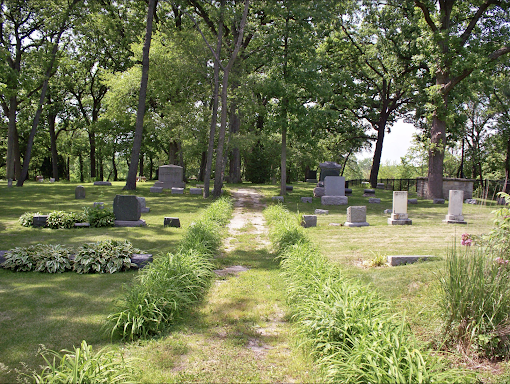
   We Mokenians of 2021 live in decidedly 21st century surroundings, with a fair share of the village’s historic landmarks long since disappeared from our landscape, and modern subdivisions abounding as far as the eye can see. There are comparatively few places where one can be face to face with our past, where it lives with such flavor as to be almost palpable. The further a villager drives down Regan Road, however, the more one gets a healthy taste of days gone by in eastern Will County, as the driver quickly leaves suburbia and heads down a quiet road bordered by dense foliage. Behind the hedgerow rest open fields, among the last in our once rural neighborhood. Suddenly, Marshall Cemetery is upon the visitor, emerging on the horizon like a mirage. Step through its iron gates and be surrounded by our forefathers.


 Marshall Cemetery on Regan Road is one of our most time-honored landmarks. (Image courtesy Michael Philip Lyons)


   While the graveyard technically lies a few rods into the perimeters of New Lenox Township, a significant number of the names found on these weathered stones lived in our village or very close to it. While the cemetery is at least 162 years old, it’s likely even older. After all these years, it’s hard to say who the first burial here was, but what is clear, is that the oldest part of the plot was set aside by Chester and Pamelia Marshall, two rugged pioneers who were among the first to settle the wilds of what would become Will County in 1833, barely a year after the end of the Black Hawk War. Natives of Onondaga County in central New York, Chester shouldered a musket as a young man in the oft-forgotten War of 1812. 


   Decades later, in 1878, while reflecting on our neck of the woods’ earliest settlers, Will County’s eminent historian George Woodruff penned that Chester Marshall “was… one of these Abolitionists, and a strong temperance man, always at hand at Temperance and Antislavery conventions. He was a tall, large, noble-looking man.” A deeply devout individual, he also served as a deacon in the Baptist church. Man and wife arrived on Illinoisan soil with one daughter and two sons in tow, ranging in age from 21 to 16. Their daughter, Electa Ann, would be wed to Eliphalet Atkins three years after the family’s locating here, and would live on the site of modern-day Mokena. The older of the two boys, Rollin Marshall, became a well-established farmer in far eastern New Lenox Township, and in his later years moved to Mokena, where he followed in his father’s footsteps and became a deacon in the village’s Baptist church. His younger brother, George Marshall, also took after their father, and worked as a secretary of the Anti-Slavery Society. He would leave for the California gold rush to seek his fortune, and ultimately struck pay dirt, only to meet his fate aboard a ship on the way home to Illinois in 1850. One of the few Marshalls not to be interred in this historic cemetery, the Pacific Ocean became his grave.


   Patriarch and Matriarch of the Marshall family departed this mortal coil in 1859 and 1865, respectively. Chester’s original rectangular gravestone has long since been separated from its base, and now lies flush with the earth, its sides having been reclaimed by the loam. Although flecked with lichen, the old marker is clearly readable and in remarkably good shape for its age. Later a dignified monument of black marble was erected on the plot that Chester and Pamelia Marshall share with the families of their son Rollin and grandson Chester. 


Pioneer Chester Marshall's gravestone can still be easily read. (Image courtesy of Michael Philip Lyons)


   This peaceful acreage started out as a family plot tended to by the Marshall family and other near neighbors, until the Marshall Cemetery Association was established in 1917. The association cared for the land until aging board member Elmira McGovney transferred responsibility for the graveyard to New Lenox Township in the spring of 1988. These hallowed grounds contain the mortal remains of at least 13 heroes of the Union from the Civil War, including the dust of at least one who gave his life upon the altar of freedom. Edwin Marshall was the grandson of Chester and Pamelia Marshall, who as a 19-year-old volunteered for duty in the 20th Illinois Infantry in the autumn of 1864. He was known to his friends and family as Webb, his middle name. 

   Years after the war, Webb’s brother, esteemed Will County judge Albert O. Marshall, wrote a memoir entitled Army Life based on his own experiences in the conflict. In the final pages of the book, he mournfully rued his brother’s fate. He remembered that Webb “…was stricken down, while in Camp Butler (near Springfield) with that fearful scourge of the army, typhoid fever. He was brought home sick, but all assistance was in vain. He died and was buried in the little country grave-yard near our farm home.” Webb Marshall passed on January 24th, 1865, less than three months before the war ended. It’s unclear if he ever had his own gravestone, but he is still represented on the family monument along with his parents and siblings. 


   Just steps inside the front gate, one finds the modest grave marker of Thomas Packard Parker, the stepson of the aforementioned Rollin Marshall. Born in March 1833 at Westford in Vermont, he came west as a lad and as an adult lived and farmed in the vicinity of today’s Townline Road. He answered President Lincoln’s call for volunteers with the formation of the 100th Illinois Infantry in the summer of 1862, fighting with his Will County neighbors through the storm of shot and shell at Stones River, Tennessee that December. On September 19th, 1863 he marched into battle at Chickamauga, Georgia, and into one of the bloodiest days in our community’s history. Thomas Parker was one of at least three other Mokenians who lost their lives on this dark day. It is unknown if his earthly remains ever made it back to Illinois, or if the small monument at Marshall Cemetery is simply a cenotaph, while his bones still rest on the battlefield, in the red soil of Georgia, far from home. His name stands on the smooth black granite stone above his infant son Willie’s, who died in 1860. The grave marker now lies toppled in the grass, which is hardly the remembrance that Thomas Parker deserves, who lay his life down in the face of rebellious despotism. 


As one of President Lincoln's soldiers, Thomas Parker of Mokena gave his life for the Union. He is pictured here around 1860.


   Another Union soldier, one of the vaunted boys in blue, is John Collins, whose name stands proudly on his weather-beaten, government-issued grave marker. An Englishman by birth, he volunteered for service in the 57th Illinois Infantry, and served as his company’s fifer until he left the regiment after having done a stint of six months. His path eventually led to Mokena, where he lived on Front Street. He was known to villagers as a peaceable single man who kept house with what were referred to as his “canine and feline pets.” In 1906, our community’s correspondent to the Lockport Phoenix-Advertiser reckoned that he was not only the oldest resident of Mokena, but also probably the whole state, tallying his age to nearly 103. Modern research into Mr. Collins’ age is inconclusive. When he joined the army in December 1861, he gave his age as 38, indicating a birthdate of around 1823, however, when the 1900 census taker was in town, the villager stated that he was born in August 1816. Regardless of his true age, when John Collins passed away in 1907, fellow Union veteran and Mokena resident John A. Hatch, secured the simple gravestone for his townsman and brother in arms. Hatch didn’t want his old comrade to go forgotten, which is a service we could do well to remember today. 


   Multiple generations of the McGovney family found their rest here at Marshall Cemetery. At least 28 of them repose in these grounds, and an entire volume could be filled with their stories. A visitor can’t turn his head without seeing their venerated names chiseled in stone, all of whom dot the pages of our history. Here Elijah McGovney, there Emily McGovney, and over in a shady corner, Walter “Dick” McGovney. The gravestone of John McGovney, who departed March 12th, 1859, has been heavily weathered and has seen over 150 summers and winters. It can only be read on a perfectly sunny day, by tracing its rough letters by fingertip and with the utmost patience.   

   There was no truer pioneer than John McGovney, who with his wife Nancy has gone down in history as the first non-native family to settle on the future site of Mokena, having arrived in an ox-drawn wagon with their five small children in tow via Adams County, Ohio on October 9th, 1831. Not only were the McGovneys possessed of the brawny individuality that allowed them to survive in the untamed west, but the family’s head further distinguished himself by platting two additions to Mokena in the days of the hamlet’s infancy. 


Founding Father John McGovney's name is barely legible on his grave marker. (Image courtesy of Michael Philip Lyons)


   Clear across the cemetery from the family patriarch is the plot of Ozias and Matilda McGovney, venerated by a stately white block bearing the family name. Ozias was the third eldest son of John and Nancy McGovney, and would in his later years be known as “the grand old man of Mokena.” Named after a biblical king, he first set foot on Illinois soil the year he turned seven. As a lad Ozias McGovney was educated in a rustic country schoolhouse that predated the organization of Frankfort Township, which he would later recall as a “log house, which was fitted up with benches minus backs, which made it very uncomfortable for the pupils as they had no means of resting their aching backs.” There being no chalkboard, “a hewn slab was erected which served as a writing desk.”

   In the frosty cold of January 1846, Ozias married Matilda Jane Ellsworth, a young lady five years his junior, who originally hailed from Onondaga County, New York, the same neighborhood as her neighbors and relatives, the Marshalls. Matilda McGovney was a true woman of the frontier, who used butter to straighten her hair and was also a healer, who was known to tend to the ill in an era when doctors were few and far between. Local historian Florence Pitman wrote “When (Matilda) heard of illness, with her basket of home remedies she would set forth to care for the ailing one, unafraid of any disease; diphtheria, smallpox, scarlet fever – she braved them all. ” It would also be remembered that Matilda McGovney once cured an area boy with a “physic of goose grease.” One of her choice remedies was a concoction of powdered rhubarb, sugar, water, essence of peppermint and brandy that was still used in the McGovney family well into the 20th century. A pious lady, a contemporary would describe Matilda as “faithful Christian woman” as well as being “devoted to sincerity, truth and the richness of high character.”


Seen here around 1880, Matilda Jane McGovney was a savior to our neighborhood's ill. 


   Over the years, Ozias and Matilda McGovney would come to stand at the head of a good Mokena family, raising five daughters and three sons who were born between 1848 and 1867. Like many in his generation, Ozias McGovney was deeply effected by the gathering storm of the Civil War. He was long an adherent of the Democratic party, but upon the repeal of the Missouri Compromise in 1854, (which had established a line north of which no slavery would be allowed) he became “suspicious of the political honesty of the leaders of the Democratic party” and became an early supporter of the new Republican party, with which he stayed for the rest of his days. 

   Many in the neighborhood of the not-yet formed Mokena knew Ozias simply as Squire McGovney, for he was elected to the post of justice of the peace at the first election held in the newly founded Frankfort Township in 1850. He would ultimately hold this position for twenty years, officiating at the marriages of countless local residents. Ozias later was admitted to the bar and became a country lawyer, and after the founding of Mokena in 1852, he became one our most prominent villagers. Representative of his stature in the village, he became very involved in local politics; holding not only the office of postmaster from 1875 to 1885, then again from 1889 to 1893, but also the post of Frankfort Township Supervisor from 1856, which he held on and off until 1870, at which point he “utterly refused to accept the position.” However, the township supervisor’s chair would come back to him in 1888, as it would be remembered that “the leading men of the town came to him and demanded that he accept the office again. That spring he was elected to the office of supervisor under protest, which office he held continuously for ten years.”

   Of all the hats Ozias McGovney wore over the years, his most honored place in our history was that of our first mayor, a duty he was elected to by the new village board in 1880, keeping the seat for four years. A contemporary proudly stated that “He discharged the duties of each and all the offices he was elected or appointed to, faithfully, honorably and to the entire satisfaction of his constituents.”

   Aside from his various elected positions, Ozias McGovney also kept a well-known general store in our village in the 19th century. He crossed the great beyond in March 1914, the year he was to have turned 90, at a time when the life expectancy for an American male was just over 50. 


Portrayed here circa 1878, Ozias McGovney held many local offices, including that of Mokena's first mayor. 


   Of the eight children of Ozias and Matilda McGovney, their eldest son to survive into adulthood, Ozias Erwin, who was born in 1855, can also be found here in the family plot in Marshall Cemetery. As a tender lad of 15, he took a job with a surveyor’s crew that was blazing a path for a new railroad across Illinois, Indiana and Ohio. The position was not without dangers, and Erwin, as he was called, would often be separated from his coworkers. Once in Ohio, it would be remembered that “…he was overcome with an exceptionally severe attack of the ague and sank prostrated to the ground. Fortunately an old lady discovered him and had him removed to her home and took care of him until he recovered.” 

   Upon his return to Mokena, he went into the store business with his father in 1874, and married Georgia Knapp in 1878. After a sojourn in Manhattan conducting his own store, (and incidentally serving as this village’s first mayor) the family made Mokena their permanent home beginning in 1887. As was quickly becoming a Mokena tradition, our community’s elected and appointed chairs were by and by occupied by members of the McGovney family. Erwin was Mokena mayor for a brief span starting in 1890, then again from 1903 to 1910, not to mention a long term as postmaster at the turn of the 20th century. He breathed his last in 1910. 


   The sharp-eyed visitor to Marshall Cemetery will also find the modest gravestone of Ona Ellsworth McGovney, complete with masonic insignia. He is the fourth generation of the Mokena clan to be interred here. Having lived from 1879 to 1938, Ona was the son of Ozias Erwin and Georgia McGovney, and like his father and grandfather, was one of our mayors and postmasters, occupying both positions simultaneously at one point, which eventually landed him in hot water. Here too is Ona’s daughter Elmira McGovney, the last resident of our village to bear the old family name. She departed this mortal coil in 1994 at 79 years. 


    Heading towards the gentle slope on the eastern side of the cemetery, one happens across a short, weatherworn obelisk bearing the name Polly Marshall, who is recognized on the small monument as being the wife of Allen Denny, the father of Mokena. Behind every great man, there stands a great woman. Born Polly Marvin, she first saw the light of day on February 21st, 1797, during the waning days of George Washington’s presidency. Like many of our pioneers, her first home was in the state of New York, but where exactly has long since been lost to the ages. Young Polly was raised by her German grandfather, passing to her a “Teutonic vigor” that she carried for the rest of her life. Around 1816 she tied the knot with Nathan Marshall, fellow New Yorker and family member of Chester Marshall, the aforementioned founder of the cemetery. 


Polly Denny passed away in 1884 at the age of 87, a remarkable achievement for her time. (Image courtesy of Michael Philip Lyons)


   So it was in 1837, that Polly and Nathan Marshall came west and settled in Will County, which at that early date had only officially existed for one year. Two children were born to this union, Jane and Martin Marshall, but reflecting the tough and unforgiving times in which they lived, neither survived to adulthood. Compounding this grief, Polly’s husband Nathan also passed in October 1843. She wed 54-year-old farmer Allen Denny, another pioneer in the Hickory Creek Settlement, on the summer day of August 24, 1844, and together they made the prairie wilderness blossom as the rose.  News of the nuptials even made it into a newspaper called The Western Citizen, based in then-far-off Chicago. The Western Citizen was our region’s premier anti-slavery publication, and its notice of their wedding speaks to their standing in this circle, as Polly’s new husband was a diehard abolitionist and operator of a stop on the Underground Railroad. As the sheltering of runaway slaves was happening in her home, Polly undoubtedly also helped break the chains of slavery too, ushering those seeking freedom on their way. 


    Immortality at large has remembered her husband Allen for his creation of a small subdivision along the new Chicago, Rock Island and Pacific Railroad in 1852, which would become Mokena. As this tiny community grew, Polly came to be known affectionately as “Aunt Polly.” She served as a midwife to many area mothers, and more than a few local residents would later say that Aunt Polly was present at their birth. Polly Denny ultimately passed away on July 9th, 1884, at the age of 87, and as a sign of her standing in town, the most prominent men in Mokena served as her pall bearers. She can rightfully be called our founding mother. 


  These are but a few of the countless stories of love, bravery and sturdiness that can be found in the lives of those who came to find eternal rest within the gates of Marshall Cemetery, hallowed grounds that are among the most historic in eastern Will County.