Friday, April 30, 2021

The Brilliance of our Youth: A History of the Mokena Campfire Girls

  They were young. They were in their late teens at the oldest, but their community spirit, and the vim and vigor with which they worked for Mokena are still worthy of our respect to this day. Their hearts beat for our community. The Camp Fire Girls, a group of adolescent ladies that were very similar to the modern-day Girl Scouts, did many good deeds for the village in their short existence, and inspired those around them. Their members and leaders were a solid representation of our town, and while they were all ordinary girls, their impressive list of accomplishments elevates them to the status of local heroes.  

   In the years before the First World War, the scouting movement swept the United States, which culminated in the official formation of the Boy Scouts of America in 1910. Mokena’s boys formed their first troop in 1914, and as they grew successful in their endeavors, their sisters looked on, and feeling the same drive to do well, decided that they would not be left behind in the shadows. Having been founded in 1912 as a direct answer to the Boy Scouts, the Camp Fire Girls of America came to town in 1915 when our village’s first official camp was formed. This group formed out of a pre-existing girls’ club called I.R.B., the initials of which stood for some meaning long since lost to the ages. On March 6th, 1915, a meeting of girls was held at Front Street’s Bechstein Hall, and a group of eight members called their organization into existence. These founders, whose names read like a who’s who of Mokena in this time, were Alma Bechstein, Esther Bosold, Cora Cooper, Agnes Frisch, Olive Geuther, Eunice Hacker, Ruth Niethammer, and Myrtle Oswald.   The girls ranged in age from 15 to 17, and represented a cross section of the community, being the daughters of the pastor of St. John’s Church, a Front Street merchant, and a railroad worker, among others. 


   In getting on their feet, they got a boost from member Alma Bechstein’s mother Emma, a true Mokenian who was known to help worthwhile local efforts, while the girls also received help in getting their charter through her father, W.H. Bechstein, the village grain dealer. For their guardian, a position not unlike a troop leader, the new Camp Fire chose 26-year-old Margaret Semmler, the wife of Mokena’s correspondent to the Joliet News.While she was newly married and had only lived in town for about a year at this time, Margaret showed the heart she had for her new home by being the guiding light to this new group of well-doers. At the outset, Mrs. Semmler’s husband William noted in his village column of the News that “the young ladies are taking a keen interest in the new organization and are displaying remarkable enthusiasm and are determined to make their society a power for good in the community.” The original eight members of the Moke Camp would quickly be joined by more local girls, and before long, 15 members were attained, the requisite number to make a Camp. The young ladies christened their new assemblage the Moke Camp, after the mythical Chief Moke, a Potawatomi man said to live on the prairie where Mokena would later be born. Before long, the new Camp adopted a star as their official symbol. 


   The Camp Fire Girls followed “The Law of the Camp Fire”, their creed, which stated “seek beauty, give service, pursue knowledge, be trustworthy, hold on to health, glorify work,” and “be happy.” According to their laws, the young ladies were not allowed to accept any monetary donations, and had to work for any money their Camp earned. At the meetings of the group Camp business was discussed, with songs being sung, as well as a time for games and socializing. The gatherings rotated at the houses of the members, and in some cases, such as when they met with Cora Cooper or the sisters Alice and Dora Andresen, they commuted en masse to their farms north of town on spring wagons. Staying true to Chief Moke and the namesake of their camp, the girls favored Potawatomi imagery, donning fringed gowns and beaded headbands that they wove themselves. 


  The Moke Camp were a busy group of girls. Typical of their activities was a bonfire held in the wooded thickets alongside Hickory Creek on April 17th, 1915. The camp’s full membership formed up at the home of Margaret Semmler on Niethammer Avenue, and walked to the woods with their lunches in bags which they tied to sticks, which in turn were hoisted over their shoulders for the march. Once their council fire was started, the girls roasted hot dogs, and in the words of Joliet News correspondent William Semmler, “they tramped through the woods and had a pleasant outing.” Barely a week later, the Camp re-convened at the Semmler place at the crisp hour of 5:00 o’clock in the morning, this time for a sumptuous breakfast of roasted marshmallows. Also being a vigorous, energetic lot, that same day members Carrie Cappel and Eunice Hacker hiked from Mokena to Joliet, finishing the trek in about three hours. Around the same time, some of the other girls made a round trip to Frankfort by foot. 


   Not content with just camping on the outskirts of town, the girls set their sights on renting a cottage at the New Lenox Methodist Campground in the summer of 1915. After liberally peppering Mokena with colorful posters advertising the event, they put on a bake sale at Paul Rinke’s meat market on June 19th, 1915 to raise money for the rent, and when the day was out, the Moke Camp counted $19 to their name, or close to $500 in today’s money. The young Mokenians got settled in at the Campground at the end of July, and enjoyed their time out of town despite damp weather. While in our neighboring community, the Mokena Boy Scouts hiked to New Lenox to visit the girls, where 10 pounds of hot dogs eventually disappeared over the camp fire. 


   Aside from various activities offered by the churches, the Mokena of the First World War era was not exactly a place brimming with opportunities in the way of fun for local youth. Seizing the initiative, the Moke Camp Fire Girls sought to change that. At the beginning of summer 1915, a committee of four members visited member Eunice Hacker’s father, mayor George Hacker, and asked for his permission to build a tennis court in the village. They got his word, and a plot of land north of the Methodist and St. John’s Churches was chosen. By early August the work was done, the new playing surface being complete with a double court net. The court was open to anyone in town who wished to use it, each player only had to supply their own ball and racket. 


   Mokena headed into the summer of 1915, and the Fourth of July appeared on the horizon. Always a day of great gaiety and mirth in our village, that year the Mokena Men’s Club was at the helm of planning the festivities. As things were coming together, the Camp Fire Girls approached the businessmen of the Club with an idea, something new for that year. Why not put on a parade? After all, it was years since the village had seen one, the last parade for the Fourth having been held in 1903, and the girls reasoned that it would “bring a crowd to town and liven things up.” The young ladies suggested to the men that the town businesses should each enter floats in the procession. Traditionally this was done using horses and wagons, but as cars were slowly edging them out of traffic, it was resolved that it would be an auto parade, a first in the history of the town. The parade was a huge success, wending its way through the main streets of town complete with a Charlie Chaplin impersonator, and ended at Cappel Grove just south of town. 

   Once the revelries kicked off at the Grove, an area just south of town complete with a dance pavilion, the Boy Scouts and others took part in the day’s program. The Moke Camp was in charge of the flag raising ceremonies, and their leader, Margaret Semmler, read a patriotic verse. One of the Andresen sisters, both of which were Camp members, read the Declaration of Independence. Different types of games rounded out the rest of the day, and cash prizes were awarded to the best floats from the parade. While those of local businessman Frank Liess and the Sippel general store ranked first and second, the Camp Fire Girls landed in third place, and were given $2 for their efforts.


The Moke Camp Fire Girls in the village Fourth of July parade, circa 1915. At the wheel is local grain merchant and early supporter of the Camp W.H. Bechstein. In the passenger's seat is Camp guardian Margaret Semmler. In the back seat left to right are Carrie Cappel, Alma Bechstein, and Ruth Niethammer. 


   Over the rest of 1915, the work of these Mokena youths stirred up so much interest amongst the girls of town that a second Camp Fire was established in April 1916. For their guardian, the new group chose Mrs. Mabel McGovney, a former school teacher, and thus forth christened themselves the Potawatomi Camp, again hearkening back to our rich native past. The list of their deeds is impressive and inspiring. Taken as a whole, the apex of the girls’ achievements was their planning and staging of Mokena’s first public Memorial Day celebration in 1916. Originally known as Decoration Day, this reverent occasion was born as a direct result of our great national bloodletting, the Civil War. Originally observed as a day in which to honor the legions of Union dead of the North, it was first formally marked in 1868, three years after the conflict’s end. Over the years, village residents observed the occasion privately, and without great pomp and circumstance. Correspondent Semmler even decreed that the occasion had been “neglected” in our midst, adding with a sting that “the churches of the village and the various societies have apparently never given the matter any thought.” As the Civil War was still very much within living memory in their day, Mokena’s Camp Fire Girls had a deep recognition and appreciation of the day’s meaning, and sought to bring it into the light. 


   They first felt deep reverence for the occasion in May 1915, when they ventured into the tangled overgrowth of the old Denny Cemetery and decorated with flags and flowers the grave of Charles Denny, who marched as one of General Washington’s men in the Revolution. Previously, this patriotic duty of adorning his and the many graves of Mokena’s Civil War soldiers was shouldered entirely by aging local veteran John A. Hatch, who not only made the rounds on his own, but also humbly took care of all the associated expenses out of his own pocket. 

   The Camp Fire Girls had great expectations for what Memorial Day could be in Mokena, but in order to put on any kind of event for the day, they needed funds. To solve this prickly issue, they put their minds together, and after much brainstorming, it was decided to stage a play. After a period of rehearsing together, the curtain went up on February 26th, 1916 at Mokena Hall to the premier of When the Cat’s Away, a one-act comedy. As the doors at the Hall opened that cold night, the town folk streamed in with high confidence in the girls, as their work on the previous Fourth of July was still the talk of the community. They would not be disappointed. The full complement of Camp Fire Girls were there, attired in their Potawatomi garb, gracing a stage that was “prettily decorated with a latticed background entwined with roses” that gave the scene the effect of a rose garden. All of the lights in the hall were turned down, leaving the whole auditorium swaddled in a reddish glow that emanated from the footlights’ covering of red paper, and the charcoal-fueled campfire in the middle of the stage. Sisters Eva and Louise Groth, both members of the Moke Camp, gave a piano duet, and rounding out the evening were readings performed by Miss Catherine Mitchell and her pupil, both having come to town from Joliet. Once again, the Camp Fire Girls made a big splash, and the whole program was a success. 


    The planning for Memorial Day began in earnest after the play.  Helping the girls in their endeavors were some “enterprising church people” and some of the village’s old Civil War veterans. On Sunday afternoon, May 28th, 1916, John A. Hatch took the Potawatomi Camp under his wing and together they went to Marshall Cemetery, where he showed them the graves of old Union soldiers, which the girls then decorated with flags and flowers. The Moke Camp followed suit that Tuesday, and did the same at the St. John and St. Mary Cemeteries, as well as at the historic Denny Cemetery. The big day came for the both of the Mokena Camps on May 30th, when once again the Mokena Hall was used for the event, this time being festooned with flags and bunting. The young ladies invited three of the village’s heartiest Civil War veterans, including the aforementioned John Hatch, as well as Griffin Marshall and Elijah McGovney, who were escorted to places of honor on the hall’s stage by the girls. At 2 o’clock their program started, with stirring music being furnished by the village’s Boy Scout band, to which the Camp Fire Girls sung “Strew Fairest Flowers”, along with the community’s ladies’ quartette, who performed several selections as well, including “Tenting on the Old Camp Ground,” an old Civil War tune. The speaker of the day was Rev. J.M. Schneider of Joliet, who gave a rousing address in three sections. First, he hailed both Camp Fires for their work marking the day in our village, and then he moved to the ideals of preserving the Union for which the audience’s parents and grandparents had so perilously toiled. The reverend than moved to a topic that was gaining in earnestness in his day; namely the brutal conflict raging in Europe that we now refer to as World War I. With a heavy note, he warned the folk of Mokena against a spirit of militarism, and said that while he was for America being on the defensive, he stated that he “did not feel that it is right for (mothers) to raise their sons to be a soldier and fodder for cannons.” 

   To wind up the day, Mrs. Grace McGovney read an honor roll containing the names of every Civil War soldier buried in Mokena. While admission to the program was free, the Camp Fire Girls accepted donations from generous residents, and even set up a candy booth at the Hall. At the end of the day, the counted $26 in their coffers. 


   As the United States entered World War I in the spring of 1917, both the Moke and the Potawatomi Camps kept up their good deeds in town, backing up our local doughboys by working arm in arm with the Red Cross’s efforts on the home front. Alas, all good things must come to an end. For reasons long since disappeared into the ether of the past, the Mokena Camp Fire Girls dissolved in the spring of 1918. One by one they got married and started families, but in the words of their erstwhile guardian’s husband, each “always cherished the fond and pleasant memories” they had made with the Camp. Over the years, the girls held reunions where old times were re-lived and old Camp Fire songs sung, with these gatherings happening on an annual basis at least through the 1920s. The last known reunion took place in Mokena in the 1960s, when the girls were now mothers and grandmothers.


   The Camp Fire Girls of our village went above and beyond in their endeavors for our community. They reached for the stars bringing holidays to us that we now all too often take for granted. May their memories be immortal. The girls’ can-do attitude and their Mokena spirit come along once a generation. Even though over a century separates us from their deeds, they have set an example that would be a worthy one for us to follow. Who of us will take up the torch?  

Friday, April 16, 2021

Mkenak and the Veiled Prophet: The Story of Our Name

   What’s in a name? A name can tell us a lot about someone.  When the shell of mystery around a name is cracked, we can recognize heritage, the era in which a person has lived, even a thing or two about the giver of a name. Names can also evolve over time; for example, it is very common that a child goes by one name in his early years, but takes a completely different one in adult life. Villages are also no exception to this rule. When one turns back the pages of our local history, such places as Van Horne’s Point, Frankfort Station, New Bremen, and Sedgewick appear. While these towns have grown to become respectable, solid Midwestern communities, (respectively known now as New Lenox, Frankfort, Tinley Park, and Orland Park) a few neighboring hamlets have died out altogether. Does any reader in 2021 remember Chelsea, Spencer, or Alpine? 


     However, exotic-sounding names often lead to rumors and mistaken truths, for despite local folklore, the true origins of the word Mokena are deeply shrouded in mystery. Norma Lee Browne, a reporter from theChicago Tribune who canvassed the town for interesting stories at the end of World War II, found an interesting take on the village’s namesake. In her 1945 work, Mokena Memorabilia, Browne wrote “…The old-timers say the town was named for a great Indian chief named Moke, Mokey, McKinney, and diverse other variations.” 

     Longtime resident Clinton Kraus remarked a few decades ago that he was also told the word trickled down from the name of a certain Chief Moke, an Indian leader who centuries ago lived where Mokena now stands. As interesting as the story sounds, Kraus admitted he had no idea how authentic it was. (Although he was quick to note, “we always liked to believe it was true.”)

    Taking as Chief Moke’s name might be, historians have never given this story much credence.


The majestic Makina, Mkenak, and Mikinaak. No mud in sight.


     Another spin on this tale was told around 1960 by pioneering local historian Florence Pittman. In gathering information for her booklet The Story of Mokena, Pittman came across an anecdote from the early days about a small but determined group of Indians who lived not far from town. Although the majority of their brethren left this part of the state in the late 1830s as a result of unfair treaties with the United States government, a few Potawatomi hangers-on lingered in this part of Will County. Having gained a healthy sustenance from a huge slough that existed somewhere northeast of Mokena, this group of Native Americans insisted that the word Mokena meant mud hole in their language.

     While she was a very talented writer who presented an account that wasn’t far-fetched, Mrs. Pittman forgot to include any references or sources as to where exactly she heard this account. Therefore, modern historians have had extreme difficulty in pinning down the authenticity of the story. 


     Yet another take on the meaning of Mokena was related by editor William Semmler of The News-Bulletin in 1930. In the columns of his newspaper, Semmler wrote that Mokena resident Milton Krapp had recently found himself doing some plumbing work at the summer home of a rich Midlothian man in Wisconsin. While there, he had become acquainted with some members of a local Chippewa tribe, who upon learning the name of Mr. Krapp’s hometown, told him that a trench or foxhole-like dugout were known as a Mokena in their mother tongue. 


     Be it a feared and respected tribal leader, a muddy swamp, or place of shelter during war, perhaps the most bizarre explanation for the meaning of Mokena can be found in the brittle and fragile pages of the October 11, 1910 issue of The Joliet Weekly News. On that day a feature titled Mokena Doesn’t Need a Copyright ran, and aside from providing us with countless historical gems on the town’s early days, the unknown writer boasted that the name Mokena “is associated with poetry…being taken from The Veiled Prophet of Korassan by Tom Moore”.  

    Today we know that that Irishman Thomas Moore wrote Lalla-Rookh, an Oriental Romance in 1817. In this work of poetry, a character named al-Mokanna makes an appearance as the Veiled Prophet of Khorasan, and interestingly enough, a routine check of facts shows that al-Mokanna was most likely based on a real figure named Al-Muqanna. A Persian prophet who led an anti-Arab rebellion in his homeland around 776 AD, al-Muqanna’s name translates to “the veiled one”, who, according to which story you hear, concealed himself due to his beauty, the fact that he was battle scarred and one-eyed, or that he was severely burned in an explosion that occurred in his line of work as a chemist. After having poisoned himself while under siege by his enemies, his followers kept up his sect until the 11th century. 

    How did al-Muqanna become connected with the Mokena of 1910? Could an early settler of Mokena been a fan of Thomas Moore’s poem? Or perhaps the “fact” that al-Muqanna and Mokena were connected was simply an invention of a Joliet newspaper editor looking to spice up his story? Any answer to these questions has long since faded into history.


    With our hindsight now in the year 2021, we can spread every theory about the meaning of our hometown’s name on an imaginary table in front of us. We can critically review and analyze them. When this is done, there is one theory, one story, and one piece of evidence that sticks out above the rest. The historical puzzle pieces snap together just nicely enough to make a theory seem believable. That is namely that the word Mokenacomes from an ancient Algonquian term meaning turtle.

     In his seminal 1881 tome, Discovery and Conquests of the North-West, DuPage County historian Rufus Blanchard included a respectable list of American place names whose origin could be traced to the first Native American residents of these regions. Along such words as Milwaukee, Minnesota, and Mississippi, the term Mokena appears, almost as if by afterthought. Peering into this fragile, antique work, the reader notices a phonetic pronunciation of the word, a brief note signifying its Algonquian root, and “A town in Illinois. Turtle.


                              This wily creature can still be found in our environs to this day.


     Blanchard’s factoid does make sense. The Potawatomi natives that Frankfort Township’s first white settlers encountered spoke a language that belonged to the large Algonquian family. Even more interesting, is the fact that linguist Michael McCafferty of Indiana University states that American Indians often named geographical features for “a prominent aquatic animal…living in or near its waters.” As if more convincing was needed, early surveyors of what would later become Frankfort Township noted vast areas of swampland not far from the future site of Mokena. Could it be that these pioneers encountered a turtle or two in the swamps, and for curiosity’s sake, had asked a Potawatomi the name in their language for these shelled reptiles? 


     While very believable, determining the correct spelling and pronunciation of any Native American word is next to impossible, this being due to the lack of a written language and a dire shortage of fluent speakers. As such, associate professor Edward Callary of Northern Illinois University, today’s pre-eminent expert on Illinois place names, concludes that our fair village’s name stems from the Algonquian Makina, from which the Tazewell County village Mackinaw’s name could also be taken. A similar word, mkenak, also denoting turtle, exists in the Potawatomi tongue, not to be outdone by mikinaak, or snapping turtle, in the closely related language of the Ojibwe. 


     The cold hard fact is, no one really knows for sure what Mokena means. While early historian Blanchard presented a very sound theory, no living person can give any explanation complete certainty. The sole reasons for this are simply because modern-day researchers have no idea who exactly gave our village its rustic name, or even if it pre-dates the 1852 founding of Mokena. It’s not out of the realm of possibility that the word Mokena, or some variant thereof, has been used for centuries to describe this location.


     All in all, maybe it doesn’t matter. Like a champion resting on his laurels, we can look back at nearly 170 years of proud history, onto a village that has not only shaped its region, but has also survived the tides of time. We can pride ourselves on the fact that we are one of kind. Our community is unique in the United States. For every city, village, municipality and hamlet in the land, we are the only Mokena. 

Friday, April 2, 2021

On Hallowed Grounds: A History of St. John's Cemetery

    Its massive trees are a setting akin to the Northwoods. Situated on a rolling ridge, on misty days one can almost hear the voices of the past whisper in a visitor’s ear. St. John’s Cemetery on Wolf Road is one of Mokena’s most hallowed places, it being the final resting place of a vast and impressive array of figures from our community’s history. As one leaves the busy thoroughfare, traffic becomes a distant hum, and as the guest wanders out into the sea of weather-beaten tablets and beholds the names thereon, it becomes clear that each and every one holds a story. An entire volume could be written about this place, and a thick one at that. It’s nearly impossible to highlight only a handful of the hundreds of people whose earthly remains lay here, and this piece will just barely skim the surface. 


    The history of the St. John’s congregation, one of our fair community’s oldest religious institutions, takes us back almost to the very birth of the village. A group of faithful German and Swiss families beginning worshipping together as early 1858 in Mokena’s schoolhouse, after a nasty falling out with their former brethren, the congregants of the Immanuel Lutheran church. Their preachers were itinerant ministers, and the flock finally gained their own resident man of the cloth when Prussian-born Reverend Wilhelm Meyer came onto the scene on New Year’s Day 1862. He brought the group into a new era, and on March 1st, the German United Evangelical St. John’s Church was founded, a mere ten years after Mokena was first platted. The devotees built themselves a simple yet refined church on the town’s Public Square the same year, and fitting themselves with all the trappings of a proper congregation, also began planning their cemetery at the same time. 


   The trustees of the church found willing property sellers in members John and Helena Schiek, who sold them a tract of land south of town for a burial ground on May 23rd, 1863 for $175, or about $4,000 in today’s figures. Situated on an old Potawatomi trail that is now Wolf Road, this slice of prairie was identical to the rest surrounding the small railroad hamlet that was Mokena in this time. The first burial took place that September, and over the years, the cemetery grew as the St. John’s congregation did. After 63 years of service, five additional acres were tacked on to the northern edge of the burying grounds in August 1926. Not a single monument profiled in this piece contains a word of English; each one is inscribed in the German tongue, with many bearing the regal gothic font chiseled in stone popular in the 19th century. While all of the founding members of St. John’s became proud Americans, they never forgot where they came from. 


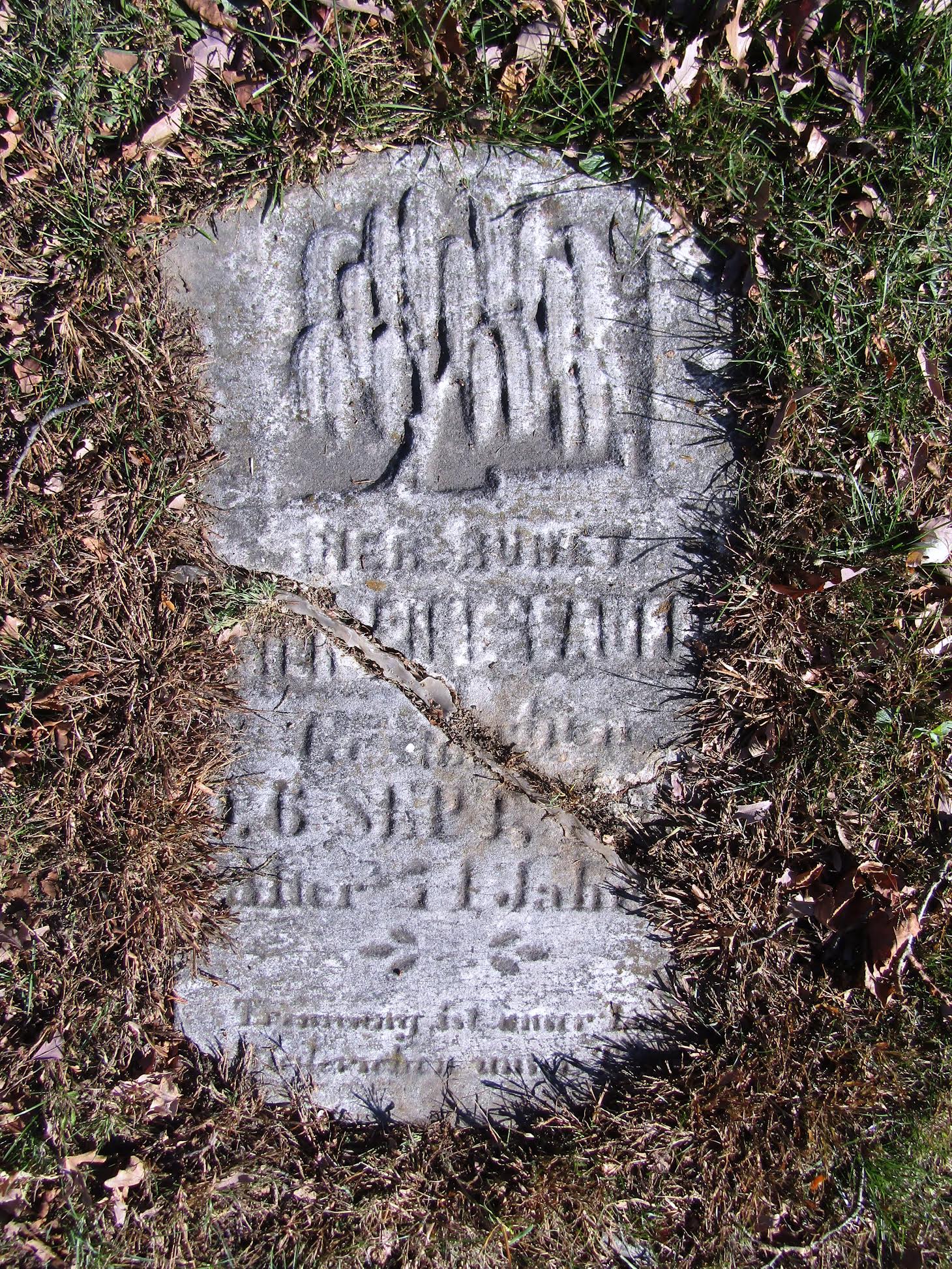
   Tradition holds that Philippine Laufer was the first person to be interred in these historic grounds. Her bones lie in the middle of the cemetery, her gravestone long since toppled from its base and lying flush with the earth. The simple slab bears a smoothly worn motif of a weeping willow, a common symbol of mourning in the mid-19th century. This stone and this ancient grave represent chapter one, day one of this cemetery’s history.

   Philippine Laufer was born to the world in 1789, and lived most of her life in Bavaria, in a world far removed from her future home. She likely made the arduous journey to America with her adult son George, who first set foot on our shores in the summer of 1846, escaping his homeland two years before it was torn asunder by revolution. After being processed through the port of New York, all paths led to Chicago, and from thence the Laufers settled in eastern Will County, then quickly becoming a haven for German-speaking folk. The newly-arrived family made their rustic pioneer’s homestead on the north side of what would become 183rd Street on the outer fringe of modern-day Frankfort Township, atop a high crest that would come to be called Summit Hill. The building materials for their first domicile were brought from Chicago by a span of oxen; only later would a more spacious home be built directly across the road. 


The grave of Philippine Laufer, traditionally said to be the first in St. John's Cemetery. (Image courtesy of Michael Philip Lyons)


   Philippine Laufer would come to have six grandchildren through her son, who in 1850 married Eva Utzinger. All of these children lived to adulthood, each one having families of their own, and while their surname gained an additional letter and came to be rendered as Lauffer, their descendants still live in and around Mokena to this day. Philippine drew her last breath on September 6th, 1863, and as the ground was broken in the new cemetery to receive her earthly remains, Abraham Lincoln sat in the White House, and the bloodbath at Chickamauga, Georgia, in which numerous Mokena men took part, was only a little more than a week away. 


   The Civil War and its dark days are intimately associated with this place, for not only were St. John’s church and cemetery born during this time of conflict, but at least eight of its Union heroes are interred here. One of them was a young man named George Treuer, who came from a small village called Hügelheim in the far southwestern German grand duchy of Baden, a mere stone’s throw from the French frontier. History doesn’t tell us when or why he made the trek to America, but Treuer lived in the environs of Mokena by 1860, when a federal census taker found him living as a farmhand on the property of Jacob Bauch, just north of today’s intersection of Wolf Road and 191st Street. 


   While working at the craft of shoemaking, the Civil War erupted in April 1861, and a month later, George Treuer came to the defense of his adopted homeland by rallying to the flag with the 20th Illinois Volunteer Infantry, mustering into the regiment on June 13th at Joliet. The unit saw hard service, and the February 1862 campaign in northern Tennessee to capture the rebel Fort Donelson on the Cumberland River was a typical example. The march to the battlefield spelled untold hardship for Private Treuer and his comrades. In the lead up to the fight, he and his brothers in arms camped in the open air during a punishing winter rain, and upon waking up the next morning after a fitful night, found their blankets frozen solid in a deep freeze. Due to these harsh conditions, an exhausting illness set in on the young man. During the battle for the fort, in which the Union men suffered over 2,600 casualties, a rebel ball passed through the fleshy part of George Treuer’s leg. His blood was not shed in vain, as the action was a major victory for the North. 


   Treuer served with the 20th Illinois until he was discharged from the unit upon the expiration of his term of enlistment in June 1864. Despite his wound, he volunteered yet again in the army, this time for duty with the Veteran Reserve Corps in February 1865. Sometimes called the Invalid Corps, they were a group of volunteer Union soldiers who were physically incapable of carrying out normal charges, and thus manned forts, guarded sites in the nation’s capitol, and tasks of this nature. Exactly a year after the war’s end, George Treuer married Anna Mavis in April 1866, and not long thereafter began a new chapter of his life, namely fathership, with the birth of their daughter Elizabetha in the fall of 1868. For a brief period in these years, its bookends unclear through the fog of time, Treuer also kept a saloon in Mokena, catering to the village’s thirsty German-Americans.  


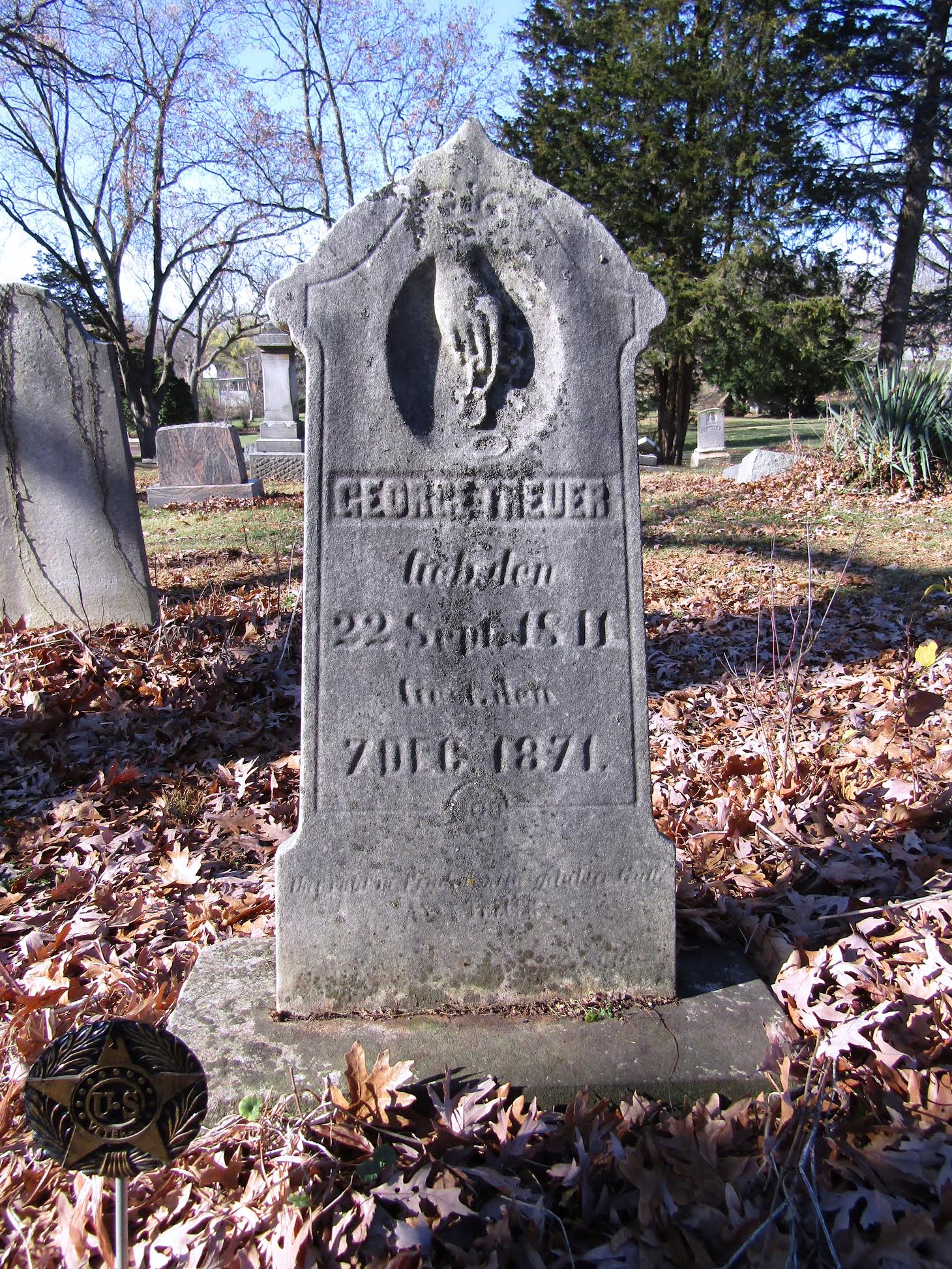
The time-honored headstone of Civil War hero George Treuer. (Image courtesy of Michael Philip Lyons)


   The war never really ended for Treuer, who was burdened by the pain of a battle wound that never properly healed, and the after effects of the debilitating sickness from that wet, freezing night in Tennessee. At the end of 1871, not two months after Chicago was ravaged by the Great Fire, the young veteran’s health issues were compounded when his weakened lungs were attacked by tuberculosis. George Treuer lost this battle, and he passed away on December 7th, 1871 at the age of 30 years. He was buried in a simple grave at St. John’s Cemetery outside town two days later. In time his loved ones had a proud marker erected over his mortal remains. Nowadays a thick crop of day lilies surround it in the warm months, this gravestone holding silent watch over a warrior hero’s dust. When the sun hits its ancient, weathered letters in just the right way, they can be read as clearly if they were chiseled yesterday. In the rays’ relief, the figure of a slender hand can be seen picking up a broken chain, its severed links representing a centuries’ old belief that the soul was tethered to the body by a golden chain. 


   Treading slightly northwest from George Treuer’s grave and down the ridge, one comes upon another time-honored plot, this one marked by a traditional gravestone with a rounded top, bearing the icon of a hand pointing toward the heavens. Here the earthen mound of Dr. Johann Andreas Grether is beheld.  One of the many early Mokenians with Swiss roots, Dr. Grether was born in the winter of 1807 near the city of Bern. Any details on the doctor’s early years are sparse, but it has been confirmed that he came to our country in 1852 with his wife Catharina and a daughter whose name has been long since lost to the ages. Three years later, Johann Andreas Grether was joined in America by his son Peter, who was finally able to make the journey.   


   It was in this decade that Dr. Grether made Mokena his home, not long after the Chicago, Rock Island and Pacific Railroad was built, and the village was first platted. Nevertheless, it was a period of hard times, as Catharina Grether died in 1854, whereupon a year later, Johann Andreas married the widow Elisabetha Schiffmann. As the United States entered the Civil War years, the family was deeply impacted by another tragedy when Peter Grether died as a Union soldier at Vicksburg, Mississippi in August 1863, being felled by disease. In this era, Dr. Grether humbly administered to our village’s sick and injured, and became successful enough in his practice that he was able to afford buying property in the new town. In the fall of 1867, he acquired a roomy house on today’s Front Street that is still with us a century and a half later, of late housing Le Angeline’s salon. 


The final resting place of Dr. Johann Andreas Grether. (Image courtesy of Michael Philip Lyons)


   Johann Andreas Grether died September 5th, 1869 at the age of 62, having surpassed the life expectancy of his time by more than two decades. Decades later, Mokena old timers would look back on his funeral, and remember it for a very unique reason. While friends and family were watching over his bier in the late doctor’s home, the figure of a woman clad completely in black was seen to enter the room. The others became aware of her presence, and while many laid eyes on her, no one knew her. After staying just long enough to make herself known, she passed into another room, whereupon another mourner gently went after her to see if her identity could be ascertained. Upon reaching the other room, she was nowhere in sight, and had disappeared into thin air. In the minds of those there that day, the only possibility was that she was a ghost. 


   St. John’s Cemetery is home to many understated, spartan graves. However, numerous larger, statelier remembrances can also be seen within the grounds. They are the grand monuments to even grander lives. They are not so much displays of wealth, but of love felt. One such obelisk marks the family lot of Franz Maue, a man who exemplified the iron-willed fortitude of the pioneer. He first saw the light of day on February 15th, 1805, in the small, picturesque town of Katzweiler in today’s western Germany. He came of age in agricultural surroundings, and would be a farmer his whole life. Along the way, he also learned the trade of tailoring, as a way to buttress his income during spells of bad weather. He was wed to Elisabetha Berdel, a native of a neighboring village on May 27th, 1827. Together they would bring nine children to the world, of which six lived to adulthood. 


The Maue plot in St. John's Cemetery. (Image courtesy of Michael Philip Lyons)


   The Maue family set sail for America in 1847, and undertook a crossing of the seas in 21 days, which to modern readers may sound unbearably rough, but in their day, it was considered an easy trip, as far as cross-Atlantic sailings went. During the journey, Franz and Elisabetha’s 16-year-old son Daniel met Sarah Mast, member of another America-bound family. Seven years later, the two would be married, as a result of what would come to be called their “voyage courtship.” Landing was made in New York, and the Maues then made their way up the Hudson River, and followed the Erie Canal to Buffalo. From there they entered the Great Lakes by boat, and eventually reached Chicago, then a fledgling rural outpost. As would later be remembered by a family member, Franz Maue then “drove into the country, looking for a good location.” He reached what we now know as Frankfort Township, the vanguard of the first wave of Germanic emigration to our community, and found in the soil here exactly what he was looking for in an American homestead. Maue immediately got to work setting up his family’s hearth here; by and by he acquired land, and eventually could look over an estate of 160 acres that was all his. His holdings, which were located northwest of where Mokena would come to stand, would ultimately be bisected by the Rock Island railroad. By 1862, a sizeable chunk of his farm had passed into the hands of his oldest son Daniel, while Franz himself still oversaw a large tract along our current 191st Street. At least two homes stood on this acreage, one east of the modern-day intersection with 104thAvenue, and another on the northwest corner of LaGrange Road’s crossing. Every trace of these have long since disappeared from our landscape. 


The fine craftsmanship of the stone etching on Franz Maue's monument. (Image courtesy of Michael Philip Lyons)


   The Maues were also founding members of the St. John’s congregation, and Franz would serve the flock as a member of the church’s council. Franz Maue passed away at his home outside town on March 2nd, 1879, after having been hit by a stroke. His respected status in our community is evidenced by a long, heart-felt obituary that was penned by Rev. Carl Schaub of St. John’s. Printed in Germania, a German language newspaper, the preacher stated that Maue “lived in harmony with his neighbors, as well as with all people” and referencing the makeup of our town in the period, said that “he was loved and beheld as a man of honor by not only the Germans, but by the Americans as well.” The Frankfort correspondent to the Joliet Weekly News said in a loving tone that “we did not suppose he ever had an enemy.” Franz Maue was buried at St. John’s Cemetery on March 5th, a rainy day on which the neighborhood’s single-track farm lanes were swamped with mud. Despite the gloomy weather, Rev. Schaub counted 85 carriages in attendance at the funeral. 


   No less a pioneer was Diederich Brumund, whose granite obelisk stands southeast of Franz Maue’s lot, being triumphantly reminiscent of the Washington Monument. Remembered by a contemporary as “honest and truthful in all things, a friend to the needy and a father to the fatherless,” he was born January 23rd, 1816 near the North Sea in a place called Sande, in the grand duchy of Oldenburg. Brumund spent his youth on the plains of northern Germany. It was later remarked that he received an “excellent education” while growing up, was noted as a “fine mathematician and scholar” and would later work as a clerk in Holland, where he picked up the Dutch language. He took Nicolina Folkers as his wife in 1843, and with four young children in tow, the family crossed the Atlantic and made their way to America in 1849. Sailing from the German port of Bremerhaven aboard the Ornholt Boming, the Brumunds navigated the choppy Atlantic for seven weeks before their arrival in New York. That August 28th, their journey ended when they picked a spot in our midst, carving out their home on the north side of modern-day LaPorte Road, a little way west of its intersection with what is now Wolf Road. 


   The Brumunds built a modest home and began farming, and within two years of their planting stakes, Diederich was able to buy the land where he made his home. These early days were tough ones, when everyday tasks could potentially be fraught with danger and hardship. Typical of this is the time when, on a trip carrying goods to the Chicago markets, one of the family’s oxen bolted and drowned in a canal. While he was a man of the soil, like so many of his brethren interred in this cemetery, Diederich Brumund also kept a small general store on the farm, a haven for pioneers in search of a convenience. Like more than a few of his neighbors, his farm was cut in two when the Rock Island railroad was built, and while some used this as time to seethe in anger at the railroad, this new American saw an opportunity to capitalize. On May 27th, 1853, a plat was filed with the Will County Recorder of the northern edge of his property bordering the west side of Allen Denny’s new town. Known as legally as Brumund’s Addition to Mokena, the farmer began selling off the parcels of land therein to some of the first residents of the young community. 


Diederich and Nicolina Brumund's obelisk, the tallest in St. John's Cemetery. (Image courtesy of Michael Philip Lyons)


   Five more children joined the Brumund fold after their arrival in our neck of the woods, and Mokena grew bit by bit, slowly becoming a small village. As the St. John’s flock came together in 1862, Diederich Brumund proved the giving spirit in his heart by being instrumental in the building of their church. He was a man who gave freely of his money when it was for the greater good, and one who also was very shrewd when it came to investing it. Aside from his large Mokena farm, Brumund came over time to own seven hundred acres in Green Garden Township, over a thousand acres in Missouri, and some land in Iowa to boot. Due to the effects of asthma, Diederich Brumund was called to eternity in Mokena on February 17th, 1885. A pillar of his church and community, he was laid to rest in St. John’s Cemetery, not far from the humble house he called home for 35 years. 


The names of the patriarch and matriarch of the Brumund family are forever preserved in granite. (Image courtesy of Michael Philip Lyons)


   These few personalities, these historic figures who grace the pages of our community’s narrative, are but a tiny sliver of all those represented at St. John’s Cemetery. A stroll through these grounds counts as an unforgettable journey into our collective past. May all who found their final resting place here be loved and honored now, just as they were in their own time. 

Friday, March 19, 2021

Where Cattle Crossed: A History of the McGovney-Yunker Farm

   Arising at the crack of dawn, milking cows by hand, herding them into pasture, preparing hay for bedding, and maintaining all the tools of the trade. These are but a select few, a tiny handful, of the many responsibilities that a dairy farmer has on his plate for just one day, winter or summer, rain or shine. A farmer must have mechanical and analytical skills, as well as raw strength for repetitive, strenuous tasks. Our village’s heritage is purely agricultural, and farms once dotted our community’s landscape in every direction one looked. This lifestyle was the everyday existence for so many in Mokena, but now it is totally extinct in our surroundings. There is however, one place in our midst that can be visited to absorb these old ways. McGovney-Yunker Farm on LaPorte Road is a gleaming jewel in our town, and a certified National Historic Landmark to boot. Now frozen in time, this place once abounded with life. While the farm and its quaintness remind our 21st century eyes of something far separated from our lives, there is a long, untold story about the history of this old spot, one of real people who lived and loved just like us. 


The McGovney-Yunker Farm on a snowy winter's morn. (Image courtesy of Michael Philip Lyons)


   As we turn back the pages of history and follow the threads of time, we find the beginning of this story with John and Nancy McGovney, two brave, rugged pioneers who in the spring of 1831 were the first young family of European descent to settle the land where Mokena would later stand. These intrepid explorers made their journey to Illinois in a covered wagon via Adams County, Ohio with five small children in tow, ranging in ages from ten to two. After the McGovneys’ arrival, three more would join the bunch. They carved out a primitive home on the untamed prairie, and built a home out of logs hewn from the Hickory Creek timber. They had barely gotten comfortable in their new surroundings when the Black Hawk War broke out in April 1832, an oft-forgotten conflict between Illinois settlers and elements of the Kickapoo, Sauk and Meskwaki tribes. When news drifted to the McGovneys of the outbreak of hostilities, they immediately packed up their belongings and fled to more thickly populated points in Indiana, it was said, on advice of the friendly Potawatomi who inhabited what would later be Frankfort Township. When the former Ohioans returned to their Illinois home after the war’s end that August, they were very pleasantly surprised to find out that their Potawatomi neighbors had tended to their property in their absence, taken care of their animals, and even left unmolested a loaf of bread that was left baking in their haste to escape. 


   The exact spot of John and Nancy McGovney’s pioneer homestead and where it corresponds to in today’s landscape remains a prickly issue. What is definitely known, is that John McGovney formally purchased two separate 80-acre tracts of land on May 20th, 1841 from the federal government land office at Chicago, after having squatted on them as a tenant. Eleven years later, the Chicago, Rock Island and Pacific Railroad would bisect this property, which enclosed part of the future village of Mokena.


   With the passage of years, beginning in 1857, ownership of part of this tract began to transfer to John and Nancy McGovney’s youngest son, 21-year-old Elijah. Over time, he added on to it, creating the acreage that is today known as the McGovney-Yunker Farm. One of the first white children to be born in the wilds of the yet unformed Frankfort Township on July 29th, 1836, Elijah McGovney wed Katherine Van Horn in September 1857. Their union ultimately welcomed nine children to the world, of which six survived to adulthood, namely Theresa, Walter (called Dick), Edward, Ada, George and Mattie. All of them would become well known and respected Mokenians. The 1860 federal agricultural census paints a vivid picture of the McGovney farm in this period, giving it a value of about $6,000, or roughly $175,000 in today’s currency. No small-time operation, the farm boasted of $100 worth of farming implements and machinery, and three horses, five milch cows, thirteen other cattle, and six swine. That year, Elijah McGovney estimated he had harvested 150 bushels of wheat, 400 bushels of Indian corn, about 100 bushels of Irish potatoes, and 40 tons of hay. 


   In this same timeframe, the United States was entering a great existential crisis, and the Civil War erupted in the spring of 1861. A little over a year later, after President Lincoln called for 300,000 more men for his army, Elijah McGovney volunteered for duty on August 22nd, 1862 in the 100th Illinois Volunteer Infantry, the newly organized Will County regiment. While donning his blue uniform, he served as the unit’s wagon master as well as a message carrier. The battles of Stones River, Chickamauga, and Franklin, some of the darkest days in our country’s narrative, which stand so starkly on the pages of our history books, were for Elijah McGovney places of intensely personal experience. He survived the war with life and limb in one piece, and was mustered out of the army in June 1865 as a hero of the Union. According to a story passed down in the McGovney family for generations, during his time at war Elijah had taken under his wing an orphaned slave child, and after the end of the conflict, he came to Mokena to the farm, where he lived as a member of the family. While his name has disappeared into the mists of time, it has been remembered that after he struck out on his own, he became a successful preacher. 


   In the aftermath of the Civil War, the McGovneys decided to try their fortune in Missouri, and much like his father did a generation before, Elijah and his brood made the tough, three-week journey via a wagon. Years later, his son Dick would recall sleeping nights with his father under the conveyance, armed to the teeth to ward off potential highwaymen. Luck was not in their favor, and two years later the McGovneys came back to their farm just outside Mokena. 


   Disaster struck on the unlucky date of Friday, August 13th, 1880, when a destructive fire broke out in their farmhouse. The blaze started a little after noon, and as it was the height of harvest season, help tamping the flames was scarce, but a fair amount of the McGovneys’ furniture and clothing were rescued. The entire house was completely ruined, but luckily, no one fell victim to the fire or smoke. By the following month, Elijah and his family were hard at work building a new house, and this structure which rose out of the ashes is likely the western portion of the current domicile on LaPorte Road. 


   Danger in the form of fire visited the McGovney farm again in June 1883; this time the tool house fell victim. The family was roused from their beds at 1:00am, and by the time they rubbed the sleep from their eyes, the building couldn’t be saved. Only by the “dexterous efforts” of Elijah and his sons could the conflagration be checked, but not before some embers had started another fire underneath a barn adjoining, which was also soon under control. Ominously, evidence on the scene pointed to the flames being the work of an arsonist.  


   The McGovney family’s time on the farm is tangible to this day, for aside from their farmhouse which still stands triumphant, other improvements that came in his time which remain now were a chicken coop and brooder house which likely date from the 1880s, alongside a well house and smokehouse which were erected around the same time. McGovney also had a new windmill put up at the end of 1883, which is regrettably long gone. In this time, a persistent problem cropped up on the farm that any longtime Mokenian will be familiar with, namely the seasonal flooding of the northern edge of the fields that adjoin the village proper. On June 17th, 1893 a special meeting of the mayor and board of trustees was called to address a petition that had been handed to them by Elijah and Kate McGovney. In it, the couple asked the village dads to “contribute a share toward draining a slough” that had formed on their property. The note went on further to “claim that their lands are kept in bad condition by reason of wash and overflow from surrounding lands, including that which comes from territory inside of the limits of the Village of Mokena.” The board left the matter with the Committee on Public Property and Nuisances, which ruled at their next meeting that “said slough would not stay there long enough to effect the sanitary condition” of the village, and therefore, the McGovneys’ request for help easing the financial strain of the flood was shot down. 


Mokena resident and Civil War veteran Elijah McGovney, seen here around 1890.


   As Elijah McGovney got older, he began to slow down on the farm, and eventually moved to Chicago to live with his daughter Ada. In the meantime, his middle son Edward took over the agricultural responsibilities in Mokena. The younger McGovney was a tinkerer, and gained a patent in 1905 for a contraption that picked bugs off spud vines. It also appears that an eastern wing was added to the McGovney farmhouse during Edward’s time at the helm. His tenure is also marked by the third nasty fire in the farm’s history, having taken place on August 5th, 1911. This time, the alarm was sounded at 3:00am by eagle eyed youth Herbert Hohenstein of Front Street, who spotted flames in the inky darkness across the fields south of his home. After Hohenstein’s having called the Mokena telephone exchange, many villagers received word of the emergency and flocked to the farm to help. The fire was confined to two large tool sheds on the south side of LaPorte Road across from the farmhouse, and after the blaze was extinguished, the buildings were completely destroyed, and McGovney had lost a binder, corn planter, hay loader, hay press, plows and other implements. Altogether, it was estimated that he had suffered a loss of about $2,000. No immediate cause was ever found for the disaster, and like a menacing ghost of the 1883 fire, it was guessed that the inferno was the work of an incendiary. 


The historic McGovney-Yunker farmhouse on LaPorte Road, a priceless Mokena landmark.


   Over the years, the problem with the so-called “slough”, or the flooding of the northern half of the farm’s fields, never really went away. However, in the World War I era villagers made the best of it, as a Mokenian in February 1916 noted it to be a “fine skating rink”, which was being used by town youth every night. On March 3rd, 1921, in what would have been his 85th year, Elijah McGovney peacefully passed away at his daughter’s home in Chicago. His mortal remains were transported back to his old Mokena home, where his funeral was held on the farm, being attended by a “large number of old settlers”, in the words of the village’s News-Bulletin. Mourning quickly gave way to chaos, as disunion and animosity sowed themselves in the McGovney family in the aftermath of their patriarch’s passing. That summer, Dick McGovney filed a suit in the Will County circuit court to break the will of his father, having charged that his siblings used “fraud, misrepresentation, and coercion” to compel their father to make the document. Furthermore, he declared that his father was not mentally capable of having made the will on his own accord when it was first filed in 1917, alleging that his brother Edward and sister Ada dictated the document, composed it, and forced their father to affix his signature to it. It took almost two years for the dust to settle, the case being settled out of court between the heirs in March 1923. 


   The entire McGovney farm, composed of 120 acres in all, was sold at auction on Saturday, December 8th, 1923. The high bidder was Elijah and Kate McGovney’s youngest son George, who forked over $130 per acre, or about $2,000 in modern funds. For reasons that have long since been lost to time, McGovney didn’t keep the place for long, and he flipped it a year later. At this station in the timeline of history, we can close the book on the McGovney family, and put it in its rightful spot in the library of ages. Let us now open a new volume, and enter at this point the Yunkers, where a fresh sunrise begins. 


A striking view of the McGovney-Yunker Farm from the north. (Image courtesy of Michael Philip Lyons)


   After having been in the McGovney family for 83 years, Fred and Carrie Yunker acquired the farm in 1924. Born Friedrich Junker on the day after Christmas 1869 to parents of sturdy Swiss origin, the new owner was a native of Orland who, along with the rest of his family, eventually anglicized the spelling of his last name to Yunker. Called an “enterprising agriculturist and horseman” by those who knew him, Fred Yunker tied the knot with Carrie Cappel, a member of a long-established Mokena family, in the spring of 1913. The couple came to make their home on the old Holstein farm on today’s LaPorte Road at the well-known s-curve, where they made their living working the land and tilling the soil. Their time spent here would likely remain dearest in their memory, for it was here that their union was graced by the birth of their only child, Edwin Walter Yunker, on March 13th, 1918. 


   After Fred and Carrie Yunker first set down their stakes on the old McGovney place in 1924, they had the stately dairy barn from the Holstein property moved east down LaPorte Road to its new home, setting it down atop a limestone foundation dating from an earlier era. It still remains today, as robust as the day it was moved. The Yunkers made other improvements to the property during their years here, making the farm uniquely theirs. A cattle shed and hog house was built around 1940, three open-wire corn bins were added in 1945, along with a new corn crib five years later, which like the dairy barn, all still stand. 


   While growing up on his family’s farm, Eddie Yunker attended Mokena schools, where he would become a star player on the basketball team. He and his family weathered the Great Depression with the rest of the village, and were known to help other Mokenians who weren’t as fortunate as they were in this dark chapter of our history. The Yunkers generously gave to the family of Mabel Kropp when they could, a local mother raising two children on her own. Her young daughter Laverne Mae would often travel from her home on Wolf Road to the Yunkers’ to visit and accept what they could humbly send her way. In doing so, she formed a tight connection with Eddie, and the two were married in the spring of 1940 in Laverne’s Mokena home. Like countless young men of his generation, Eddie Yunker was summoned to the army during World War II, but Uncle Sam ultimately felt he’d be more useful to the country’s efforts if he stayed on the farm, feeding the men and women in uniform, rather than marching with them. During the war years, Eddie and Laverne would bring their two sons Lee and Ron into the world. 


Eddie and Laverne Yunker on the farm, with LaPorte Road in the background. (Image courtesy of Brian Yunker)


   In April 1948, Fred and Carrie Yunker retired and moved to town, settling in a new home they had built on Mokena Street. A new epoch was heralded when Eddie and Laverne inherited the farm not long after the passing of Fred Yunker in 1949. As was the case since day one, the Yunker farm was in a slow but constant state of transformation, with a garage workshop being completed in 1960 along with two doghouses the same year. A new tool and implement shed was completed around 1965, and a metal shed on the south side of LaPorte Road was added in 1975.  Among his many hats worn in Mokena, Eddie Yunker helped found the village park district in 1959, and served on its board of directors from its inception until 1975. He also had a chair on the board of Mokena Elementary School, District 159. To top things off, the Yunkers were active members of St. John’s Church. 


   To know Mokena, was to know the Yunker farm. This author can reach back into his memory and recall being delighted as a child by the sight of Eddie’s many dairy cows in their pasture, and can also easily remember what little traffic there was on LaPorte Road in this time occasionally being halted as the farmer would lead his herd across the road back to their home on the north side of the thoroughfare. It was also not uncommon to see Sailor, the Yunker border collie, chasing cars on LaPorte Road. 


   Craig Yunker, a Mokena resident and Eddie and Laverne’s grandson, started out helping his grandfather around the farm by hunting rodents, all the while receiving a bounty of a dime per mouse, and quarter for every rat. He eventually became Eddie’s right hand man, which was a full-time job in itself, and fondly remembers that “it couldn’t have been a better childhood out there in the fresh air.” 


   His cousin, Lisa Welz, paints a vivid picture of their grandparents. Her grandfather was a man of few words, but when he spoke, she remembers that he “commanded attention.” He was a farmer of the old school, a man who was able to do parts of the job that would easily rebuff those not accustomed to them, and simply accepted them as facts of farm life. Eddie Yunker was “very patient, extremely kind, and very smart”, but was also possessed of a keen sense of humor, as Lisa recalls that he loved to tease and joke around. Those who took part in Eddie’s dairy milking demonstrations readily relate how he would squirt visitors from the cow’s udder when they least suspected it. Craig Yunker related that his grandfather was a man of class, and “never said a bad word about anybody.” He was a man of great height, standing in at a regal 6’2’’, and as Lisa Welz related to the author, “he had huge hands, his fingers were the size of bananas!” 


   Laverne Yunker is remembered as a talker, a lady whose family was everything to her, one whose passion was cooking and baking. She kept a huge garden behind the farm’s silo, one that was brimming with produce such as squash and zucchini. Lisa Welz remembers the stream of visitors that always seemed to be stopping at the farmhouse, where her grandparents treated everyone as a friend, offering all food and drink, turning away no one. 


   In this same vein is the way the Yunkers opened their farm to area youth. Craig Yunker recalls how his father Ron’s position as a history teacher at Lincoln-Way brought him into contact with a fair number of troubled youths from the community. Ron Yunker came to be a mentor of sorts, offering the teens places to work on the family farm in Mokena, where Eddie and Laverne welcomed the opportunity to teach them. After Ron Yunker’s untimely passing in 1987, Craig well remembers the “dozens of kids” who approached him to tell of how his father and grandparents had changed their lives. 


 Eddie Yunker and his Rascal, his canine companion, in a 1990 image.


   Animals played a huge role in life on the farm. The Yunker cows are remembered as docile creatures, but the bulls had a fiery meanness to them. Lisa Welz says this is best exemplified by the time Eddie entered their enclosure, and one charged him, knocking the pitchfork from his hand that he carried for protection. As the bull went in to attack again, Bimmie, a rough-around-the-edges dog of Lisa’s that had been sent to live on the farm, sprang into action. He jumped up and fiercely latched onto the bull’s tail with his jaws, allowing Eddie to escape. She calls the dog’s rescue of her grandfather nothing short of divine intervention. Craig Yunker remembers his grandfather’s heart for animals, and how he would tear up whenever a calf would be stillborn. There was also the time Sailor, the Yunker border collie, was stolen from the farm. Eddie searched high and low for his companion, but found no trace of him, and was absolutely heartbroken. One day a few months later, a neighbor called Eddie out of the blue and relayed the news that Sailor was back, and had been seen in the pasture. The farmer hurried to the spot, and the dog immediately came to Eddie, despite being underweight. From then on, he never needed to be chained up, as he never left his master’s side. Lisa Welz says “Grandpa was so happy and relieved to him back.” It was never resolved who took Sailor, or where he was in his absence. 


   As the years passed, and the other farms in Mokena became unceremoniously swallowed up by development one by one, Eddie and Laverne’s farm stood out like a beacon in the night. As time went on, they fended off developers who offered them astronomical sums for the property. They could’ve lived like royalty in their final years by taking any of these offers, but instead the Yunkers chose to give the farm, the scene of so much of their love and labor, to all of Mokena. In 1997, Eddie sealed a deal on the farm with the Mokena Park District, in the understanding that it be kept up for future generations of villagers to enjoy and learn from. All was sealed with a handshake, as he was an honorable man, and his word was his deed. 


   Laverne Yunker, who had been a mother figure to so many in Mokena, passed away in 1995, and Eddie kept working the farm until his last harvest in the fall of 1997, when his second cousin Richard Erickson helped him do the work. Eddie Yunker crossed the great beyond at the age of 83 on July 22, 2001, a date which marked the end of an era. Through the tireless efforts of Mokenian Jen Medema, the McGovney-Yunker farm was officially added to the National Register of Historic Places on May 31st, 2006, after she spent two years laboring on the immense nomination project. 


                    Eddie Yunker reflects upon his life in Mokena in this 1997 image.


   As the farm is such a prominent place in our town, the Yunkers, especially Eddie, have taken on an almost larger than life status in the community. Craig Yunker summed it up perfectly when he said that being with his grandfather “was like working with Paul Bunyan, he was so strong and tough.” The onus of preserving the farm, this wondrous historical treasure, is in the hands of the Mokena Park District, its current owner. All Mokenians with love in their hearts are looking to them, in fervent hope that the Yunkers’ wishes are carried out. The responsibility is big. If any piece of the farm were to be removed from the landscape, as has already been attempted, no replica could ever take its place. Eddie and Laverne were the last of their kind, and our community owes it to their memory to keep and preserve their farm. Let us remember Proverbs 22:28: “Remove not the ancient landmark, which thy fathers have set.”